

On this page
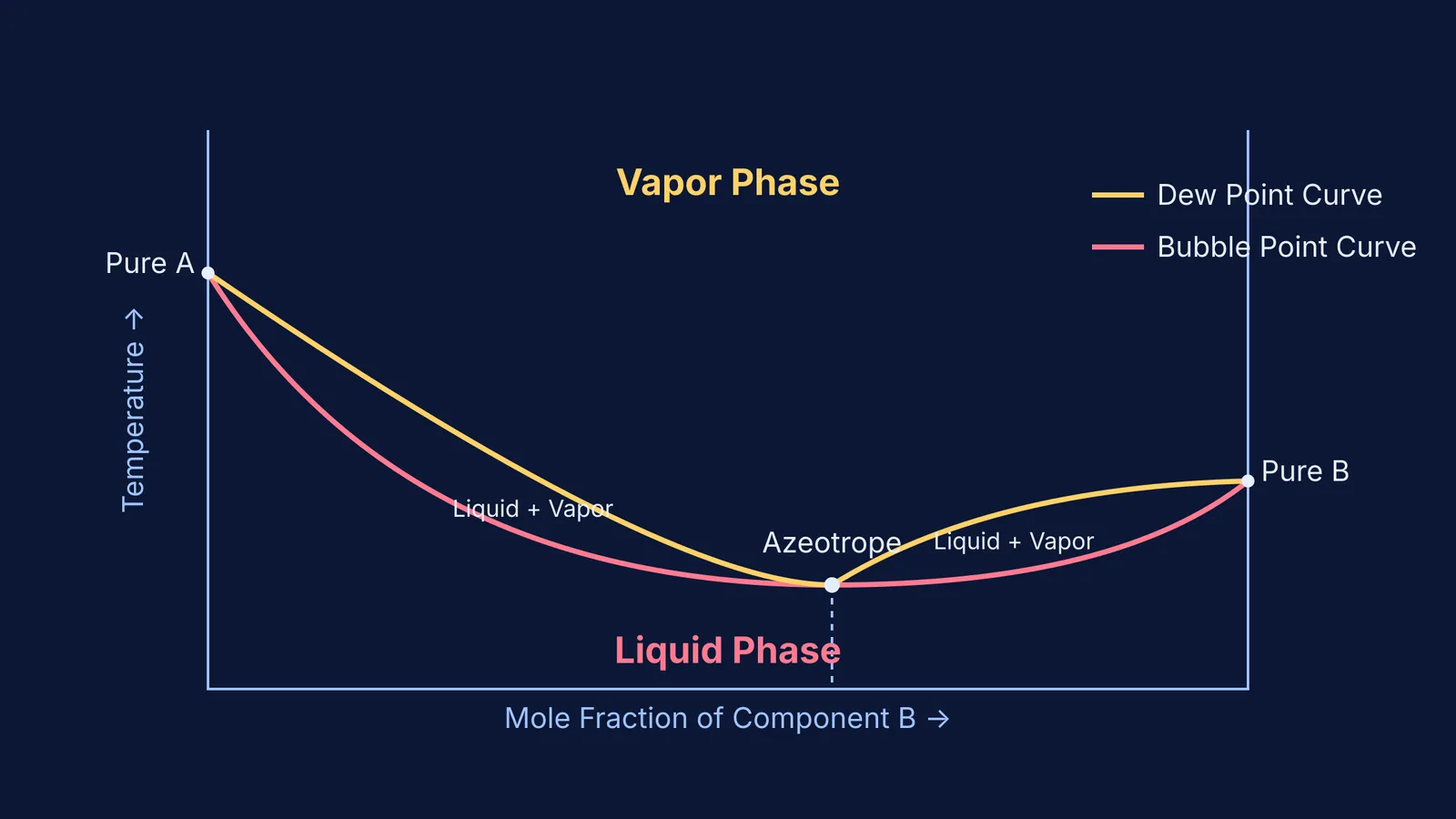
If you try to purify ethanol by fractional distillation, you will hit a wall at a concentration of 95.63%. At this exact composition, the liquid boils and turns into a vapour that has the exact same 95.63% ratio. Because the vapour is not enriched in ethanol, distillation can separate the mixture no further. This constant-boiling mixture is called an azeotrope.
Azeotropes happen when a mixture deviates so strongly from ideal behaviour that its boiling point drops below or rises above the boiling points of both pure components. Understanding how this works is a standard part of physical chemistry and a common topic in board exams and the JEE.
What are minimum boiling and maximum boiling azeotropes?
A liquid mixture behaves ideally when it follows Raoult's law across all concentrations. In an ideal mixture, the intermolecular forces between the different molecules (A–B) are roughly the same as those between similar molecules (A–A and B–B). Most real types of solutions are non-ideal and show either positive or negative deviations from Raoult's law.
When these deviations are large enough, the mixture forms an azeotrope at a specific composition.
Minimum boiling azeotrope: The mixture boils at a lower temperature than either of its pure components.
Maximum boiling azeotrope: The mixture boils at a higher temperature than either of its pure components.
Because the liquid and vapour phases share the exact same composition at this boiling point, the mixture boils at a constant temperature, mimicking a pure liquid.
Minimum boiling azeotropes examples: what causes them?
A minimum boiling azeotrope forms when a mixture shows a large positive deviation from Raoult's law. In these mixtures, the intermolecular forces between the different molecules (A–B) are weaker than the forces in the pure liquids (A–A or B–B). Because the molecules do not hold onto each other as tightly, they escape into the vapour phase more easily than expected. This higher vapour pressure means the mixture needs less heat to reach atmospheric pressure, resulting in a lower boiling point.
The most famous example is the ethanol-water mixture. Pure water boils at 100 °C and pure ethanol boils at 78.4 °C. However, a mixture of 95.63% ethanol and 4.37% water by mass forms a minimum boiling azeotrope that boils at 78.2 °C, which is lower than both pure components. When you mix them, the bulky ethyl groups of the ethanol disrupt the strong hydrogen bond network of the water, weakening the overall intermolecular forces.
Maximum boiling azeotropes examples: why does the boiling point rise?
A maximum boiling azeotrope forms when a mixture shows a large negative deviation from Raoult's law. Here, the A–B intermolecular forces are stronger than the A–A and B–B forces. The molecules attract each other so strongly that fewer of them escape into the vapour phase. This lowered vapour pressure means you must heat the mixture to a higher temperature to make it boil.
A classic example is the mixture of nitric acid and water. Pure nitric acid boils at 83 °C and pure water at 100 °C. When mixed to a concentration of roughly 68% nitric acid and 32% water by mass, they form a maximum boiling azeotrope that boils at 120.4 °C. The nitric acid and water molecules form very strong hydrogen bonds with each other, and the acid dissociates into ions that strongly attract the water dipoles, creating a tight, hard-to-boil mixture.
Why does simple distillation stop at the azeotrope?
In a fractionating column, you boil a liquid and the vapour rises. Because the vapour is usually richer in the more volatile (lower boiling point) component, condensing that vapour gives you a more concentrated liquid. You boil it again, and the new vapour is even more concentrated.
But when you boil an azeotrope, this enrichment stops. The vapour produced by boiling a 95.63% ethanol mixture is exactly 95.63% ethanol. No matter how many times you condense and re-boil it in a fractionating column, the concentration will never rise to 96%. To get absolute (100%) ethanol, chemists must use special techniques, such as azeotropic distillation (adding a third substance like benzene to break the azeotrope) or using molecular sieves to absorb the water.
If you are struggling to picture phase diagrams or how vapour pressure curves cross, the Fermi Concept Library breaks down these physical chemistry topics. You can explore the exact mechanics of Raoult's law deviations and see how they compare to saturated, unsaturated and supersaturated solutions.
How to solve physical chemistry problems on azeotropes?
When you face questions on colligative properties, Raoult's law or the steam distillation of non-ideal solutions, start by identifying the type of deviation.
Look at the intermolecular forces: Are there hydrogen bonds, dipole-dipole interactions, or London dispersion forces?
Compare the pure liquids to the mixture: Decide if mixing the two liquids strengthens or weakens those forces. For example, adding a non-polar liquid to a hydrogen-bonded liquid usually breaks the hydrogen bonds, causing a positive deviation.
Link the deviation to the azeotrope: Remember that weaker forces lead to positive deviations and minimum boiling azeotropes, while stronger forces lead to negative deviations and maximum boiling azeotropes.
If you are stuck on a specific textbook problem or a past paper question about mixtures, try pasting it into the Fermi Problem Library. It has a step-by-step solver that explains the reasoning rather than printing an answer.


