

On this page
Magnesium chloride is sold as colourless crystals of MgCl₂·6H₂O. If you heat them in an open crucible, expecting the water to boil off and leave MgCl₂, you get something else: a white powder of magnesium oxide, MgO, and choking fumes of HCl. Hydrated barium chloride, BaCl₂·2H₂O, does lose its water cleanly. The difference is the small, highly charged Mg²⁺ ion, which hydrolyses its own water of crystallisation. This matters in industry, because magnesium metal is made by electrolysing molten anhydrous MgCl₂, and the way round the problem is to heat the hydrate in a stream of dry HCl gas.
What happens when you heat MgCl₂·6H₂O in air?
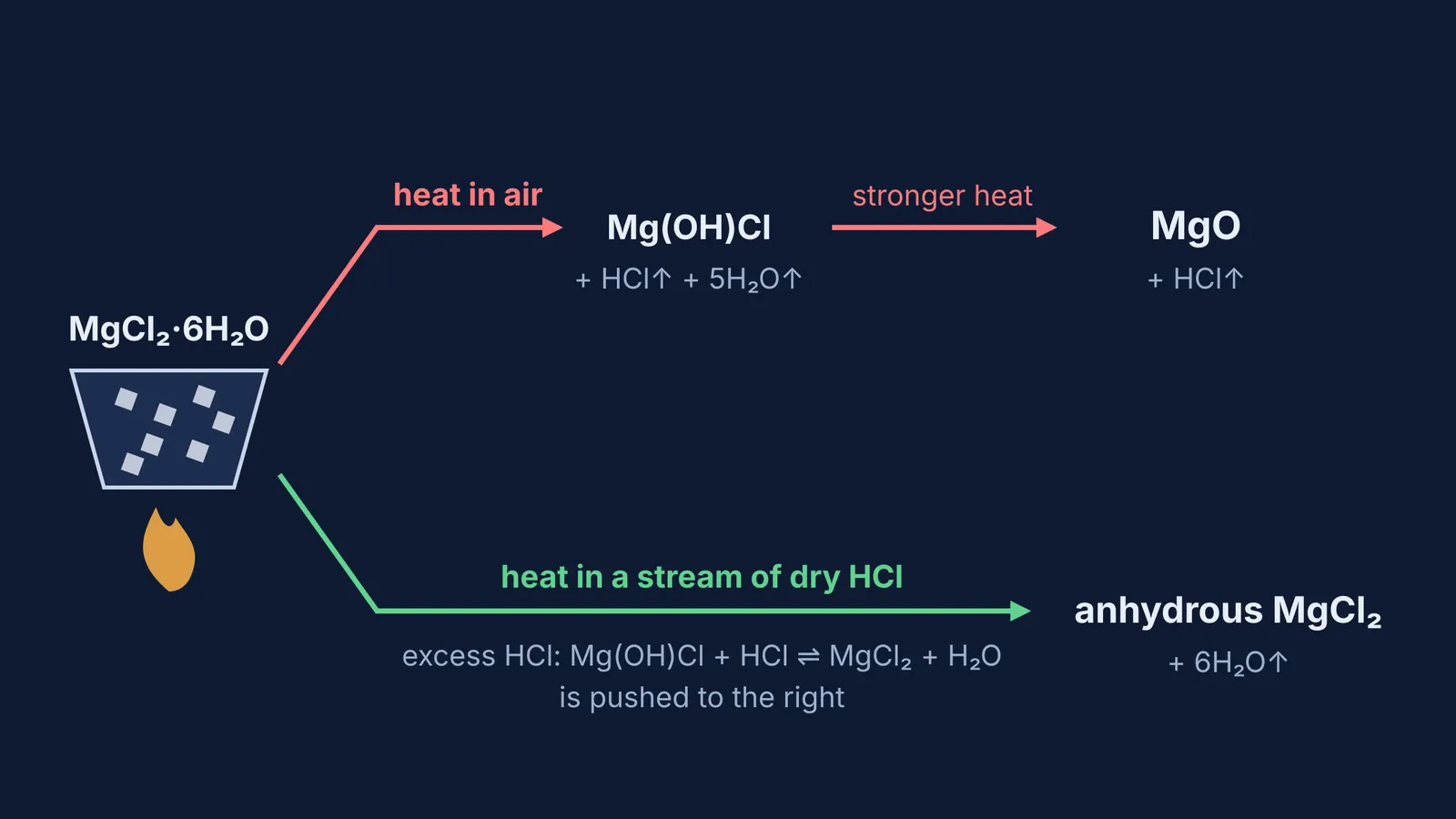
In the crystal, all six water molecules are bonded directly to magnesium, as the ion [Mg(H₂O)₆]²⁺, with the two Cl⁻ ions sitting outside. On gentle heating some water leaves as vapour. But the last water molecules are held tightly by Mg²⁺, and before they can leave as H₂O, the reaction changes course. A water molecule loses H⁺ instead, the H⁺ leaves with a Cl⁻ as HCl gas, and the OH⁻ stays on magnesium:
MgCl₂·6H₂O → Mg(OH)Cl + HCl + 5H₂O
On stronger heating the basic chloride loses its second HCl:
Mg(OH)Cl → MgO + HCl
Adding the two gives the overall change:
MgCl₂·6H₂O → MgO + 2HCl + 5H₂O
Check the balance: Mg 1 = 1, Cl 2 = 2, H 12 = 2 + 10, O 6 = 1 + 5. What you scrape out of the crucible is mostly MgO.
Why does Mg²⁺ hydrolyse its water of crystallisation?
Mg²⁺ is small (ionic radius about 72 pm) and carries a 2+ charge, so it has a high charge density. It pulls electron density from the oxygen of each bonded water molecule, which weakens the O–H bonds and makes the hydrogens slightly acidic:
[Mg(H₂O)₆]²⁺ ⇌ [Mg(H₂O)₅(OH)]⁺ + H⁺
In solution this equilibrium lies far to the left, so MgCl₂ solution is only very slightly acidic. The same effect is much stronger for Al³⁺ and Fe³⁺, as explained in why aluminium and ferric chloride solutions are acidic.
Heating changes the picture in two ways:
There is no bulk water left. In solution, the H⁺ is surrounded by water and the equilibrium can run back. In a hot, drying solid, the H⁺ meets a Cl⁻ and forms HCl.
HCl escapes. HCl is a gas at these temperatures and leaves the open crucible. A product that keeps leaving can never build up, so by Le Chatelier's principle the hydrolysis keeps going until the chloride is used up.
The end product also favours the oxide. The Mg–O bond is strong, and MgO, built from small 2+ and 2− ions, has a very large lattice energy.
Which other hydrated chlorides behave like this?
The rule follows the charge density of the cation.
AlCl₃·6H₂O gives alumina: 2AlCl₃·6H₂O → Al₂O₃ + 6HCl + 9H₂O. This is why the anhydrous AlCl₃ used in Friedel–Crafts reactions is made from aluminium and dry chlorine or HCl, not by drying the hydrate. Its uses are covered in the role of anhydrous AlCl₃ and why it must be dry.
FeCl₃·6H₂O gives iron(III) oxide in the same way: 2FeCl₃·6H₂O → Fe₂O₃ + 6HCl + 9H₂O.
BaCl₂·2H₂O simply loses water: BaCl₂·2H₂O → BaCl₂ + 2H₂O. Ba²⁺ is large, so its charge density is low and its bonded water is barely acidic.
NaCl crystallises without any water of crystallisation, and Na⁺ (large, only 1+) does not hydrolyse water anyway.
So: small, highly charged cations (Mg²⁺, Al³⁺, Fe³⁺) cannot be dried to the anhydrous chloride by heating in air. Large, low-charge cations (Na⁺, K⁺, Ba²⁺) can.
How do you make anhydrous MgCl₂ from the hydrate?
Heat the hydrate in a stream of dry HCl gas. The hydrolysis steps are reversible:
Mg(OH)Cl + HCl ⇌ MgCl₂ + H₂O
MgO + 2HCl ⇌ MgCl₂ + H₂O
In air, HCl leaves and each equilibrium is pulled towards the oxide. In a stream of HCl, the gas is always in large excess, so the equilibria are pushed back towards MgCl₂, and the flowing gas sweeps the water vapour away, which pushes the same way. The net change becomes a simple dehydration:
MgCl₂·6H₂O → MgCl₂ + 6H₂O (heated in dry HCl)
This is not just a lab trick. Magnesium is extracted by electrolysis of fused anhydrous MgCl₂: Mg²⁺ + 2e⁻ → Mg at the cathode and 2Cl⁻ → Cl₂ + 2e⁻ at the anode. The cell needs chloride, not oxide, so any MgO formed during drying is wasted feed. The other main route, described in Lloyd Pidgeon and the Pidgeon process, avoids the chloride altogether by reducing MgO with silicon.
Worked example: how much residue is left?
A student heats 2.03 g of MgCl₂·6H₂O to constant mass, once in air and once in a stream of dry HCl. What mass remains each time? Use Mg = 24.305, Cl = 35.453, H = 1.008, O = 15.999.
Molar mass of the hydrate. 24.305 + 2(35.453) + 6(18.015) = 203.30 g/mol.
Moles taken. 2.03 ÷ 203.30 = 0.00999 mol, almost exactly 0.0100 mol.
In air the residue is MgO. One MgCl₂·6H₂O gives one MgO, so 0.00999 mol of MgO forms. M(MgO) = 40.30 g/mol, so the mass is 0.00999 × 40.30 = 0.402 g.
In dry HCl the residue is MgCl₂. Again 1 : 1, and M(MgCl₂) = 95.21 g/mol, so the mass is 0.00999 × 95.21 = 0.951 g.
Compare. The air-heated residue is about 19.8% of the starting mass; the HCl-heated residue is about 46.8%. In air the sample loses 1.628 g: about 0.728 g as HCl and 0.899 g as water.
A residue mass is a quick test of which reaction happened. If a question gives you 0.40 g left from 2.03 g, the answer is MgO, not MgCl₂. For more mole problems like this, the Fermi Problem Library has a step-by-step solver that explains the reasoning, not just the final number.
Quick checklist
MgCl₂·6H₂O heated in air gives MgO, HCl and H₂O, through Mg(OH)Cl.
Cause: the high charge density of Mg²⁺ makes its bonded water acidic, and HCl escapes.
AlCl₃·6H₂O and FeCl₃·6H₂O behave the same way; BaCl₂·2H₂O just loses water.
Heating in dry HCl reverses the hydrolysis and gives anhydrous MgCl₂.
Anhydrous MgCl₂ is needed for electrolytic extraction of magnesium.
From 2.03 g of hydrate: about 0.402 g of MgO in air, about 0.951 g of MgCl₂ in HCl.


