On this page
The reaction that still supplies most of the world's magnesium works because someone thought to take the air away. That someone was Lloyd Pidgeon, a Canadian chemist whose idea fits in one equation.
Who was Lloyd Pidgeon?
Lloyd Montgomery Pidgeon was born on 3 December 1903 in Markham, Ontario, and died on 9 December 1999 in Kingston, Ontario, according to his Wikipedia biography. The Canadian Mining Hall of Fame records that he graduated in 1925 as gold medallist in chemistry from the University of Manitoba, took an M.Sc. (1927) and a Ph.D. (1929) at McGill University, and worked at Oxford before joining the National Research Council of Canada.
At the NRC he developed a way to make magnesium by reducing calcined dolomite with ferrosilicon. He joined Dominion Magnesium in 1941 as director of research, and six magnesium plants were built across North America during the war, when aircraft needed metal with strength and lightness (Canadian Mining Hall of Fame). From 1943 to 1969 he was professor and head of metallurgical engineering at the University of Toronto. He was made an Officer of the Order of Canada in 1996.
How does the Pidgeon process work?
The raw material is dolomite, a common rock of calcium magnesium carbonate. Heating it first (calcining) drives off carbon dioxide and leaves "dolime", a mix of calcium oxide and magnesium oxide.
A pilot study of the method by Wu and colleagues describes the modern version step by step:
Grind dolime, ferrosilicon (75% silicon) and a little fluorite together, and press them into briquettes.
Load the briquettes into steel retorts inside a furnace.
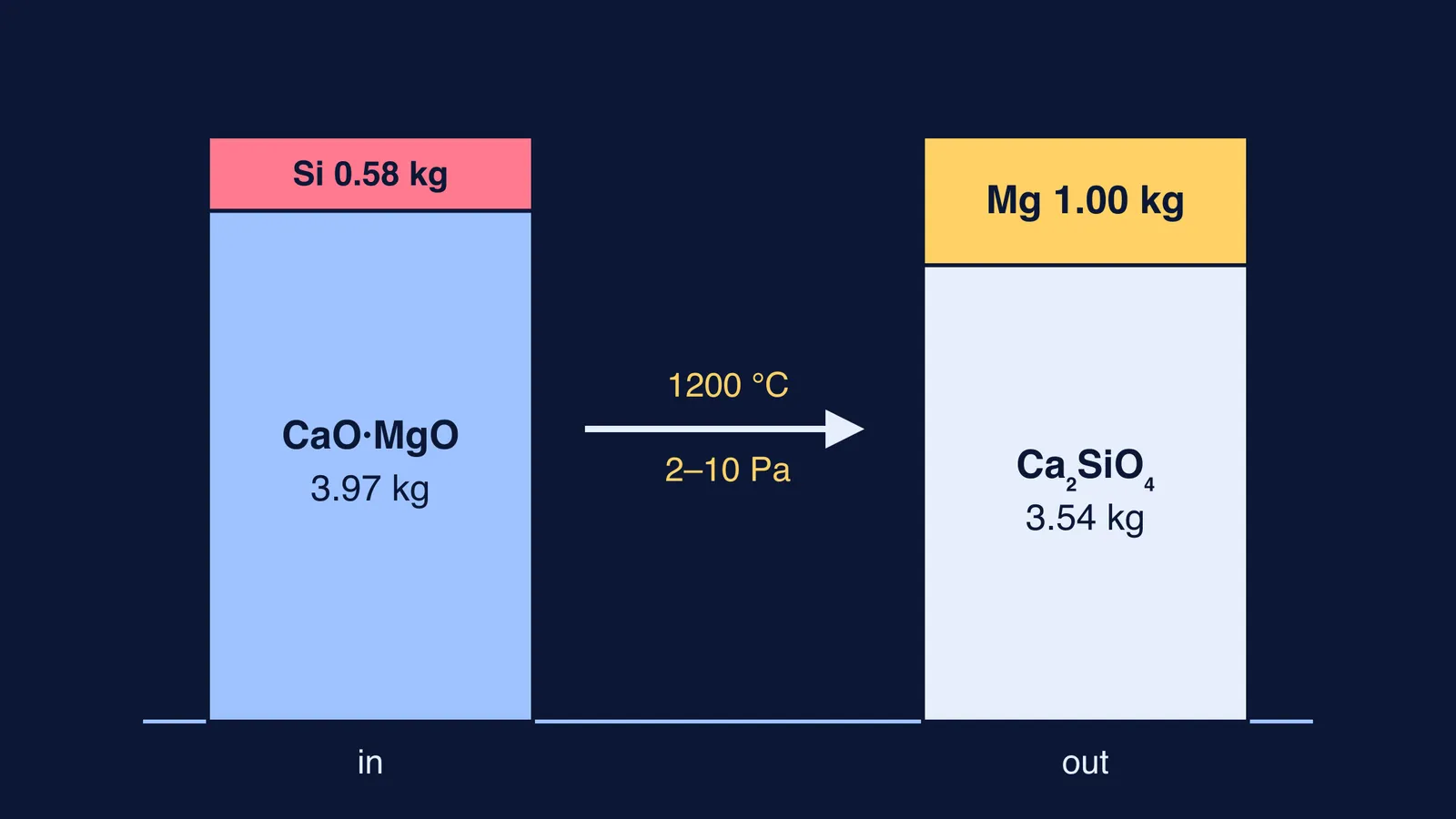
Heat to near 1200 °C while pumps hold the pressure at 2-10 Pa.
Silicon takes oxygen from magnesium oxide, and magnesium leaves as vapour.
At the water-cooled end of the retort the vapour condenses into a crystalline "magnesium crown".
In that study the reduction itself ran for close to 8 hours, similar to industrial retorts. The overall reaction is 2 MgO·CaO + Si → 2 Mg + Ca2SiO4, as given in the Pidgeon process article. The calcium oxide earns its place: it locks the silicon dioxide into a solid calcium silicate slag.
Why does the Pidgeon process need a vacuum?
This is the clever part, and it is Class 11 equilibrium. Look at the states in the equation: every reactant and the slag are solids, and the only gas is magnesium vapour. By Le Chatelier's principle, if you keep removing a gaseous product, the equilibrium keeps shifting towards products.
A vacuum pump does exactly that: magnesium boils off the hot zone, the cold end traps it as metal, and the reaction keeps running. Pidgeon did not need a stronger reducing agent; he changed the conditions so a cheap one would do.
Worked example: how much rock for 1 kg of magnesium?
Use the balanced equation and standard atomic weights from CIAAW (Mg 24.305, Si 28.085, Ca 40.078, O 15.999).
One formula unit of MgO·CaO has a mass of 96.381 and gives one Mg atom, so 1 kg of magnesium needs 96.381 ÷ 24.305 = 3.97 kg of dolime.
One Si atom frees two Mg atoms, so you need 28.085 ÷ 48.61 = 0.58 kg of silicon.
At 75% silicon, the ferrosilicon grade in the Wu pilot study, that is 0.58 ÷ 0.75 = 0.77 kg of ferrosilicon.
The slag, Ca2SiO4 (mass 172.237 per two Mg), comes to 172.237 ÷ 48.61 = 3.54 kg.
Check: 3.97 + 0.58 = 4.54 kg in, and 1.00 + 3.54 = 4.54 kg out. These are theoretical minimums; real plants never reach perfect yield. Even so, the slag outweighs the metal three and a half times.
If a step like the 2:1 mole ratio tripped you up, the Fermi Problem Library has worked problems with a step-by-step solver that explains the reasoning rather than printing an answer.
Why is the Pidgeon process still used today?
The US Geological Survey's Mineral Commodity Summaries 2026 estimates world primary magnesium production at 1,100 thousand tonnes in 2025, of which China produced 950 thousand tonnes, about 86%. Wu and colleagues note that most Chinese plants use the Pidgeon process, which needs fewer steps and less investment in equipment than its rivals and gives a high-quality product.
The same paper is frank about the cost: the process is energy and resource intensive, and fluorite in the briquettes can release fluorides that pollute air and water. Cleaning up a wartime method is exactly the kind of problem today's metallurgists work on.
What can students learn from Lloyd Pidgeon?
Use Pidgeon's method as a checklist the next time you meet an industrial process in your chemistry course, such as the Haber process or the blast furnace:
Write the balanced equation with state symbols.
Find the gases. Which side are they on?
Ask what changing pressure, temperature or removing a product would do.
Do the mass balance for 1 kg of product.
Ask where the waste goes.
If Le Chatelier's principle or reduction still feels shaky, the Fermi Concept Library gives every chemistry concept its own lesson and shows where it sits on the map.