On this page
Every dissolved oxygen (DO) number you meet in water pollution chapters, such as "9.1 mg/L at 20 °C" or "fish suffer below 5 mg/L", has to be measured somehow. The classic way is the Winkler titration, worked out by the Hungarian chemist Lajos Winkler in 1888. Oxygen gas cannot go into a burette, so the method first locks it into a brown manganese solid, then turns that solid into iodine, and finally titrates the iodine. For you it is a compact revision of iodometry, n-factors and the oxidation states of manganese, and it ends in one neat number: the n-factor of O₂ is 4.
Why can't you titrate dissolved oxygen directly?
Oxygen in water is a gas at low concentration, roughly 8 to 9 mg per litre at room temperature. An open sample swaps oxygen with the air, so any reading drifts. You must first convert the oxygen into something that stays put.
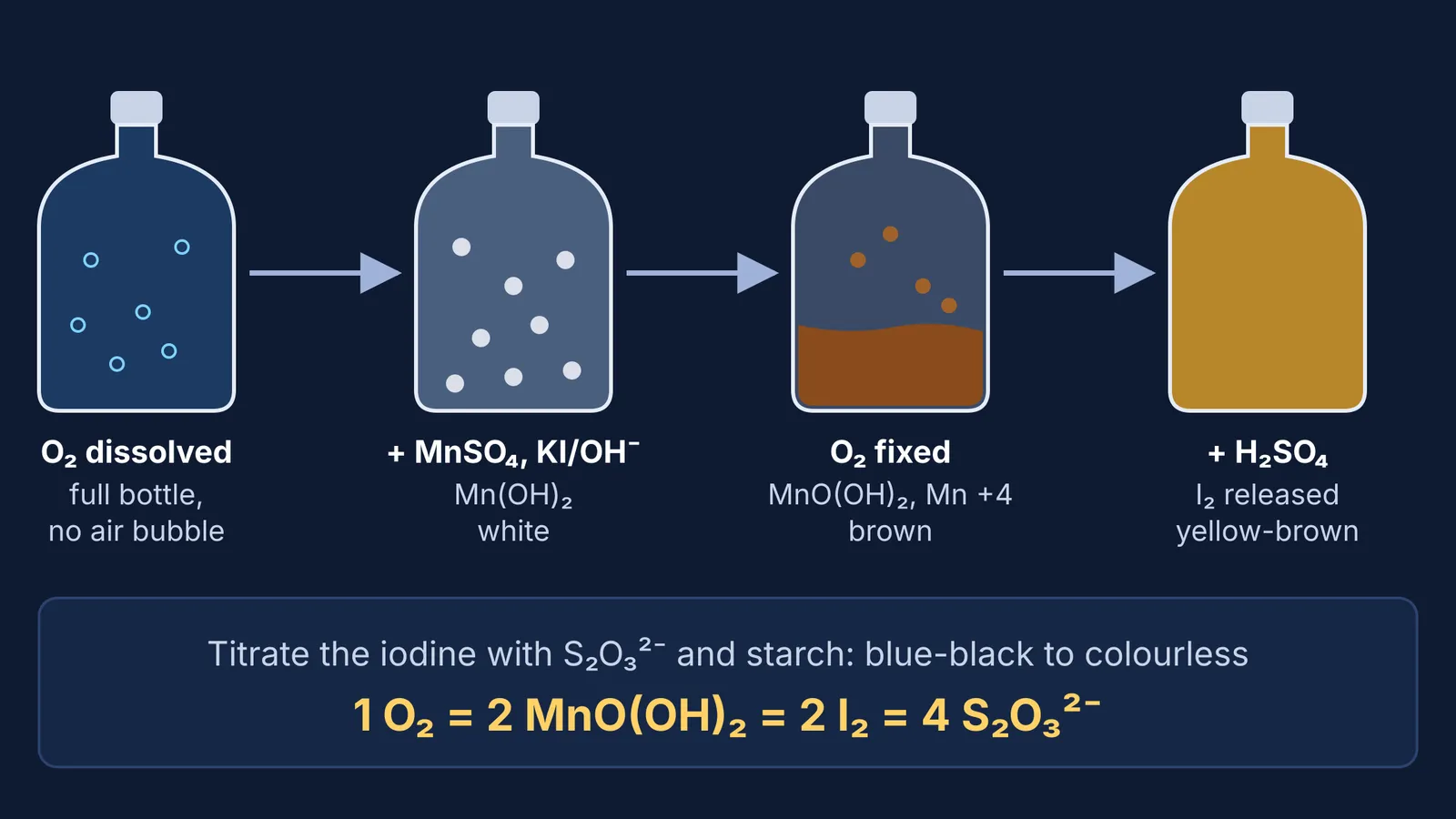
That is why the test starts in a special glass-stoppered BOD bottle, filled to the brim. Henry's law says the amount of gas that dissolves depends on its partial pressure above the liquid. A trapped air bubble is a small reservoir of oxygen at 0.21 atm, so it would add oxygen to the sample and push the result up. Fill the bottle completely, push the stopper in so that no bubble remains, and add the reagents straight away.
What happens when manganese sulphate and alkaline iodide are added?
Two reagents go in below the surface: manganese(II) sulphate, then an alkaline iodide solution (KI with NaOH or KOH). The steps are:
Mn²⁺ meets hydroxide and gives a white precipitate: Mn²⁺ + 2OH⁻ → Mn(OH)₂.
In alkali, Mn(OH)₂ is easily oxidised, so it grabs the dissolved oxygen: 2Mn(OH)₂ + O₂ → 2MnO(OH)₂. The floc turns brown, and manganese goes from +2 to +4.
Nothing happens to the iodide yet. In alkaline solution Mn(IV) does not oxidise I⁻ to any useful extent.
The oxygen is now "fixed" in a solid. That is why field teams fix samples on the riverbank and titrate later in the lab.
Textbooks do not agree on how to write the brown solid. Some write MnO(OH)₂ (Mn +4), others MnO(OH) or Mn(OH)₃ (Mn +3), with 4Mn(OH)₂ + O₂ + 2H₂O → 4Mn(OH)₃. The bookkeeping comes out the same either way: each O₂ still takes 4 electrons, so the final ratio does not change.
How does the acid release iodine?
Next, concentrated sulphuric acid is added and the bottle is mixed again. The precipitate dissolves, and in acid Mn(IV) is a strong oxidant, so it now oxidises the iodide:
MnO(OH)₂ + 4H⁺ + 2I⁻ → Mn²⁺ + I₂ + 3H₂O
Manganese drops from +4 back to +2 and hands its 2 electrons to two iodide ions. The solution turns clear yellow-brown, and manganese ends where it started, as Mn²⁺: it only carried the oxidising power of O₂ to iodide.
How is the iodine titrated, and why is the n-factor of O₂ equal to 4?
The iodine is titrated with standard sodium thiosulphate, the standard step in every iodometric titration: I₂ + 2S₂O₃²⁻ → 2I⁻ + S₄O₆²⁻. Starch goes in near the end, when the colour has faded to pale yellow, and the end point is the loss of the blue-black colour.
Now chain the ratios:
1 O₂ → 2 MnO(OH)₂ (equation 2)
2 MnO(OH)₂ → 2 I₂ (one I₂ per Mn)
2 I₂ → 4 S₂O₃²⁻ (two thiosulphate per I₂)
So 1 mol O₂ ≡ 4 mol S₂O₃²⁻. In equivalent language, O₂ (oxidation state 0) is reduced to oxide (−2) in the end, so it gains 4 electrons per molecule. Its n-factor is 4 and its equivalent mass is 32/4 = 8 g. If you want to revise how n-factors work in general, see the n-factor and equivalent concept.
That gives the working formula:
DO (mg/L) = V(thiosulphate, mL) × M(thiosulphate) × 8000 ÷ V(sample titrated, mL)
The 8000 is 8 g of O₂ per equivalent, written in mg. Thiosulphate's n-factor is 1 here, so its molarity equals its normality.
Worked example: how much oxygen is in the sample?
A 200 mL portion of a fixed and acidified sample needs 7.2 mL of 0.025 M sodium thiosulphate. Find the DO.
Moles of thiosulphate = 0.025 × 7.2 × 10⁻³ = 1.80 × 10⁻⁴ mol.
Moles of O₂ = 1.80 × 10⁻⁴ ÷ 4 = 4.50 × 10⁻⁵ mol.
Mass of O₂ = 4.50 × 10⁻⁵ × 32 g = 1.44 × 10⁻³ g = 1.44 mg.
This is in 200 mL, so DO = 1.44 × 1000 ÷ 200 = 7.2 mg/L.
The formula gives the same thing in one line: 7.2 × 0.025 × 8000 ÷ 200 = 7.2 mg/L.
Notice that the titre in mL equals the DO in mg/L. That is not luck. The Indian standard method, IS 3025 (Part 38), titrates 200 mL with 0.025 N thiosulphate and states that the DO in mg/L equals the volume of titrant in mL. Other volumes and strengths work too; this pair is just convenient.
How healthy is that water? The EPA volunteer monitoring guide gives about 9.07 mg/L as the saturation value at 20 °C and about 7.54 mg/L at 30 °C. At 20 °C the sample is 7.2 ÷ 9.07 × 100 ≈ 79% saturated. If the water was at 30 °C, the same 7.2 mg/L would be about 95% saturated. Same number, different story, which is the idea behind why warm water holds less oxygen.
Extension to BOD. A BOD test is just two Winkler titrations five days apart. Suppose a sample diluted 10 times gives titres of 8.4 mL on day 0 and 5.1 mL on day 5 (same 200 mL portions, same 0.025 M thiosulphate). Then D₁ = 8.4 mg/L, D₂ = 5.1 mg/L, and BOD = (8.4 − 5.1) × 10 = 33 mg/L. The BOD values post shows what such numbers mean for a river.
What can go wrong in a real Winkler test?
Nitrite. Polluted water often contains nitrite, which also oxidises iodide in acid and adds false "oxygen". The standard version is the azide modification: the alkaline iodide reagent also contains sodium azide, which destroys nitrite before it can interfere (IS 3025 Part 38 describes it). Sodium azide is highly toxic, so this is a lab reagent only.
Air bubbles. A bubble trapped when stoppering adds oxygen, as explained above.
Lost iodine. Iodine is volatile, so titrate soon after acidifying and do not leave the flask open.
Old thiosulphate. It slowly decomposes, so it is standardised against a known iodine source before use.
If you lose track of a chain like this, the Fermi Problem Library is a step-by-step solver that explains the reasoning, so you can see where each ratio comes from.
Quick checklist
The bottle is filled to the brim and stoppered with no air bubble.
Mn²⁺ + alkali → white Mn(OH)₂; O₂ turns it into brown MnO(OH)₂ (Mn +2 → +4).
Acid lets Mn(IV) oxidise iodide: MnO(OH)₂ + 4H⁺ + 2I⁻ → Mn²⁺ + I₂ + 3H₂O.
1 O₂ ≡ 2 I₂ ≡ 4 S₂O₃²⁻; the n-factor of O₂ is 4, equivalent mass 8.
DO (mg/L) = V × M × 8000 ÷ V(sample).
200 mL titrated with 0.025 M thiosulphate: mL of titrant = mg/L of O₂.
Compare with saturation (about 9.07 mg/L at 20 °C) to judge water quality.