On this page
A treatment plant cannot wait five days to find out how dirty its incoming water is. The BOD test does take five days, and it only counts what microbes manage to eat in that time. So plants and pollution boards also measure chemical oxygen demand (COD): boil the sample with a known excess of acidified potassium dichromate, then find how much dichromate was used up. The answer is reported as milligrams of oxygen per litre, even though no oxygen gas was used. Converting dichromate into "oxygen" is pure equivalent-concept bookkeeping, and it is exactly the kind of step JEE likes to test.
What is chemical oxygen demand?
COD is the mass of oxygen that would be needed to oxidise the oxidisable matter in one litre of water, measured using a strong chemical oxidant instead of bacteria. The Indian standard method, IS 3025 (Part 58), states the principle simply: most organic matter is destroyed when boiled with dichromate and sulphuric acid, giving CO₂ and water, and the dichromate consumed is proportional to the oxygen needed.
BOD asks how much oxygen microbes use in five days, which is what a river will feel. COD asks how much a hot, strong oxidant can burn, closer to the total load. COD is usually the larger number, and it arrives in hours. The biological side is covered in BOD values for clean and polluted water.
How is the COD test done?
The IS 3025 (Part 58) procedure for high-COD samples runs like this:
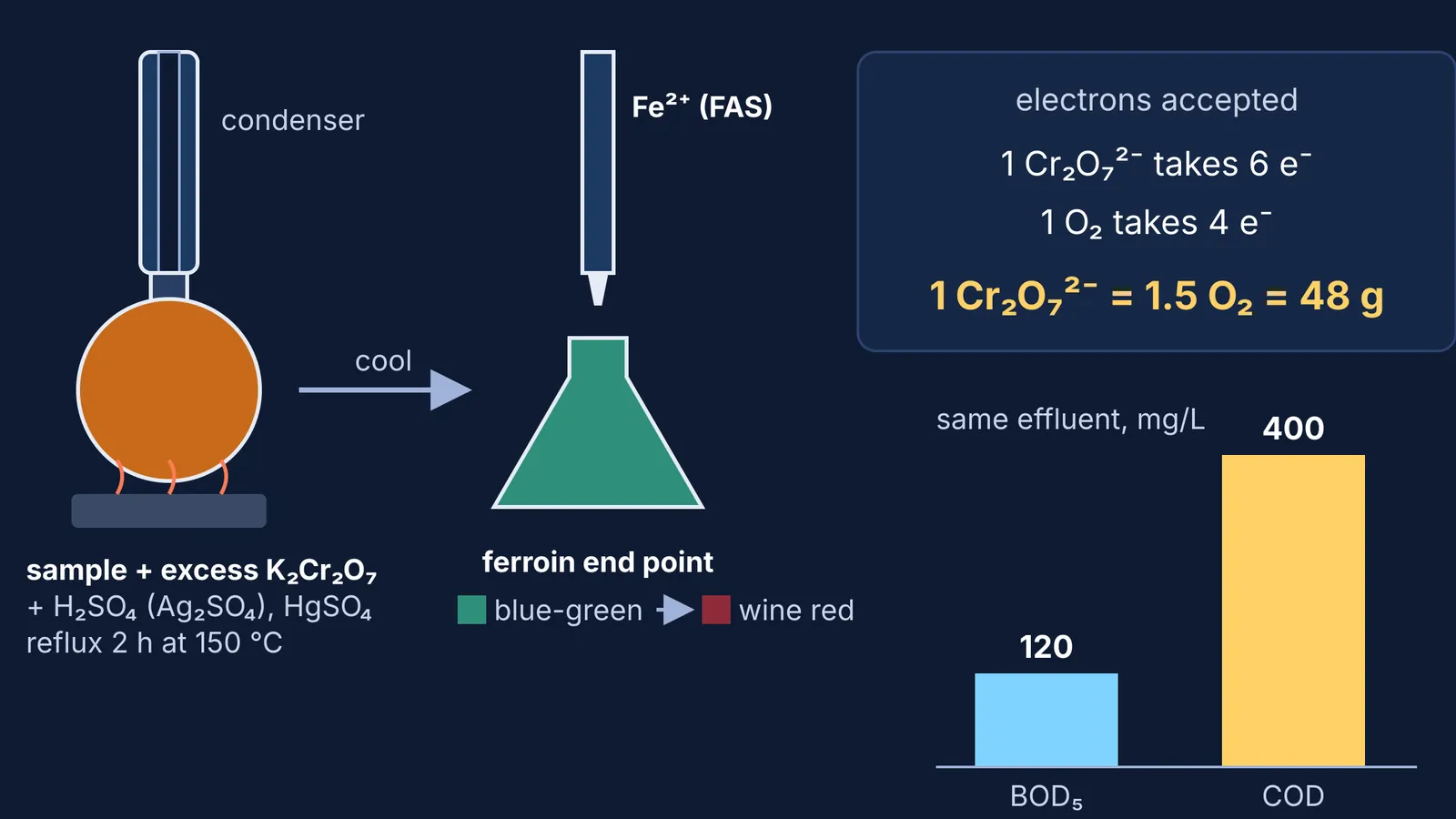
Put about 0.4 g of HgSO₄ in a reflux tube and add 20 mL of sample.
Add 10 mL of 0.25 N K₂Cr₂O₇ (that is 0.0417 M, since dichromate's n-factor is 6).
Slowly add 30 mL of concentrated H₂SO₄ that already contains silver sulphate.
Reflux for 2 hours at 150 °C, cool, and dilute.
Titrate the leftover dichromate with standard ferrous ammonium sulphate (FAS, Mohr's salt) using ferroin. The colour changes sharply from blue-green to wine red.
Run a blank (distilled water instead of sample) through the same steps.
This is a back titration: you measure how much dichromate was left, and the blank tells you how much you started with. The titration reaction is the familiar one from Fe²⁺ and Fe³⁺ mixture analysis:
Cr₂O₇²⁻ + 6Fe²⁺ + 14H⁺ → 2Cr³⁺ + 6Fe³⁺ + 7H₂O
Why does one Cr₂O₇²⁻ count as 1.5 O₂?
Compare the two half-reactions:
Cr₂O₇²⁻ + 14H⁺ + 6e⁻ → 2Cr³⁺ + 7H₂O (each Cr goes from +6 to +3)
O₂ + 4H⁺ + 4e⁻ → 2H₂O (each O goes from 0 to −2)
The organic matter does not care which oxidant takes its electrons. One dichromate ion takes 6 electrons, and one O₂ would take 4. So 1 mol Cr₂O₇²⁻ does the work of 6/4 = 1.5 mol O₂, which is 48 g of oxygen.
In equivalents, oxygen has an equivalent mass of 32/4 = 8 g, and each Fe²⁺ used in the titration is one equivalent. That leads to the formula in the standard:
COD (mg/L) = (V₁ − V₂) × N × 8000 ÷ V₀
Here V₁ is the FAS volume for the blank, V₂ the FAS volume for the sample, N the normality of FAS (equal to its molarity, since Fe²⁺ → Fe³⁺ is one electron), and V₀ the sample volume in mL. The 8000 is 8 g of O₂ per equivalent, written in mg. If you need a refresher, see the n-factor and equivalent concept.
Worked example: COD of an effluent, step by step
(a) Checking the method with KHP. Labs check COD reagents with potassium hydrogen phthalate (KHP, KC₈H₅O₄, molar mass 204.2 g/mol). Its anion burns completely:
C₈H₅O₄⁻ + H⁺ + 7.5O₂ → 8CO₂ + 3H₂O
Check: 8 C; 6 H; 4 + 15 = 19 O on the left and 16 + 3 = 19 on the right; net charge 0 on both sides. So 1 mol KHP needs 7.5 × 32 = 240 g O₂, and 1 g needs 240 ÷ 204.2 = 1.175 g O₂. A solution of 425 mg/L KHP should therefore read 425 × 1.175 ≈ 500 mg/L COD. If your reagents give much less, something is wrong.
(b) The effluent. A 20.0 mL effluent sample is refluxed as above. The blank needs 24.8 mL of 0.100 M FAS and the sample needs 14.8 mL.
FAS equivalent to the dichromate used = 24.8 − 14.8 = 10.0 mL.
Moles of Fe²⁺ (= moles of electrons) = 10.0 × 10⁻³ × 0.100 = 1.00 × 10⁻³ mol.
Moles of O₂ that would take the same electrons = 1.00 × 10⁻³ ÷ 4 = 2.50 × 10⁻⁴ mol.
Mass of O₂ = 2.50 × 10⁻⁴ × 32 = 8.00 × 10⁻³ g = 8.00 mg in 20.0 mL.
COD = 8.00 × 1000 ÷ 20.0 = 400 mg/L.
The formula agrees: 10.0 × 0.100 × 8000 ÷ 20.0 = 400 mg/L. A sanity check: the blank of 24.8 mL means the sample used 10.0 ÷ 24.8, about 40%, of the dichromate, so plenty was left in excess. The standard says that if the mixture turns green (all Cr(VI) used up), you repeat with a smaller portion of sample.
(c) Comparing with BOD. Suppose the same effluent has BOD₅ = 120 mg/L. Then BOD/COD = 120 ÷ 400 = 0.30. Less than a third of the chemically oxidisable load was used by microbes in five days. That points to a lot of organic matter that is slow to biodegrade or not biodegradable at all, and it is the main reason plants measure both numbers.
What does COD miss, and what interferes?
COD is an operational measure, defined by the method. It is not "all the organic matter" in the water.
Chloride is also oxidised by hot dichromate (6Cl⁻ + Cr₂O₇²⁻ + 14H⁺ → 3Cl₂ + 2Cr³⁺ + 7H₂O) and would raise the result. HgSO₄ ties it up as poorly ionised HgCl₂; IS 3025 says 0.4 g handles about 40 mg of chloride.
Slow compounds. Straight-chain aliphatic compounds and some aromatics oxidise poorly; Ag₂SO₄ is added as a catalyst to help. Some compounds, such as pyridine, still escape oxidation.
Nitrite and iron(II) consume dichromate too. The standard adds sulphamic acid to the dichromate to remove nitrite.
Ammonia is not oxidised in this method, so nitrogen-rich waste can read lower than you might expect.
FAS drifts. Air slowly oxidises Fe²⁺ to Fe³⁺, so the standard asks for FAS to be standardised against dichromate every day. Dichromate itself is stable, which is why it is the reference; see why dichromate is a primary standard.
The same oxygen-equivalent idea, with an n-factor of 4 for O₂, appears in the Winkler titration for dissolved oxygen, where O₂ ends up as 4 S₂O₃²⁻. If back titrations and n-factors still feel slippery, the Fermi Problem Library is a step-by-step solver that explains the reasoning behind each conversion.
Quick checklist
COD: reflux sample with excess acidified K₂Cr₂O₇, back-titrate leftover with FAS and ferroin.
1 Cr₂O₇²⁻ (6 e⁻) ≡ 1.5 O₂ (4 e⁻ each) ≡ 48 g O₂.
COD (mg/L) = (blank − sample titre) × N(FAS) × 8000 ÷ sample volume.
HgSO₄ removes chloride interference; Ag₂SO₄ is the catalyst.
KHP: 1.175 g O₂ per g, so 425 mg/L reads about 500 mg/L.
COD is usually higher than BOD₅; a low BOD/COD ratio means much of the load is slow to biodegrade.