

On this page
A solution holds both ferrous (Fe2+) and ferric (Fe3+) iron, and you need how much of each. It turns up in JEE redox numericals, practical vivas and real ore analysis. The trick: potassium dichromate reacts with only one of the two ions, so you run two titrations and subtract.
Why does dichromate see only Fe2+?
In acid, dichromate oxidises ferrous iron: Cr2O7 2- + 6Fe2+ + 14H+ → 2Cr3+ + 6Fe3+ + 7H2O, as written in this LibreTexts experiment on determining iron with potassium dichromate.
Each mole of K2Cr2O7 reacts with six moles of Fe2+, because each iron gives up one electron and each dichromate ion takes six, as Harvey's Analytical Chemistry 2.1 explains in its redox titrations chapter/09%3A_Titrimetric_Methods/9.04%3A_Redox_Titrations).
Fe3+ is already in its oxidised state, so it does not react. The IISER Mohali CHM112 lab protocol notes that the oxidised form of iron does not react with K2Cr2O7.
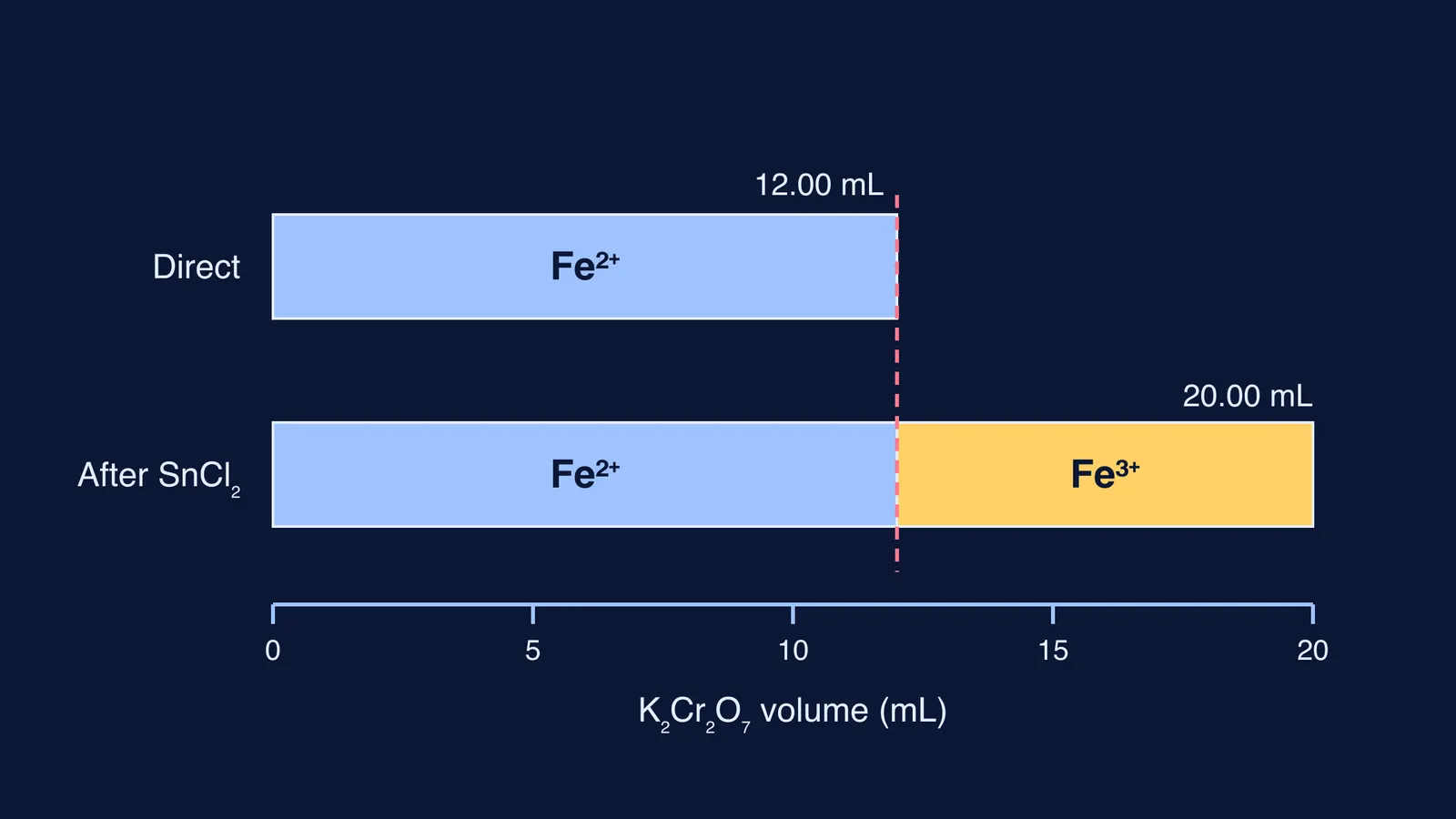
Titration A (untreated mixture): measures Fe2+ only.
Titration B (after reducing all iron to Fe2+): measures total iron.
Fe3+ = total iron − Fe2+.
If oxidation states still feel shaky, our guide on tracking oxidation states to tell if a reaction is redox goes through them element by element.
How do you reduce all the iron to Fe2+?
The classical lab route uses tin(II) chloride, following the IISER Mohali protocol:
Heat the iron solution almost to boiling.
Add SnCl2 drop by drop until the yellow Fe(III) colour just disappears, then 2 more drops to make sure the reduction is complete (Sn2+ + 2Fe3+ → Sn4+ + 2Fe2+).
Cool the flask, then add HgCl2 quickly to destroy the leftover Sn2+, which would otherwise use up dichromate (Sn2+ + 2HgCl2 → Sn4+ + Hg2Cl2 + 2Cl-).
Look at the flask. A small white precipitate means all is well. No precipitate means too little SnCl2; a grey or black one means mercury metal from too much SnCl2. Either way, discard that trial.
Titrate straight away, because Fe2+ is readily oxidised by air.
The same protocol adds sulphuric and phosphoric acids and titrates with K2Cr2O7 using barium diphenylamine sulphonate indicator, from blue-green through grey to the first permanent violet.
Some textbook problems say the iron was "reduced with zinc" instead. One lab version of that is the Jones reductor, a column of amalgamated zinc whose oxidation reduces the analyte, described in Harvey's redox titrations chapter/09%3A_Titrimetric_Methods/9.04%3A_Redox_Titrations). The arithmetic does not change.
Worked example: how much Fe2+ and Fe3+ is in the solution?
Two 25.00 mL portions of an iron solution are titrated with 0.0200 M K2Cr2O7.
Portion A, titrated directly, needs 12.00 mL.
Portion B, reduced with SnCl2 and treated with HgCl2, needs 20.00 mL.
Step 1: Fe2+ from titration A. Moles of dichromate = 0.0200 × 0.01200 = 2.40 × 10^-4 mol. Moles of Fe2+ = 6 × 2.40 × 10^-4 = 1.44 × 10^-3 mol.
Step 2: total iron from titration B. Moles of dichromate = 0.0200 × 0.02000 = 4.00 × 10^-4 mol. Moles of Fe = 6 × 4.00 × 10^-4 = 2.40 × 10^-3 mol.
Step 3: subtract. Fe3+ = 2.40 × 10^-3 − 1.44 × 10^-3 = 0.96 × 10^-3 mol.
Step 4: convert to concentration. Divide by 0.02500 L: Fe2+ = 0.0576 M and Fe3+ = 0.0384 M. The CIAAW iron page gives the standard atomic weight of iron as 55.845, which rounds to 55.85. So Fe2+ is 0.0576 × 55.85 = 3.22 g/L and Fe3+ is 0.0384 × 55.85 = 2.14 g/L.
A quick check: the volumes alone tell you the split. Fe3+ is (20.00 − 12.00) / 20.00 = 40% of the iron, and 0.96 / 2.40 gives the same 40%.
What mistakes cost marks in this problem?
Using 1 : 1 instead of 1 : 6. Write the half-reactions before you multiply.
Giving total iron as the Fe3+ answer. Titration B is Fe2+ plus Fe3+, not Fe3+ alone.
Unequal portions. If the two aliquots differ, convert each to moles per litre before you subtract.
Switching oxidant. If the second titration uses KMnO4, use its own ratio (1 MnO4- to 5 Fe2+, from the equation in the IISER Mohali protocol). Our guide to KMnO4 titration with Mohr's salt covers that case.
In the viva, mixing up the ions. The spot tests that tell Fe2+ from Fe3+ are in distinguishing Fe2+ and Fe3+ in the salt analysis practical.
If your answer still comes out wrong, try the Fermi Problem Library: its step-by-step solver explains the reasoning rather than printing an answer, so you can see which step slipped. For gaps in redox stoichiometry itself, the Fermi Concept Library gives each chemistry concept its own lesson.
Next time you see a Fe2+/Fe3+ mixture, write "A = Fe2+, B = total" at the top of your page before you calculate anything.


