

On this page
When you reach Group III in your salt analysis practical, identifying iron is one of the more visually striking tests in the chemistry syllabus. The key to telling ferrous (Fe²⁺) and ferric (Fe³⁺) ions apart lies in choosing the right reagent to bring out a distinct colour.
Before testing for iron, standard procedures require boiling the original solution with concentrated nitric acid. This step oxidises any Fe²⁺ present in the salt to Fe³⁺, ensuring that all the iron precipitates out as reddish-brown iron(III) hydroxide when ammonium hydroxide is added, which you can read about in our guide to ICSE analytical chemistry hydroxides. Once you dissolve that precipitate in dilute hydrochloric acid, you can run the confirmatory tests.
What is the thiocyanate test for Fe³⁺?
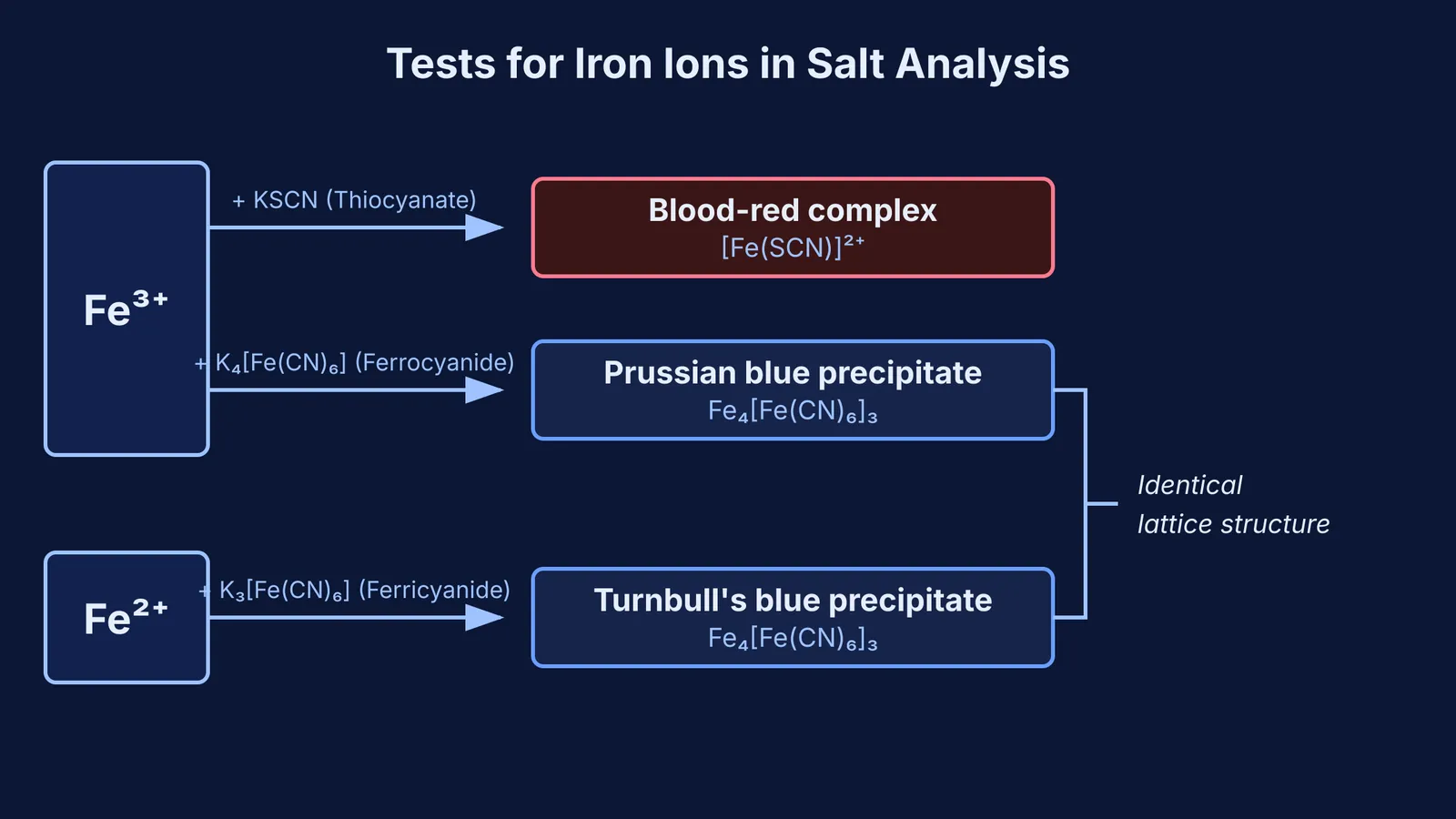
The most sensitive visual test for ferric ions is the addition of potassium thiocyanate (KSCN). When SCN⁻ ions meet Fe³⁺, they form the thiocyanatoiron(III) complex, [Fe(SCN)]²⁺.
This complex has an intense blood-red colour. The reaction is so sensitive that a spectrophotometer can detect iron down to 0.234 mg/L using a flow injection method. In a test tube, the red colour is unmistakable even for trace amounts of iron. Fe²⁺ ions do not react with thiocyanate, making this a definitive test for the +3 oxidation state.
How do you test for Fe³⁺ with potassium ferrocyanide?
If you add potassium ferrocyanide, K₄[Fe(CN)₆], to a solution containing Fe³⁺ ions, a deep blue precipitate forms immediately. This solid is iron(III) hexacyanidoferrate(II), commonly known as Prussian blue.
The reaction works because the ferrocyanide complex contains iron in the +2 state. When it combines with the free Fe³⁺ ions in your test tube, they form a highly insoluble lattice (Fe₄[Fe(CN)₆]₃). This is the same reaction used in the Lassaigne's test to confirm the presence of nitrogen in an organic compound.
How does the ferricyanide test for Fe²⁺ work?
To test specifically for ferrous ions (Fe²⁺), you use potassium ferricyanide, K₃[Fe(CN)₆]. Here, the reagent has iron in the +3 state. When added to an Fe²⁺ solution, it yields a dark blue precipitate historically called Turnbull's blue.
The traditional equation for this reaction writes the product as Fe₃[Fe(CN)₆]₂, suggesting it is a different compound from Prussian blue.
Are Prussian blue and Turnbull's blue the same?
For over a century, chemists debated whether Turnbull's blue and Prussian blue were distinct substances. It turns out that when Fe²⁺ and ferricyanide mix, an extremely fast electron transfer occurs, oxidising the Fe²⁺ to Fe³⁺ and reducing the ferricyanide to ferrocyanide before the solid forms.
A 1968 study using Mössbauer spectroscopy proved that soluble Prussian blue, insoluble Prussian blue and Turnbull's blue all share the identical electronic structure. Both precipitates consist of the same face-centred cubic lattice containing Fe³⁺ and [Fe(CN)₆]⁴⁻ ions. The slight difference in shade you might see in the lab is entirely down to the size of the particles and the impurities trapped inside them during rapid precipitation.
The intense blue colour of this lattice is not due to standard d-d electron transitions. Instead, it arises from intervalence charge transfer (IVCT). When light hits the compound, it gives an electron just enough energy to jump from the Fe²⁺ ion on the carbon atom across the cyanide bridge to the Fe³⁺ ion on the nitrogen atom. This jump absorbs red and orange light, leaving the transmitted and reflected light to appear deep blue.
A checklist for iron salt analysis
When you receive an unknown salt in the lab, follow this sequence to avoid false negatives:
Always boil the original solution with a few drops of concentrated nitric acid before adding ammonium chloride and ammonium hydroxide for Group III. If you skip this, any Fe²⁺ will fail to precipitate completely.
Filter the reddish-brown precipitate and dissolve it in dilute hydrochloric acid. Do not use sulphuric or nitric acid here, as they can interfere with the confirmation steps.
Split the dissolved solution into two separate test tubes.
To the first tube, add potassium thiocyanate. The blood-red colour is highly sensitive and will show up even if your precipitation was incomplete.
To the second tube, add potassium ferrocyanide. Ensure your solution is not too acidic, or the Prussian blue precipitate might decompose.
If you are confused by which reagent to use, the Fermi Concept Library contains every concept in physics, chemistry, biology, mathematics and computing, each with its own lesson and its place in the map. For step-by-step guidance, Fermi's AI tutor teaches rather than answers: it holds a line of reasoning across a session, notices where a student is stuck, and decides whether to explain, ask, or show.


