

On this page
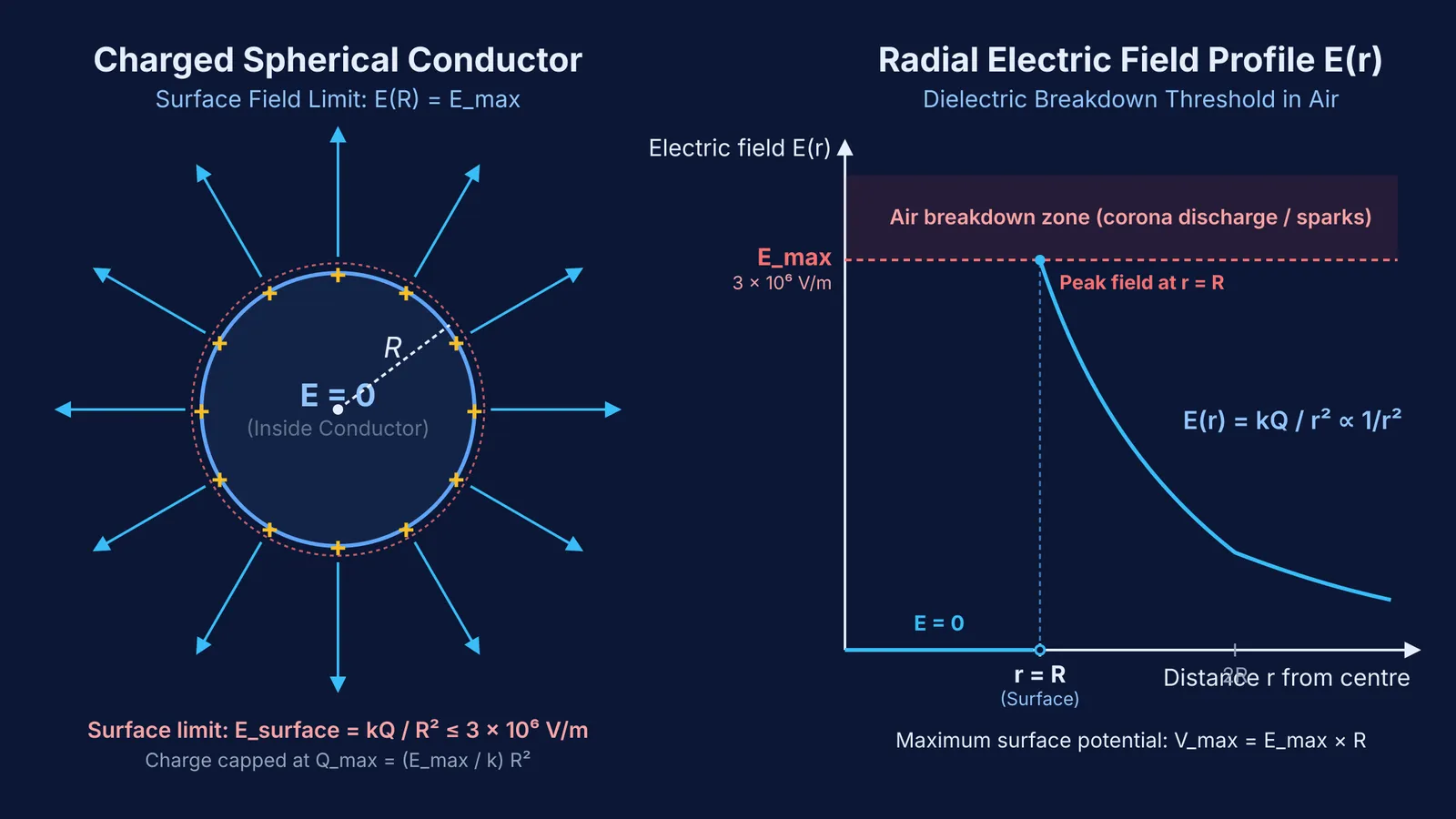
When you transfer electric charge to an isolated metal sphere, the charge distributes across its outer surface, setting up a radial electric field in the surrounding air. Students often assume that a conductor can store any amount of charge if connected to a strong enough source. However, the surrounding medium imposes a strict physical limit. In dry ambient air, insulation fails when the electric field reaches roughly 3 × 10⁶ V/m. Above this dielectric strength, air ionises into a conducting plasma that discharges the sphere as quickly as charge is added.
What is the dielectric strength of air?
Dielectric strength is the maximum electric field an insulator can withstand before breaking down and conducting electricity. For dry ambient air at standard temperature and pressure, this threshold is approximately 3 × 10⁶ V/m (or 30 kV/cm), as tabulated by HyperPhysics.
Friedrich Paschen investigated gas breakdown in his 1889 paper in *Annalen der Physik*, showing that spark voltage depends on gas pressure and electrode separation. In 1901, John S. Townsend showed in the *Philosophical Magazine* how this occurs at the molecular level: ambient electric fields accelerate free electrons, which knock electrons off neutral gas molecules. This collision process creates a Townsend avalanche, turning insulating air into a spark channel within microseconds.
Why does dielectric strength limit the charge on a sphere?
For an isolated conducting sphere of radius R with charge Q, Gauss's law shows that the internal field is zero, as discussed in our guide to conductors and electrostatic shielding. Outside the sphere, the electric field behaves like a central point charge: E = kQ/r², where k = 1/(4πε₀) ≈ 9 × 10⁹ N m²/C², referenced at HyperPhysics.
The field is strongest at the conductor's surface (r = R): E_surface = k Q / R²
As charge Q increases, E_surface grows until it reaches air's dielectric strength E_max ≈ 3 × 10⁶ V/m. As F. W. Peek Jr. showed in the 1911 *Proceedings of the AIEE*, exceeding this gradient causes corona discharge. The surrounding air ionises, creating a faint glow and carrying charge away into the atmosphere to clamp the surface field at E_max.
How do you calculate the maximum charge and potential?
To find the maximum charge Q_max, set the surface electric field equal to E_max: k Q_max / R² = E_max => Q_max = (E_max / k) × R²
Using E_max = 3 × 10⁶ V/m and k ≈ 9 × 10⁹ N m²/C² from HyperPhysics: E_max / k = (3 × 10⁶) / (9 × 10⁹) = (1/3) × 10⁻³ C/m² ≈ 3.33 × 10⁻⁴ C/m²
The maximum charge is therefore Q_max ≈ 3.33 × 10⁻⁴ R² Coulombs (with R in metres). The corresponding maximum surface charge density is constant for any smooth sphere: σ_max = ε₀ E_max ≈ (8.854 × 10⁻¹² C²/N m²) × (3 × 10⁶ V/m) ≈ 2.66 × 10⁻⁵ C/m² = 26.6 μC/m².
The maximum surface potential V_max follows directly from V = k Q / R: V_max = k Q_max / R = E_max × R = (3 × 10⁶ V/m) × R = 3 × 10⁶ R Volts.
This yields clear caps across typical sphere sizes:
Small sphere (radius R = 1 cm = 0.01 m): Q_max ≈ 33.3 nC; V_max = 30 kV.
Medium sphere (radius R = 10 cm = 0.1 m): Q_max ≈ 3.33 μC; V_max = 300 kV.
Large sphere (radius R = 1 m): Q_max ≈ 333 μC; V_max = 3 MV.
As seen when two charged spheres are joined by a wire, smaller spheres reach this breakdown field at much lower charge and potential. Storing this charge also requires assembly work, detailed in our guide to the self-energy of a charged sphere.
Why do high-voltage generators use large spheres?
The relation V_max = E_max R explains why high-voltage machines rely on large spherical terminals. In 1933, Robert J. Van de Graaff, Karl T. Compton, and L. C. Van Atta reported in *Physical Review* that reaching millions of volts for particle acceleration required large spherical terminals, utilizing 60 cm diameter spheres to generate 1.5 MV and designing 15-foot (4.57 m) diameter domes to attain 10 MV. In open air, reaching 3 MV requires an isolated sphere radius of at least 1 m; smaller spheres spark and lose charge before reaching target potential.
Conversely, sharp points have a tiny radius of curvature R, so V_max is very small. Even modest potentials create localized surface fields exceeding air's dielectric limit, generating corona discharge and an ionised electric wind. This allows lightning rods to drain charge gradually. Modern accelerators enclose high-voltage terminals in compressed insulating gases such as sulfur hexafluoride (SF₆), which withstands far greater electric fields than ambient air and permits much higher operating voltages without sparking.
How should students approach electrostatic breakdown problems?
In exams like JEE Main and JEE Advanced, problems often test whether you distinguish between local electric field and overall potential. A common trap is assuming that potential can rise indefinitely without checking whether the surface field breaches air's dielectric limit.
For reviewing electrostatic theory and conductor boundaries, the Fermi Concept Library maps every concept in physics, chemistry, biology, mathematics and computing, each with its own lesson and its place in the map.
For numerical practice on breakdown thresholds, charge sharing, and capacitance, the Fermi Problem Library provides worked problems with a step-by-step solver that explains the reasoning rather than printing an answer.


