On this page
In the tropics the top of the sea is warm all year, and the water about a kilometre down stays only a few degrees above freezing all year. That gap is a heat source and a heat sink sitting on top of each other, so you can run a heat engine between them. The idea is called ocean thermal energy conversion, or OTEC. It never runs out and does not depend on wind or sunshine on the day. The catch is the second law of thermodynamics: a small temperature gap allows only a small efficiency, and the numbers below show how small.
What is ocean thermal energy conversion?
An OTEC plant takes in warm surface water and uses it to boil a working fluid. In a closed cycle the fluid is something with a low boiling point, such as ammonia. In an open cycle it is the seawater itself, which boils at about 28 °C if you lower the pressure to about 3.8 kPa. The vapour drives a turbine. Cold water pumped up from the deep then condenses the vapour, and the cycle repeats.
NREL's OTEC pages say the surface water must be about 20 °C warmer than water no deeper than about 1,000 m, and that this gap is generally found between latitudes 20° N and 20° S (NREL, archived OTEC page). It also helps if deep water lies close to the shore, so the cold-water pipe can be short.
What is the maximum efficiency of an OTEC plant?
No heat engine working between two temperatures can beat the Carnot efficiency, η = 1 − T_c/T_h, with both temperatures in kelvin. Heat engines and the Carnot cycle derives this formula; here we only apply it.
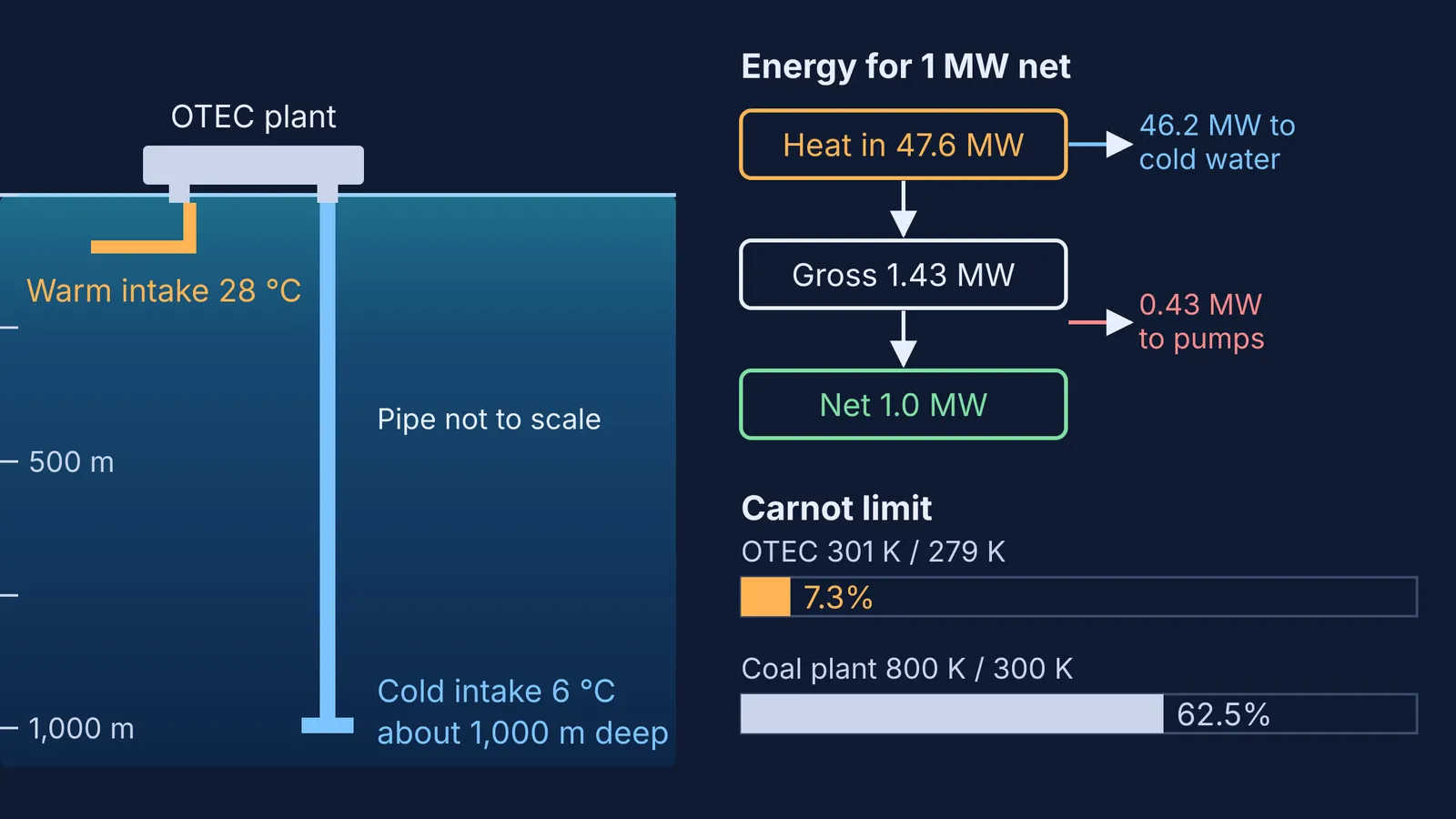
Take 28 °C at the surface and 6 °C at depth. These are round illustrative values that fit NREL's 20 °C rule, not measurements from one site.
T_h = 28 + 273.15 = 301.15 K
T_c = 6 + 273.15 = 279.15 K
η = 1 − 279.15/301.15 = 0.0731, or 7.3%
Compare a coal plant whose steam is at 800 K and whose condenser is at 300 K: η = 1 − 300/800 = 62.5%. The OTEC limit is less than one-eighth of that. Whether it is better to raise the hot side or lower the cold side is covered in raise the source or lower the sink. In the sea you cannot change either one, so 7.3% is the ceiling.
How much seawater does a 1 MW OTEC plant need?
Real cycles fall well short of Carnot. The figures below are labelled round values, chosen only to show the method: a gross efficiency of 3% and pumps that use 30% of the gross output. Seawater's specific heat is about 3,990 J/kg K, a little below fresh water's 4,186, and its density is about 1,025 kg/m³.
Worked example. Find the heat input and the seawater flow for 1 MW of net output.
Gross output. If pumps take 30%, net = 0.70 × gross, so gross = 1.0/0.70 = 1.43 MW. The pumps use 0.43 MW.
Heat taken from warm water. Gross = 0.03 × heat in, so heat in = 1.43/0.03 = 47.6 MW.
Heat dumped into cold water. By energy conservation, 47.6 − 1.43 = 46.2 MW.
Warm water flow. If the warm water cools by 3 K as it passes through, Q = mcΔT gives m = 47.6 × 10⁶/(3,990 × 3) = 3,980 kg/s. That is about 4 tonnes, or 3.9 m³, every second.
Cold water flow. If the cold water warms by 3 K, m = 46.2 × 10⁶/(3,990 × 3) = 3,860 kg/s, or 3.8 m³/s, pumped up from 1,000 m.
Overall efficiency. Net/heat in = 1.0/47.6 = 2.1%.
Check the units: W ÷ (J/kg K × K) = (J/s) ÷ (J/kg) = kg/s. Check the sense: 3% gross is about 41% of the 7.3% Carnot limit, which is a plausible fraction for a real engine.
So a plant the size of a small diesel generator moves almost 8 tonnes of water a second. For comparison, an ordinary power station's cooling tower handles its waste heat by evaporating about 2 litres of water per kWh. An OTEC plant has no tower; the deep ocean is its sink.
Why do OTEC pumps use so much power?
You might think the pumps must lift 3.8 tonnes a second through 1,000 m, which would need 3,860 × 9.8 × 1,000 = 38 MW, far more than the plant makes. They do not. The pipe is full of water and is surrounded by the sea, so the pressure of the sea outside pushes the water up the pipe almost to the surface for free. The pumps only have to overcome friction in the long pipe and the small extra weight of the cold water, which is slightly denser than the warm water near the surface. Those losses are still large because the flow is huge and the margin is thin: every kilowatt spent on pumping comes out of a gross output that is only 3% of the heat.
What is India doing with ocean thermal energy?
India's National Institute of Ocean Technology (NIOT) uses the same warm-over-cold gap at Lakshadweep for desalination rather than power. In a low temperature thermal desalination (LTTD) plant, warm surface water flash-evaporates in a low-pressure chamber and cold deep water condenses the vapour into fresh water. A 2022 government statement says LTTD plants at Kavaratti, Agatti and Minicoy each make 1 lakh litres of drinking water a day, and that the method needs a gap of about 15 °C (PIB, 21 July 2022). A second release says NIOT has started building a 65 kW OTEC plant at Kavaratti to power an LTTD plant of the same capacity (PIB, 3 August 2022). Check NIOT for its current status before quoting it in a project.
How much heat does 1 lakh litres a day take? Evaporating water near 25 °C needs about 2.44 MJ/kg.
Mass per second = 1,00,000 kg ÷ 86,400 s = 1.16 kg/s
Heat = 1.16 × 2.44 × 10⁶ = 2.8 MW
That heat comes from the warm seawater itself, not from electricity. The power supply only runs the pumps and keeps the chamber at low pressure, which is why a 65 kW supply can serve a plant that handles about 2.8 MW of heat.
If you want to practise more heat engine problems with uncommon temperatures, the Fermi Problem Library has a step-by-step solver that explains the reasoning.
Quick checklist
OTEC runs a heat engine between warm surface water and cold water from about 1,000 m.
Always use kelvin: 28 °C and 6 °C give a Carnot limit of 7.3%.
Real gross efficiency is a few per cent; pumping cuts the net further.
For 1 MW net (with 3% gross and 30% pumping) you need about 47.6 MW of heat and about 4 m³/s each of warm and cold water.
The sea's own pressure lifts the cold water; pumps only fight friction and a small density difference.
Lakshadweep's LTTD plants use the same gap to make 1 lakh litres of fresh water a day.