

On this page
When designing a heat engine, the goal is to extract the maximum mechanical work from supplied heat. For an ideal Carnot engine, efficiency depends solely on the temperatures of the hot source and the cold sink. If you can change either temperature by a fixed increment, which choice gives a larger efficiency boost? The mathematics of thermodynamic cycles provides a clear answer.
Is it better to raise source temperature or lower sink temperature?
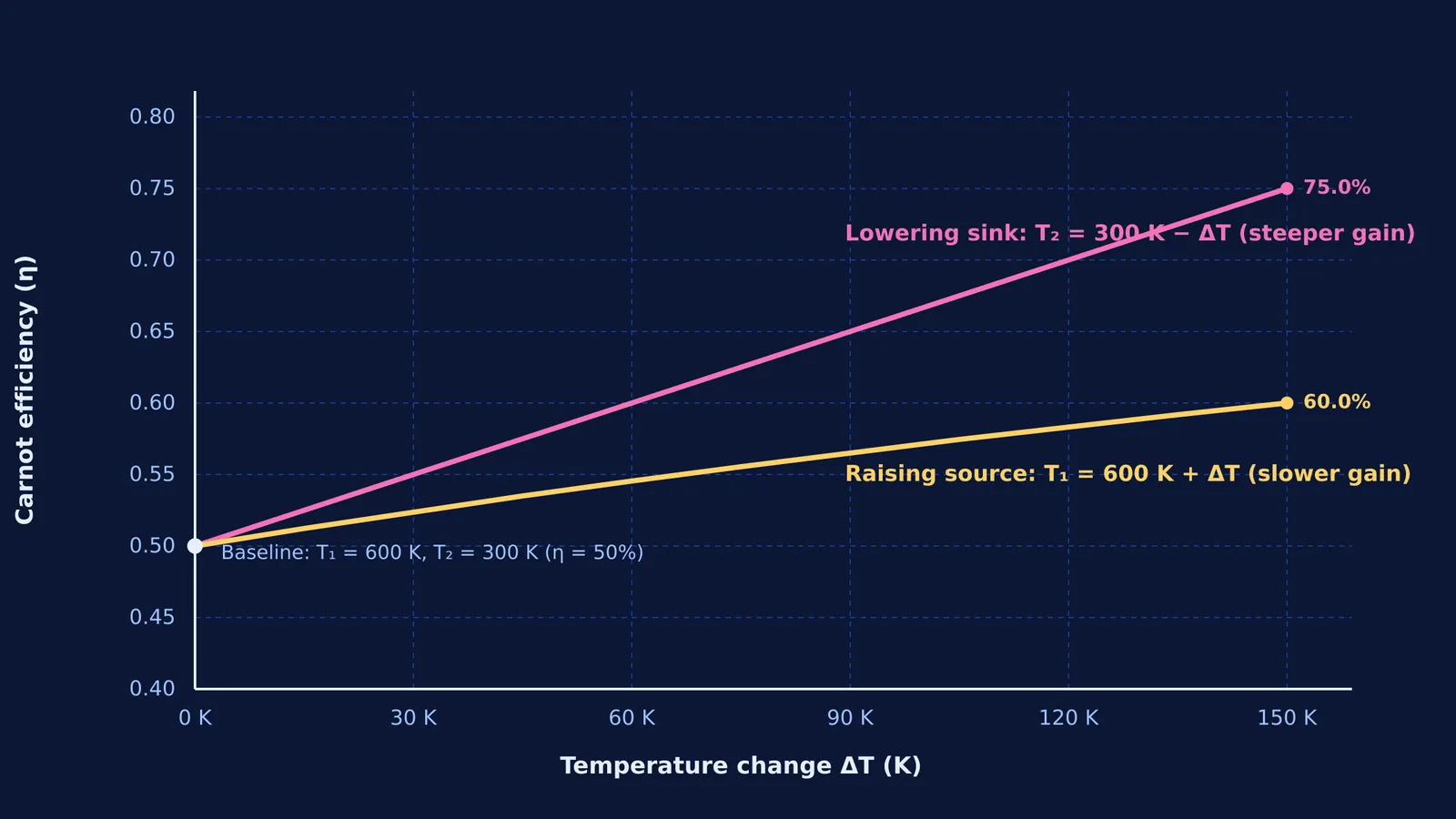
Lowering the sink temperature increases Carnot efficiency more than raising the source temperature by the exact same amount. This fundamental principle of thermodynamics follows directly from how thermal efficiency depends on reservoir temperatures, as outlined in the classic formulation of the Carnot cycle.
For any ideal heat engine operating reversibly between a hot source at absolute temperature T₁ and a cold sink at absolute temperature T₂, the Carnot thermal efficiency (η) is defined as the ratio of work output to heat input:
η = 1 − (T₂ / T₁)
Both temperatures must be measured on the absolute thermodynamic scale in Kelvin. To push efficiency closer to 1 (or 100%), the ratio T₂/T₁ must become as small as possible. You can accomplish this either by raising the source temperature T₁ (increasing the denominator) or by lowering the sink temperature T₂ (decreasing the numerator). Because the denominator T₁ is always larger than the numerator T₂, altering the numerator produces a steeper change in the fraction.
Why does calculus show cooling the sink is more effective?
To compare the sensitivity of efficiency to each temperature, we calculate partial derivatives. Foundational thermodynamic studies, such as the analysis of heat engine efficiency limits by Curzon and Ahlborn in the *American Journal of Physics* Curzon & Ahlborn, 1975, examine how efficiency responds to reservoir conditions.
Differentiating efficiency with respect to the source temperature T₁ while holding T₂ constant gives:
∂η/∂T₁ = T₂ / T₁²
Differentiating efficiency with respect to the sink temperature T₂ while holding T₁ constant gives:
∂η/∂T₂ = −1 / T₁
The negative sign indicates that lowering T₂ increases efficiency. Because heat flows spontaneously from hot to cold, every heat engine operates with T₂ < T₁. Dividing both sides of this inequality by T₁² shows:
T₂ / T₁² < 1 / T₁
This inequality proves that the rate of efficiency gain with respect to the sink, |∂η/∂T₂| = 1/T₁, is strictly greater than the rate of gain with respect to the source, ∂η/∂T₁ = T₂/T₁². In fact, the sensitivity to sink temperature exceeds the sensitivity to source temperature by the factor T₁/T₂, which is always greater than 1.
The same conclusion holds for any finite temperature step ΔT. Lowering the sink by ΔT increases efficiency by ΔT/T₁. Raising the source by ΔT increases efficiency by T₂ΔT / [T₁(T₁ + ΔT)]. Because T₁ exceeds T₂, subtracting the two expressions confirms that lowering the sink always yields a greater gain.
When working through thermodynamic cycle calculations and multi-variable derivatives, understanding the step-by-step logic prevents sign and substitution errors. The Fermi Problem Library provides worked problems with a step-by-step solver that explains the reasoning rather than printing an answer.
Why do real heat engines raise the source instead?
If lowering the sink temperature is mathematically superior, why do power plants and gas turbines focus primarily on raising combustion temperatures? The divergence between thermodynamic theory and practical engineering comes down to physical constraints documented in thermal power plant design and the engineering analysis of the Carnot cycle:
The ambient environment sets a temperature floor: In real power plants, heat rejection occurs into the atmosphere or natural water bodies at ambient conditions (roughly 290 K to 300 K). Lowering the sink below ambient requires active refrigeration, which consumes useful work.
Chilling consumes net power: Calculating the energy needed to cool a reservoir involves evaluating the coefficient of performance in refrigerators and heat pumps. The second law of thermodynamics ensures that running a chiller to lower the sink wastes more energy than the engine recovers.
Materials engineering expands the upper ceiling: Because the sink is pinned by ambient conditions, engineers increase efficiency by raising the upper temperature T₁. Advanced nickel superalloys and thermal barrier coatings enable modern gas turbines to operate at temperatures exceeding 1700 K.
Analyzing ideal cycles alongside practical machines requires connecting temperature limits to pressure and volume changes. Evaluating net engine work requires finding the net work in a cycle from the indicator diagram's loop area. Distinguishing reversible heat transfer from unconstrained expansion also relies on understanding why work and internal energy change vanish in free expansion.
To explore how heat engines connect to broader thermodynamic laws, the Fermi Concept Library organizes every concept in physics, chemistry, biology, mathematics and computing, each with its own lesson and its place in the map.


