

On this page
Which metals show the photoelectric effect with visible light?
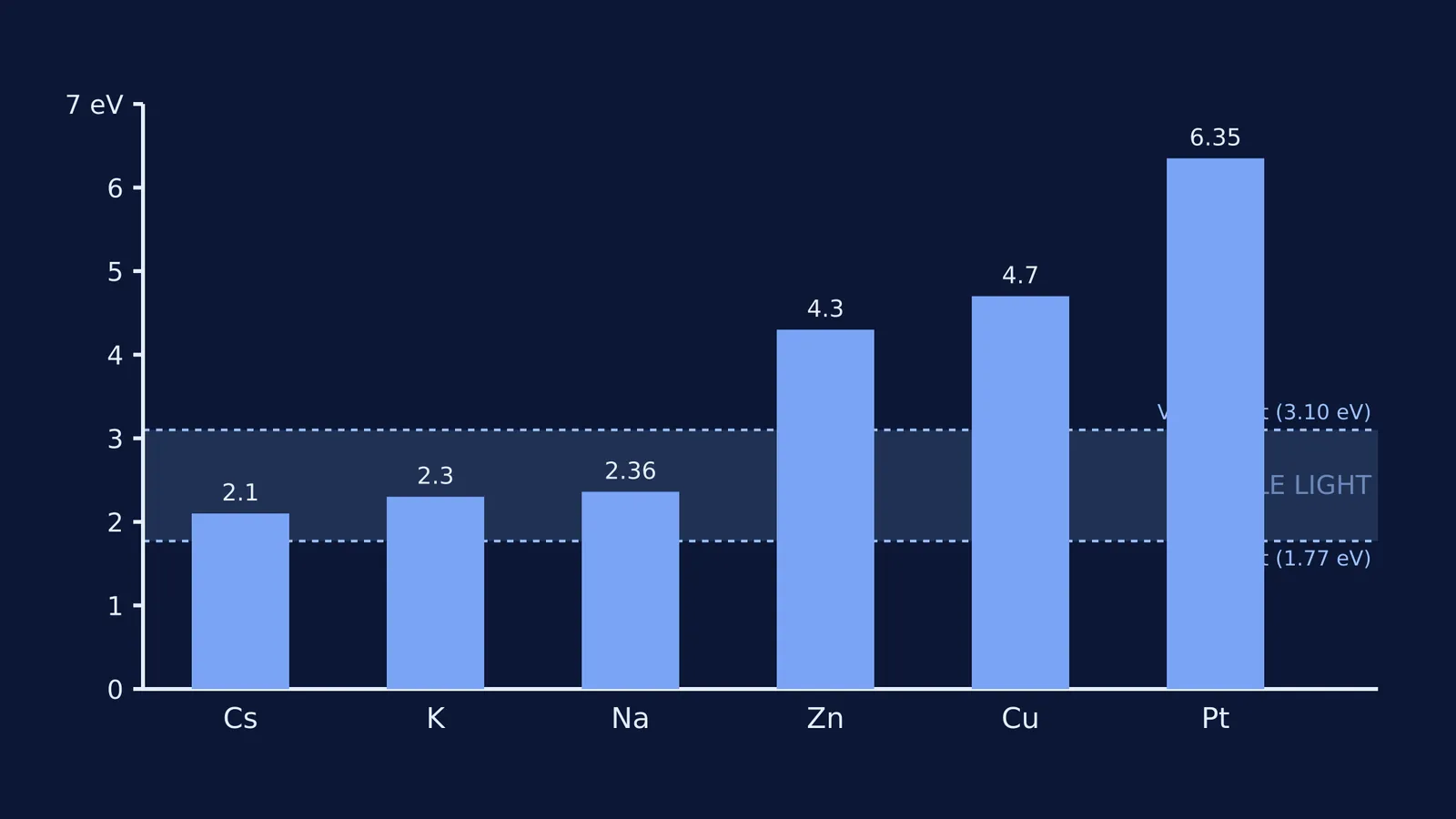
When light strikes a metal, it can knock an electron loose if the light's photon carries enough energy. The minimum energy required to eject an electron is called the metal's work function. Visible light has a photon energy between approximately 1.77 eV (red light) and 3.10 eV (violet light) 1.
For a metal to show the photoelectric effect under a regular visible lamp, its work function must be lower than the photon energy of that light. The alkali metals—like caesium, potassium and sodium—meet this condition. Caesium has a work function of just 2.1 eV 2. That means any visible light from green through to violet packs enough of a punch to eject electrons.
Why do alkali metals emit electrons so easily?
Alkali metals sit on the far left of the periodic table. They have a single electron in their outermost shell, which is relatively far from the nucleus and loosely bound.
This loose grip translates to a low work function:
Caesium: 2.1 eV
Potassium: 2.3 eV
Sodium: 2.36 eV
Because these values are below the 3.10 eV cap of visible light 1, a simple beam of blue or violet light is all it takes to trigger an electric current 2.
How does atomic size affect the work function?
The low work function of alkali metals is a direct result of their atomic structure. As you move down the group from lithium to sodium, potassium, and caesium, the atoms get progressively larger. A larger atomic radius means the outermost electron is further away from the positive pull of the nucleus.
Additionally, the inner layers of electrons shield this outer electron from the nucleus. This combination of distance and shielding results in a very weak attraction. It takes very little energy to strip that outermost electron away. This is why caesium, being larger than sodium, has an even lower work function and responds to an even broader range of visible light.
Why doesn't copper work with visible light?
Transition metals like copper, zinc and platinum hold their electrons much tighter. Copper is a smaller atom with a higher effective nuclear charge, pulling its electrons firmly inwards. This results in a work function of about 4.7 eV 2.
Even the most energetic visible light—deep violet at 3.10 eV 1—falls short of this barrier. When a violet photon hits copper, the electron absorbs the 3.10 eV but cannot overcome the 4.7 eV wall to escape. The energy is simply turned into heat. To see the photoelectric effect in copper, you must use ultraviolet (UV) light, which has shorter wavelengths and delivers energies well above 4.7 eV.
This strict requirement applies to most common metals. Zinc requires 4.3 eV, and platinum demands a massive 6.35 eV 2.
Where are these metals used in real life?
Because caesium and potassium respond so well to visible light, they are used in devices that need to "see" light the way human eyes do. For example, they are the active coatings in older television camera tubes, photomultiplier tubes, and automatic light switches. If a streetlamp turns on automatically when the sun sets, it might be relying on a sensor triggered by the photoelectric effect.
On the other hand, because copper and zinc only respond to ultraviolet light, they are completely immune to visible light interference. If an engineer wants to build a detector for UV rays without it being blinded by bright daylight, a metal with a high work function is actually the perfect choice.
A worked example: Will a laser pointer work?
If you are studying for your exams, you might see a question asking if a specific light source can eject electrons from a given metal.
If you get stuck on questions like this, the Fermi Concept Library maps out the photoelectric effect with its own lesson. Let's look at how to tackle one manually.
Imagine you shine a green laser pointer (wavelength 532 nm) on a piece of potassium (work function 2.3 eV). Will you see photoelectrons? We can use Einstein's photoelectric equation to find out 2.
Find the energy of the incoming photon: E = 1240 / 532.
E = 2.33 eV.
Compare it to the work function: 2.33 eV > 2.3 eV.
Since the photon energy is greater than the work function, the green laser will successfully eject electrons from potassium. Furthermore, the leftover energy (0.03 eV) becomes the maximum kinetic energy of the ejected electron.
By contrast, if you shine the same laser on copper, 2.33 eV is far less than 4.7 eV 2. Because one electron can only absorb one photon at a time, it does not matter how bright the green laser is or how long you leave it on. The electrons simply cannot collect enough energy to escape, so nothing happens. If you are practising these calculations and need help counting the resulting photoelectrons, see our guide on finding the number of photons emitted per second.


