

On this page
When you buy a smartphone or a power bank, its battery capacity is advertised in milliampere-hours (mAh). While this number gives a sense of how long the device will last, it hides the actual physics happening inside the cell. A battery does not store electrical energy as a fluid; it stores chemical potential energy that reacts to release electrons. By converting that mAh rating into Coulombs and then into moles of electrons, you can connect an everyday specification to the fundamental laws of electrochemistry.
If you are preparing for exams like JEE or NEET, this conversion is a classic application of Electrolysis and Faraday's laws. It bridges the gap between the theoretical constants you memorise and the devices you use every day.
What does a mAh rating mean in physics?
In physics, an ampere (A) is the standard unit of electrical current. It is defined as one Coulomb (C) of electrical charge flowing past a specific point in a circuit every second. Therefore, multiplying a current by a period of time gives you the total amount of charge that was moved.
A milliampere-hour (mAh) is simply a scaled-down, practical unit of charge used by the electronics industry. Because smartphones draw current in the milliampere range over a span of several hours, mAh is a more intuitive unit for consumers than Coulombs. To convert it into standard SI units, you just need to break down the prefixes and time units:
One milliampere is 0.001 amperes.
One hour is exactly 3,600 seconds.
By multiplying the two together, you get the conversion factor: 1 mAh = 0.001 C/s × 3600 s = 3.6 C.
This means that for every 1 mAh printed on the side of a battery, it can push exactly 3.6 Coulombs of charge through a circuit before the chemical reaction stops and the battery goes flat.
How to convert a battery mAh rating to Coulombs?
To find the total charge stored in any battery, multiply its mAh rating by 3.6.
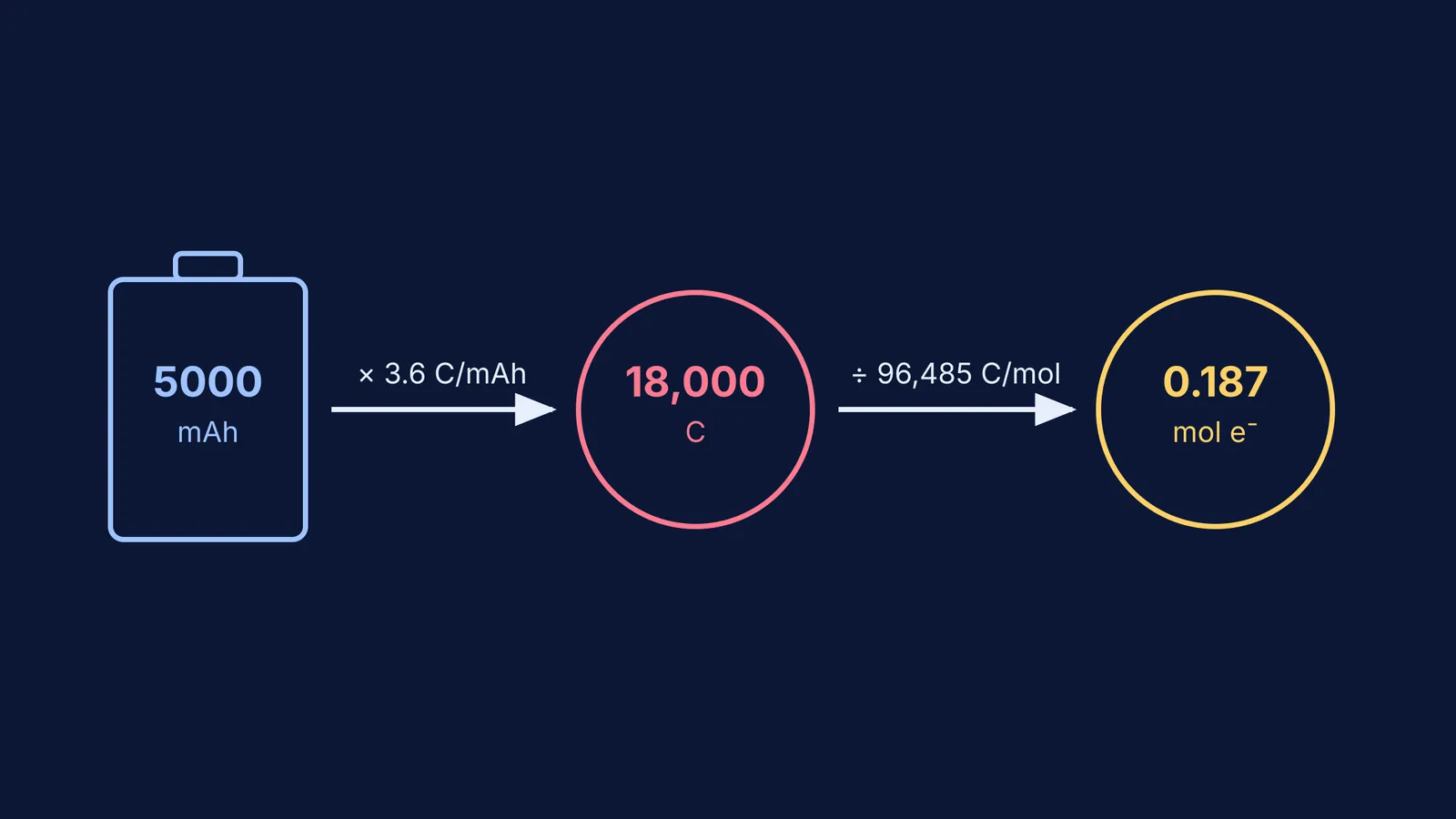
If you look at the specifications of a typical modern smartphone, it often features a lithium-ion battery rated at 5000 mAh. Using our conversion factor:
5000 mAh × 3.6 C/mAh = 18,000 C.
A fully charged 5000 mAh battery holds 18,000 Coulombs of movable charge. To put this huge number in perspective, a static electricity shock from touching a metal doorknob in winter involves less than a microcoulomb of charge. A lightning strike transfers around 15 to 350 Coulombs. The battery holds thousands of times more charge than a lightning bolt, but it releases it safely and slowly over many hours at a very low voltage. You can explore how different cell chemistries manage this steady discharge in our guide to batteries and fuel cells.
How many moles of electrons are in a phone battery?
To link this massive total charge back to the microscopic chemistry of the battery, we need to count the electrons themselves. Because individual electrons carry a tiny fraction of a Coulomb, they are too small to count practically. Instead, chemists group them into moles using Avogadro's number.
The total charge carried by exactly one mole of elementary charges (like electrons) is known as the Faraday constant. Following the 2019 revision of the SI base units, the Faraday constant is defined exactly as 96,485.332 C/mol (NIST CODATA). For almost all practical and exam calculations, using 96,485 C/mol is perfectly accurate.
To find the moles of electrons moved by a 5000 mAh battery, divide its total charge in Coulombs by the Faraday constant:
Moles of electrons = 18,000 C ÷ 96,485 C/mol ≈ 0.187 mol.
This calculation reveals that discharging a 5000 mAh battery from 100% down to 0% forces approximately 0.19 moles of electrons through your phone's processor, screen, and antennas. Because each electron requires a chemical reaction at the electrodes to be released, this number directly dictates how many moles of lithium ions must intercalate between the battery's anode and cathode.
A step-by-step conversion framework
When tackling electrochemistry problems that involve practical battery capacities, you can map the calculation process using this three-step framework:
Find total charge: Multiply the given capacity in mAh by 3.6 to get the total Coulombs.
Find moles of electrons: Divide the Coulombs by 96,485 to find the moles of electrons.
Relate to the cell reaction: Use the balanced chemical equation of the cell to find the moles of active reactant consumed. For a process involving a 1-electron transfer, such as moving lithium ions, the moles of reactant will match the moles of electrons.
If you ever run into trouble mapping these variables to the Nernst equation or Gibbs free energy formulas, the Fermi Concept Library has every concept in physics, chemistry, biology, mathematics and computing, each with its own lesson and its place in the map. Tracing the path from a physical device specification to a molar quantity is a highly effective way to make abstract chemistry feel tangible.


