

On this page
When you solve textbook physics problems or examine the components inside a computer, you rarely see capacitors measured in whole farads. Instead, they are marked in microfarads (μF) or picofarads (pF). The reason is that one farad represents a massive amount of capacitance.
Why is one farad considered a very large capacitance?
Capacitance measures how much electric charge a conductor can store for a given electrical potential. By definition, a one-farad capacitor holds one coulomb of charge for every volt of potential difference across it.
A coulomb is a staggering amount of charge—it takes roughly 6.24 × 10¹⁸ electrons to make up a single coulomb. Because it takes so much charge to change the potential by just one volt, a traditional capacitor built to hold one farad must be physically enormous.
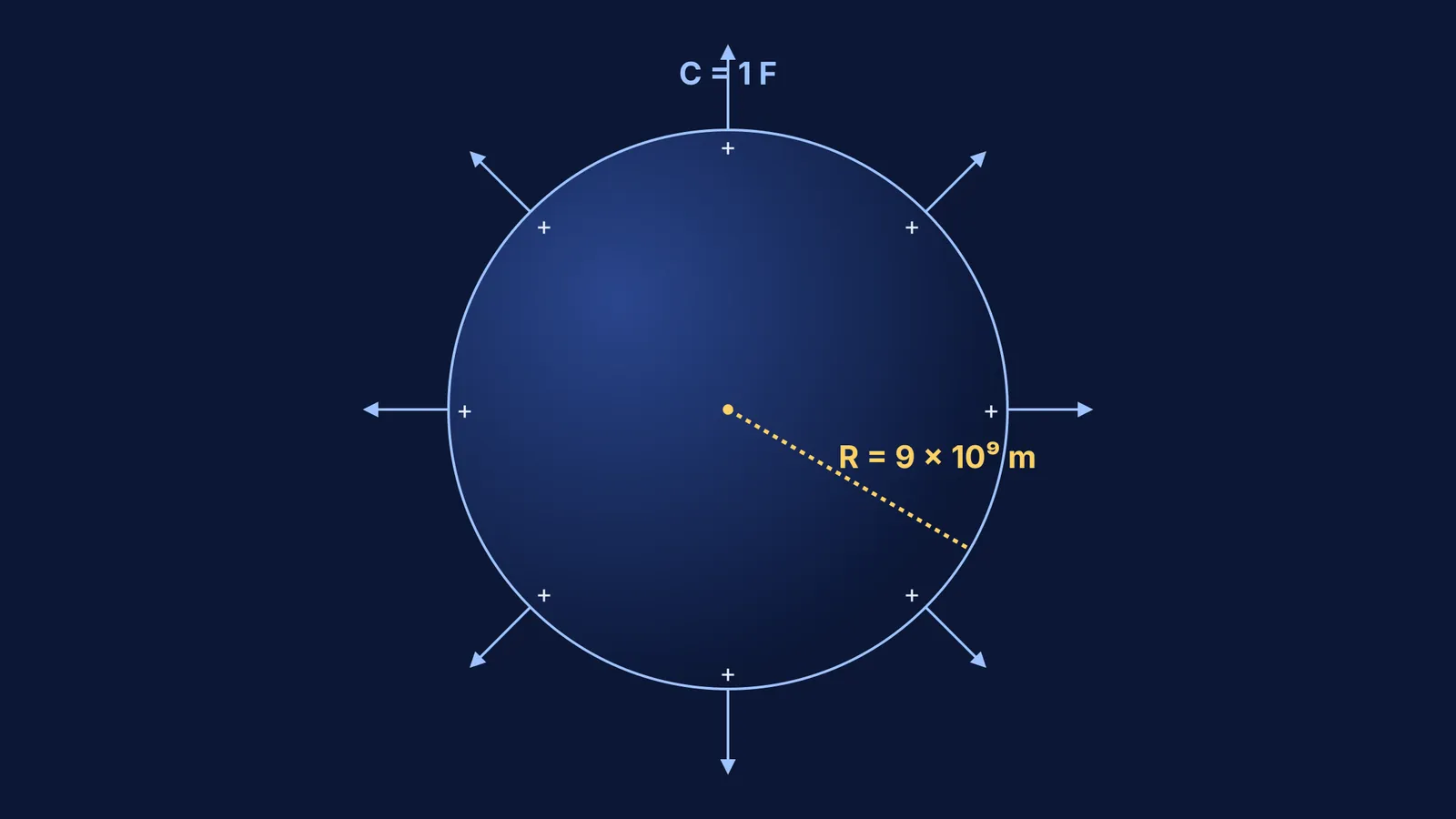
How big is a one-farad sphere?
We can see this clearly by calculating the size of a simple spherical capacitor. As shown when deriving the capacitance of spherical and cylindrical capacitors, the capacitance C of an isolated conducting sphere in a vacuum is given by the formula C = 4πε₀R, where R is the radius and ε₀ is the vacuum permittivity.
To find the radius of a one-farad sphere, we rearrange the formula to R = C / (4πε₀). The term 1 / (4πε₀) is Coulomb's constant, which is approximately 9 × 10⁹ N·m²/C². Plugging in C = 1 F gives a radius of exactly 9 × 10⁹ meters.
For context, the mean radius of the Earth is 6,371 kilometres (6.371 × 10⁶ meters). This means a one-farad sphere would need a radius roughly 1,400 times larger than our planet.
Working through derivations like this builds your intuition for electrostatics. When you are stuck on similar calculations—such as finding the self-energy of a charged sphere—the Fermi Problem Library has worked problems with a step-by-step solver that explains the reasoning rather than printing an answer.
How do practical capacitors manage their size?
Since we cannot build components the size of planets, real-world capacitors use different geometries and materials. A common design is the parallel plate capacitor. Its capacitance is given by C = Kε₀A / d, where A is the area of the plates, d is the distance between them, and K is the dielectric constant of the material separating them.
To maximize capacitance in a small volume, engineers increase the plate area by rolling or folding long strips of conductive foil. They also minimize the distance between the plates by using incredibly thin separators.
Most importantly, they use dielectric materials like ceramics or tantalum instead of a vacuum or air. These materials polarize in an electric field, which reduces the effective field strength and allows the plates to store more charge at the same voltage. For example, some barium titanate ceramics have a dielectric constant as high as 7,000, allowing for much smaller capacitor designs.
Why do we use microfarads and picofarads?
Because the farad is so large, practical circuits rely on smaller fractions of the unit. The small currents and voltages used in radios, logic gates and everyday electronics mean that a tiny fraction of a farad is enough to store the necessary energy or filter signals.
You will almost always use these smaller prefixes:
1 microfarad (μF) = 10⁻⁶ F
1 nanofarad (nF) = 10⁻⁹ F
1 picofarad (pF) = 10⁻¹² F
While modern supercapacitors can reach thousands of farads, they achieve this density through electrochemical properties. They use porous materials like activated carbon to create massive surface areas and separate charges by microscopic distances of less than a nanometer, not by using traditional isolated metal plates.


