

On this page
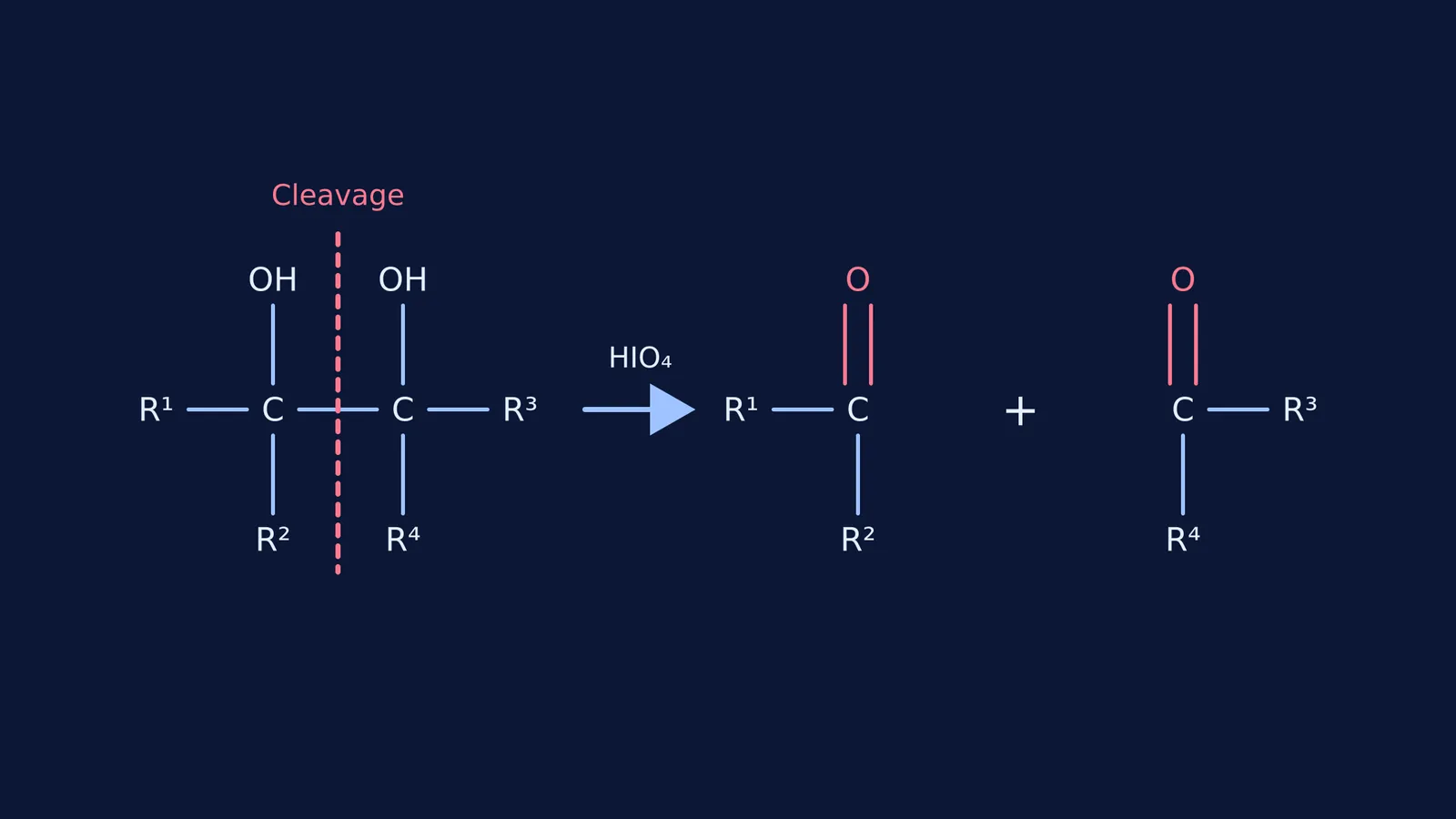
When you need to break a carbon-carbon bond in organic chemistry, you need a highly specific reagent. Periodic acid (HIO₄) does exactly this for vicinal diols—molecules with hydroxyl (-OH) groups on adjacent carbon atoms. By cleaving the bond between these two carbons, periodic acid leaves behind two carbonyl compounds.
This transformation is formally known as the Malaprade reaction. First reported by Léon Malaprade in 1928, it remains one of the most reliable ways to break open carbon rings and locate -OH groups in complex molecules like sugars.
What is the Malaprade reaction?
The Malaprade reaction is an oxidation process that converts vicinal diols into a pair of carbonyl derivatives (aldehydes or ketones) using periodic acid or a periodate salt, such as sodium metaperiodate (NaIO₄).
Periodic acid features iodine in the highest oxidation state of +7. When it reacts with the diol, the iodine is reduced, and the carbon atoms are oxidized. Unlike harsher oxidising agents that might destroy the entire carbon skeleton, HIO₄ acts like a chemical scalpel, cutting only the bond between the two oxygen-bearing carbons.
If you are trying to fit this reaction into the wider landscape of organic chemistry, the Concept Library contains every concept in chemistry, each with its own lesson and its place in the map.
How does the HIO4 cleavage mechanism work?
The cleavage does not happen in a single collision. Instead, the reaction is assumed to proceed by the formation of a cyclic diester of iodine(VII) as an intermediate.
Formation of the ring: The two adjacent hydroxyl groups of the diol attack the iodine atom of the periodic acid. This releases water and forms a five-membered ring containing the two carbon atoms, the two oxygen atoms, and the iodine atom.
Cleavage: This cyclic periodate ester is unstable. It rapidly breaks down, severing the carbon-carbon bond.
Product release: The oxygen atoms double-bond to their respective carbons to form carbonyl groups, and the iodine leaves as iodate (HIO₃), dropping to a +5 oxidation state.
Because the mechanism relies on forming a five-membered ring, the physical shape of the starting molecule matters. For instance, *cis*-diols on a rigid ring react much faster than *trans*-diols because their -OH groups are already positioned to grab the same iodine atom.
Which other compounds are cleaved by periodic acid?
While vicinal diols are the textbook example, periodic acid will also cleave other 1,2-difunctional compounds. It can break the bonds in:
1,2-aminoalcohols: Yielding a carbonyl compound and an imine (which quickly hydrolyses into ammonia and another carbonyl).
α-hydroxy ketones and α-diketones: Breaking the bond between the carbonyl carbon and the adjacent oxygen-bearing carbon.
However, it will not cleave isolated -OH groups or diols separated by extra carbon atoms, making it highly selective.
How is HIO4 cleavage used to study carbohydrates?
Carbohydrates are essentially chains and rings of carbons loaded with hydroxyl groups. Because periodic acid specifically targets vicinal diols, it is frequently used to open saccharide rings and deduce their exact structures. This analytical technique helps chemists map out complex reducing and non-reducing sugars by looking at the specific fragments left behind after cleavage.
In biochemistry, this selectivity provides a brilliant tool for studying genetics. RNA contains ribose, a sugar ring that has vicinal diols at its 2' and 3' positions. DNA contains deoxyribose, which is missing the oxygen at the 2' position and therefore lacks vicinal diols. Because of this difference, periodate oxidation is often used to selectively label the 3'-termini of RNA instead of DNA.
How to predict the products of HIO4 cleavage?
Predicting the products of a Malaprade cleavage is straightforward if you follow a systematic method.
Locate the target: Find the two adjacent carbons carrying -OH groups.
Draw the cut: Imagine a line cutting straight through the C-C bond connecting them.
Form the carbonyls: Erase the C-C bond and turn the single C-O bonds into double C=O bonds.
Check the substituents:
If the original carbon was attached to one hydrogen and one alkyl (R) group, it becomes an aldehyde.
If the original carbon was attached to two alkyl groups, it becomes a ketone.
If it was a terminal -CH₂OH group, it becomes formaldehyde (HCHO).
Unlike the dehydration of alcohols which forms an alkene, this reaction destroys the carbon framework. When predicting products for long carbohydrate chains, keeping track of every carbon can be tricky. Fermi's AI tutor can work out what you already know and build a plan for the session, holding a line of reasoning while you work through complex structures together. If you are preparing for an exam, the Fermi Problem Library provides worked problems with a step-by-step solver that explains the reasoning rather than just printing the final answer.


