On this page
Lost a mark for writing "methyl orange" in an acetic acid titration? The fix is one comparison: where the indicator changes colour, and where the pH jumps. The Chemistry LibreTexts guide to acid-base indicators/Equilibria/Acid-Base_Equilibria/6._Acid-Base_Indicators) gives you the two ranges you need.
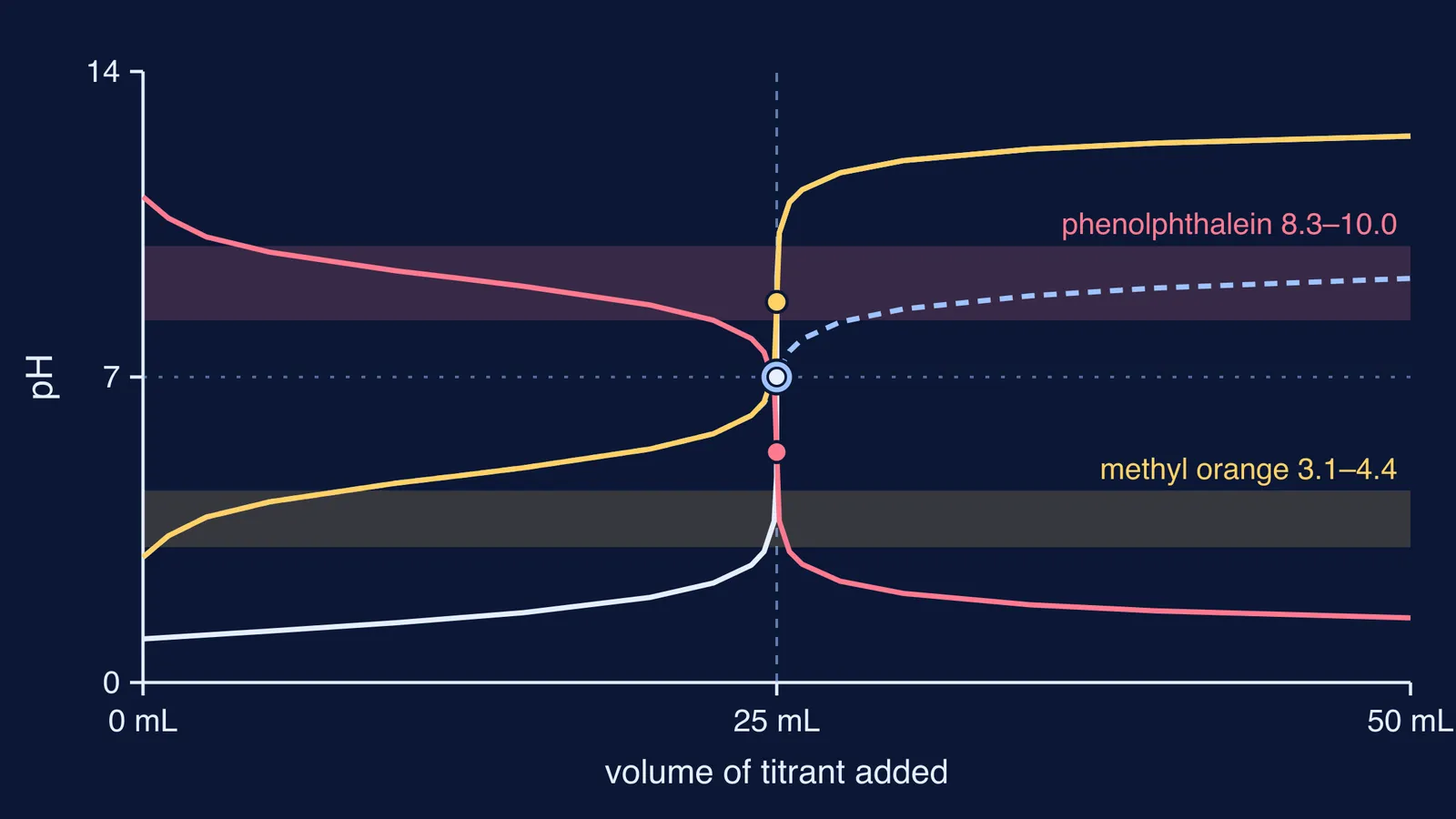
Methyl orange changes from red to yellow between pH 3.1 and 4.4, with its halfway orange at pH 3.7.
Phenolphthalein changes from colourless to pink between pH 8.3 and 10.0, with its halfway point at pH 9.3.
Why does the indicator range have to match the equivalence point?
An indicator is a weak acid whose acid form and conjugate base are different colours, so it changes colour over a range of pH, not at one exact value. OpenStax Chemistry 2e puts this colour-change interval at roughly pKa ± 1 for most indicators.
The equivalence point is where the moles of acid and base are equal. The end point is where you see the colour change. You want both in the same drop. Close to equivalence the pH moves almost vertically. If the indicator's range sits inside that stretch, one drop carries you through the whole colour change; if not, the colour drifts and you stop at the wrong volume. For more on why the curve has that shape, read our guide to reading acid-base titration curves. If the indicator chemistry itself feels shaky, start with how acid-base indicators work.
What is the equivalence pH for each titration type?
The salt present at equivalence decides the pH. OpenStax on salt hydrolysis explains the pattern: a salt of a weak base and a strong acid gives an acidic solution, and a salt of a weak acid and a strong base gives a basic one. When both ions are weak, the result depends on how Ka compares with Kb.
Strong acid–strong base: titrating 25.00 mL of 0.100 M HCl with 0.100 M NaOH reaches equivalence at pH 7.00 (OpenStax).
Weak acid–strong base: 25.00 mL of 0.100 M acetic acid with 0.100 M NaOH reaches equivalence at pH 8.72 (same source).
Strong acid–weak base: 0.100 M ammonia with 0.100 M HCl reaches equivalence near pH 5.3 (we work it out below).
Weak acid–weak base: acetic acid with ammonia ends close to pH 7, because acetic acid's Ka and ammonia's Kb are both 1.8 × 10⁻⁵ (OpenStax). But the jump there is gentle.
Which indicator for a weak acid–strong base titration?
Use phenolphthalein. The equivalence pH of 8.72 sits inside its 8.3–10.0 range, and OpenStax Chemistry 2e says outright that only phenolphthalein suits the weak acid titration. Methyl orange would finish changing while most of the acid is still unreacted, because acetic acid passes through pH 3.1–4.4 early, in its buffer region. Our explainer on why the equivalence pH of a weak acid titration is above 7 goes through that calculation step by step.
Here is the full rule for all four types, based on the LibreTexts guide/Equilibria/Acid-Base_Equilibria/6._Acid-Base_Indicators):
Strong acid + strong base: either indicator. The curve is so steep that both give virtually the same volume.
Weak acid + strong base: phenolphthalein only.
Strong acid + weak base: methyl orange only.
Weak acid + weak base: neither. LibreTexts says you would never titrate this pair with an indicator. In practice you follow the pH with a meter instead.
How do you check methyl orange for a strong acid–weak base titration?
Take 25.0 mL of 0.100 M ammonia titrated with 0.100 M HCl. The constants come from OpenStax: Kb of ammonia is 1.8 × 10⁻⁵, which makes Ka of the ammonium ion 5.6 × 10⁻¹⁰.
Equivalence comes at 25.0 mL of HCl. All 2.50 mmol of NH₃ is now NH₄⁺, in 50.0 mL, so its concentration is 0.0500 M.
NH₄⁺ is a weak acid: [H⁺] = √(Ka × C) = √(5.6 × 10⁻¹⁰ × 0.0500) = 5.3 × 10⁻⁶ M.
pH = 5.28. That is acidic, as the salt rule predicts.
Check the jump. At 24.9 mL the solution is still a buffer: pH = 9.26 − log(2.49 ÷ 0.01) = 6.86. At 25.1 mL there is 0.01 mmol of excess H⁺ in 50.1 mL, so [H⁺] = 2.0 × 10⁻⁴ M and pH = 3.70.
Compare. The pH falls from 6.86 to 3.70 across 0.2 mL, which carries it into methyl orange's 3.1–4.4 band. Phenolphthalein's 8.3–10.0 band is passed much earlier, around pH 8.30 at 22.5 mL, so it would lose its pink about 10% too soon.
The Fermi Problem Library has worked titration problems with a step-by-step solver that explains the reasoning rather than just printing an answer, which helps when you get the indicator right but the pH arithmetic wrong.
If salt hydrolysis is the part you keep forgetting, the Fermi Concept Library gives each chemistry concept its own lesson. After that, every indicator question is the same check: equivalence pH, steep jump, matching range.