

On this page
When you add a few drops of phenolphthalein to an acid, nothing appears to happen. But if you drip it into a base, the solution flashes a brilliant pink.
This colour change is the backbone of acid-base titrations. To understand why it happens, we look to the underlying chemical equilibrium that explains how pH indicators work.
What is an acid-base indicator?
An acid-base indicator is either a weak organic acid or a weak organic base. The defining feature of an indicator is that its unionised (undissociated) form has a completely different colour to its ionised (dissociated) form.
When you dissolve a weak acid indicator (which we can write as HIn) in water, it establishes a chemical equilibrium:
HIn ⇌ H⁺ + In⁻
Because it is a weak acid, it only partially dissociates into ions. The degree of dissociation — and therefore the dominant colour of the solution — is controlled entirely by the surrounding pH.
How do acid-base indicators work?
The shift in colour relies on chemical equilibrium, which adjusts to counteract changes in the system.
In an acidic medium: An acidic solution is already full of hydrogen ions (H⁺). Adding the indicator introduces a common ion. The high concentration of H⁺ pushes the equilibrium to the left, suppressing the ionisation of the indicator. The indicator remains mostly as unionised HIn molecules, so the solution takes on the colour of the unionised form.
In a basic medium: A basic solution contains hydroxide ions (OH⁻). These ions react with the H⁺ ions from the indicator to form water (H₂O). As H⁺ is removed from the system, the equilibrium shifts to the right to replace it. The indicator is forced to ionise, flooding the solution with In⁻ ions. The solution now takes on the colour of the ionised form.
Why does phenolphthalein turn pink?
Phenolphthalein is a classic weak acid indicator. Its unionised form (HIn) is completely colourless, while its ionised form (In⁻) is a deep pink.
If you drop phenolphthalein into hydrochloric acid, the surplus of H⁺ keeps the indicator in its unionised state, leaving the liquid colourless. But if you add it to sodium hydroxide, the OH⁻ ions sweep away the H⁺, pulling the equilibrium to the right and turning the liquid pink.
At what pH does phenolphthalein change colour?
An indicator does not change colour exactly at pH 7 (neutral pH is not always 7 anyway). Instead, the transition point depends on the indicator's own dissociation constant, or pKa.
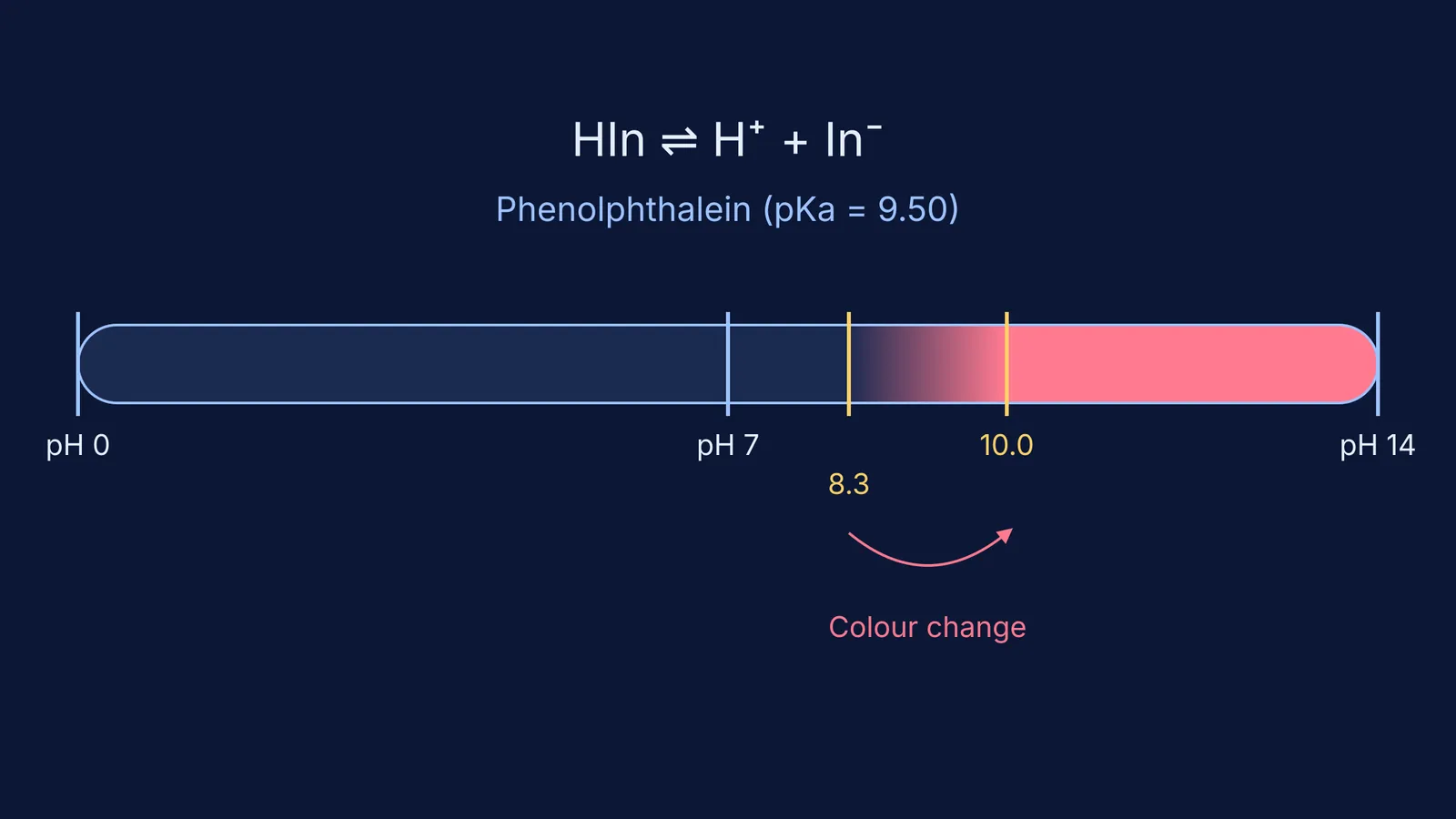
An indicator usually shifts colours over a range of about pH = pKa ± 1. For phenolphthalein, the pKa is 9.50. Because of this, its visible transition range lies between pH 8.3 and 10.0.
Below pH 8.3: The solution is colourless.
Between pH 8.3 and 10.0: The solution transitions through a pale pink.
Above pH 10.0: The solution is a solid, bright fuchsia.
Because phenolphthalein changes colour in the basic range, it is the standard indicator for titrating a strong base against a weak acid. At the equivalence point of this titration, the salt produced makes the solution slightly basic, landing perfectly in phenolphthalein's pink transition window.
Choosing the right indicator
If you are trying to memorise which indicator to use for which titration, do not rely on rote learning. Instead, map the pKa of the indicator against the pH of the salt at the equivalence point.
If you want to trace how these exact equilibria shift, the Fermi Concept Library holds every concept in chemistry, each with its own lesson and its place in the map. Rather than memorising the colour, you can see how the H⁺ concentration controls the balance.
By understanding the underlying chemistry, a pink flask is no longer just a trick — it is a visible measure of ionisation happening in real time.


