

On this page
A power station has to push a lot of power through kilometres of wire, and the current in that wire turns some energy into heat before it reaches your home. The fix takes five lines of Class 12 physics.
Why is electricity transmitted at high voltage?
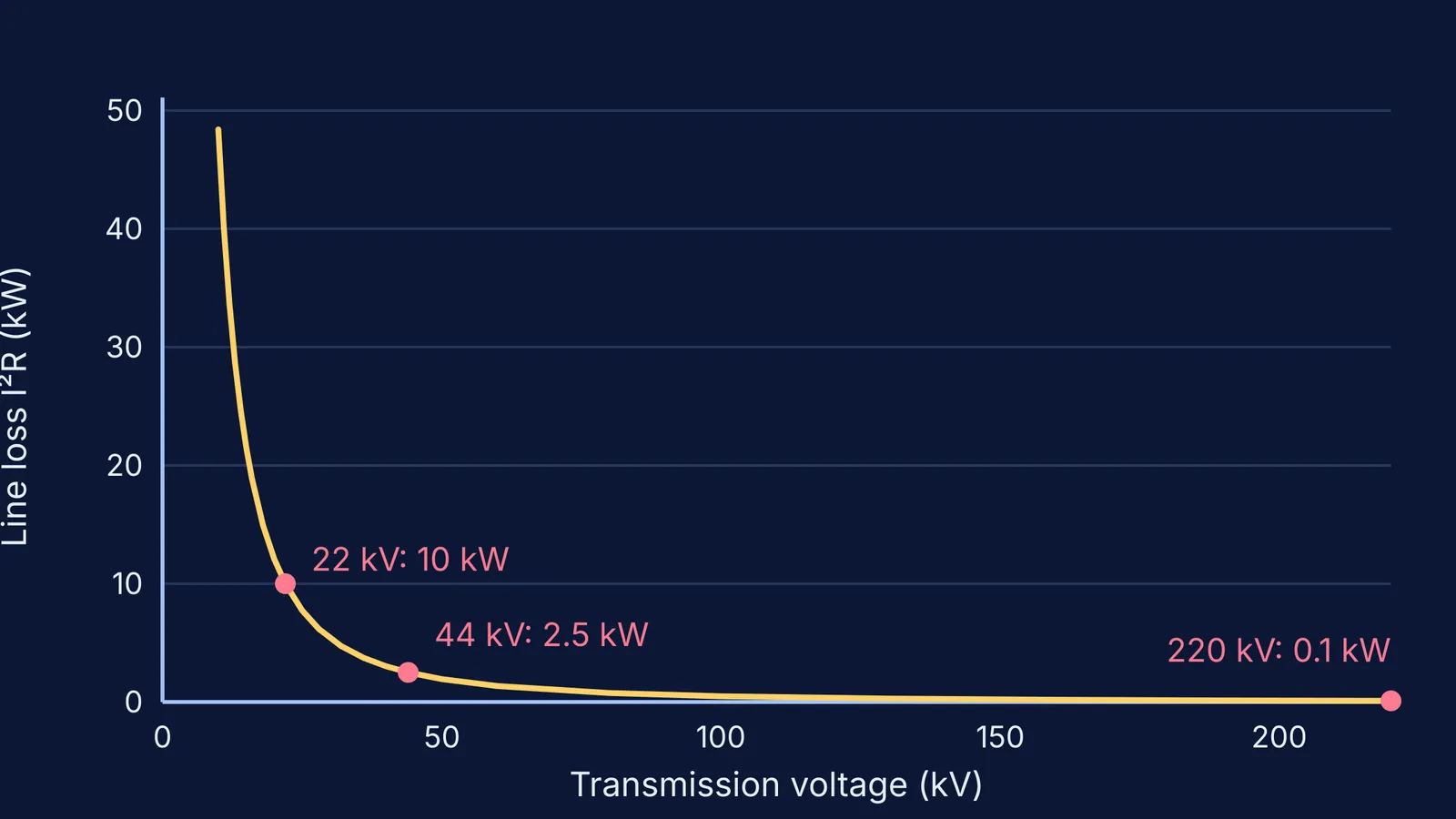
A line carrying power P at voltage V carries a current I = P/V. The heat lost in the line is I²R, where R is the resistance of the wires. Put those together and the line loss is (P/V)²R.
So, for the same power and the same wires, line loss falls with the square of the voltage. The NCERT Class 12 Physics chapter on alternating current puts it this way: the generator's voltage is stepped up "so that current is reduced and consequently, the I²R loss is cut down".
What do step-up and step-down transformers do?
A transformer is two coils on an iron core. In the same NCERT chapter, the secondary voltage is Vs = (Ns/Np)Vp and the secondary current is Is = (Np/Ns)Ip. More turns on the secondary makes a step-up transformer, and fewer turns makes a step-down transformer.
NCERT traces the full chain. The voltage is stepped up at the power station and sent over long distances to an area substation near consumers. There it is stepped down, then stepped down again at distribution substations and utility poles, until 240 V reaches your home. A step-up transformer does not create energy: in an ideal one, VpIp = VsIs, so the current falls by the factor the voltage rises. For efficiency and losses inside the transformer, see our explainer on transformers and AC generators.
How much power does high voltage save? A worked numerical
Suppose a power station sends 1.1 MW down a line with a total resistance of 4 Ω. We use the NCERT transformer relations, treat the transformers as ideal and work in rms values.
Sent at 2.2 kV: I = 1,100,000 / 2,200 = 500 A. Loss = 500² × 4 = 1,000,000 W, which is 1 MW, or about 91% of the power.
Sent at 22 kV: I = 50 A. Loss = 50² × 4 = 10,000 W, which is 10 kW, or about 0.9%.
Sent at 220 kV: I = 5 A. Loss = 5² × 4 = 100 W, or about 0.009%.
Each tenfold rise in voltage cuts the loss a hundredfold. Going from 2.2 kV to 220 kV needs a step-up transformer with 100 times as many turns on the secondary. The current falls from 500 A on the generator side to 5 A in the line.
Check the first case: 500 A through 4 Ω drops 2,000 V, leaving 200 V at the town, so it receives 500 × 200 = 100 kW, exactly 1.1 MW minus the 1 MW lost.
Why not just use V²/R?
If you put the 220 kV line voltage into V²/R, the loss seems to grow as the voltage rises, which is backwards. In V²/R, the V must be the voltage across the resistance itself, which here is the drop along the line, IR, not the voltage between the line and the ground.
At 22 kV the drop is 50 × 4 = 200 V, and 200² / 4 = 10,000 W, matching I²R. Our post on the heating effect of current covers when each form of the power formula applies.
Why not thicker wires? Since R = ρL/A, halving the loss means doubling the metal on every tower, while ten times the voltage cuts it a hundredfold.
What does this look like on India's grid?
POWERGRID's milestones page lists India's first 765 kV line, Sipat to Seoni, commissioned in 2007. It also lists Pole-I of the ±800 kV Champa–Kurukshetra direct-current link in 2017 and the completion of the 6,000 MW Raigarh–Pugalur–Thrissur HVDC project in 2021.
In a Lok Sabha answer dated 30 July 2026, the Ministry of Power said the country's transmission losses are around 3-4% on an annual basis. The same answer gives aggregate technical and commercial (AT&C) losses of distribution utilities, which also count shortfalls in collecting bills, of 15.04% in FY25. By these figures, far more goes missing at the distribution end than on the transmission network. For the history, read about Edith Clarke and her calculator for power transmission lines.
How do you solve a transmission-loss numerical?
Find the line current from the transmission voltage: I = P/V.
Use the total resistance of the line. If you are given resistance per km per wire, multiply by the length and by the number of wires.
Find the loss as I²R, then divide by P for the percentage.
For each transformer, use Vs/Vp = Ns/Np and VpIp = VsIs.
Sanity-check that the line drop IR is small compared with V.
If you get stuck on a step, the Fermi Problem Library has worked problems with a step-by-step solver that explains the reasoning rather than printing an answer. To revise the ideas behind it, the Fermi Concept Library gives each concept its own lesson and shows its place in the map.


