

On this page
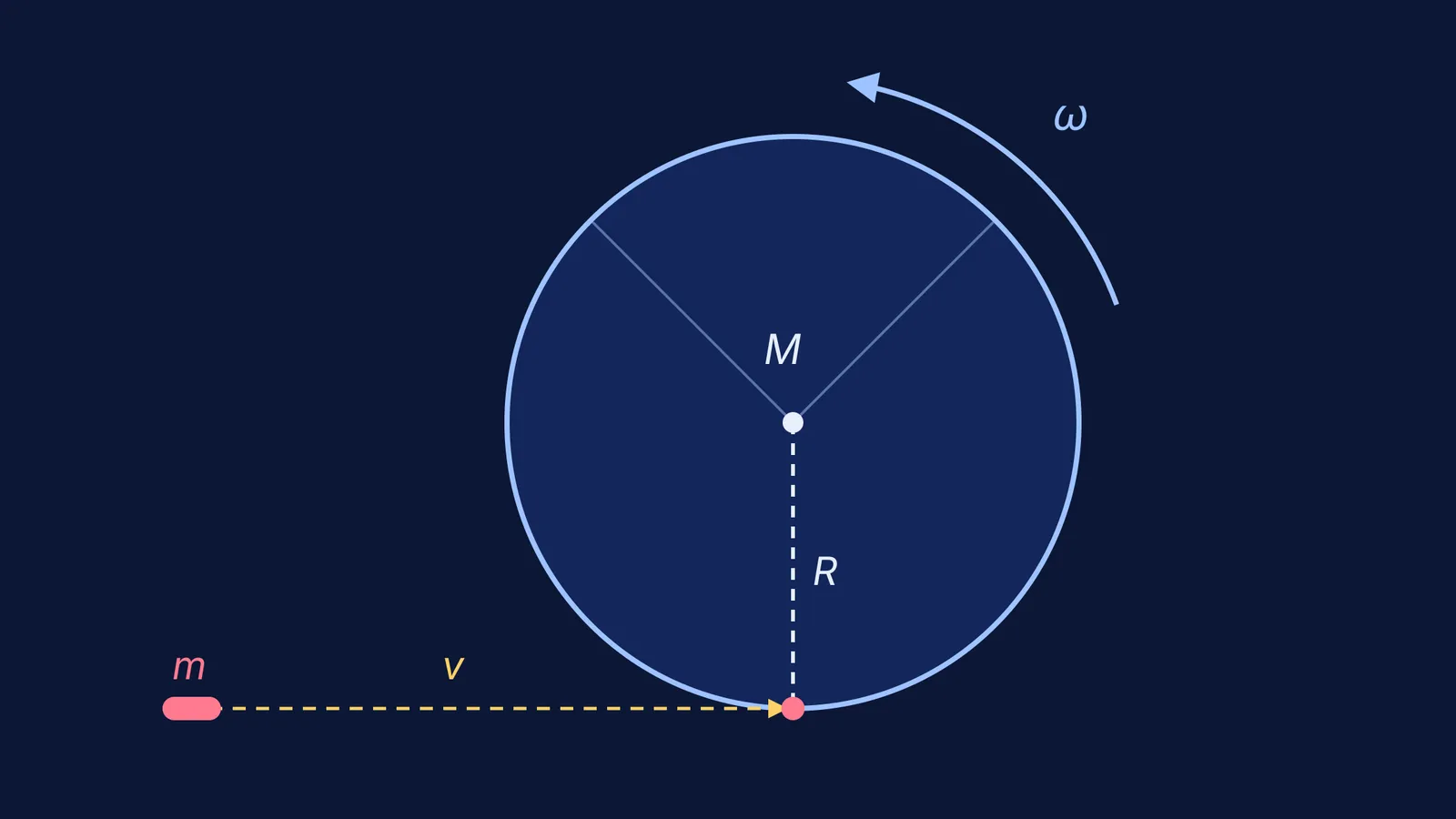
When a bullet hits a disc that turns on a fixed axle and gets stuck in it, you have one equation to write: angular momentum about the axle before the hit equals angular momentum about the axle after it. The bullet's only job in the "after" picture is to add m r² to the moment of inertia.
Why is angular momentum conserved but not linear momentum?
OpenStax University Physics states the rule: the angular momentum of a system about a point in a fixed inertial frame is conserved if there is no net external torque about that point.
During the impact the axle pushes on the disc to stop it being knocked sideways. That external force breaks linear momentum conservation. But it acts through the axis, so it has no lever arm and no torque there: angular momentum about the axle, and only about the axle, is conserved.
Kinetic energy is not conserved either: some goes into embedding the bullet, as the energy check below shows.
What goes into each side of the equation?
For a single particle, angular momentum is l = r p sin θ, the cross product of position and momentum, as defined in OpenStax section 11.2. For a rigid body turning about a fixed axis, L = I ω.
The moment of inertia of a uniform thin disc about its central axis is I = ½MR², and a point mass at distance r from the axis has I = mr², according to OpenStax section 10.5. Moments of inertia about the same axis add, so disc plus bullet has I = ½MR² + mr².
That gives the working equation:
Before: m v d + I(disc) ω0, where d is the perpendicular distance from the axle to the bullet's line of flight.
After: (I(disc) + m r²) ω, where r is the distance from the axle to where the bullet stops.
If the bullet hits the rim moving along a tangent, d = r = R. If it comes in at a slant, d is smaller than r. Mixing these two distances up is the classic mistake.
How do you find the final angular speed, step by step?
OpenStax works one version in its example 11.9: a 2.0 g bullet at 500.0 m/s embeds in the edge of a 3.2 kg solid disc of radius 0.5 m that is free to rotate and starts at rest, and the disc ends up turning at 1.2 rad/s (OpenStax section 11.3). Here is a harder set where the disc is already spinning. Take a disc of mass 2 kg and radius 0.4 m turning at 5 rad/s, and a 20 g bullet at 200 m/s.
Disc's moment of inertia: ½ × 2 × 0.4² = 0.16 kg m². Its angular momentum: 0.16 × 5 = 0.8 kg m²/s.
Final moment of inertia with the bullet lodged in the rim: 0.16 + 0.02 × 0.4² = 0.1632 kg m².
Case A, tangential hit in the same sense as the spin: bullet term 0.02 × 200 × 0.4 = 1.6. Total 2.4, so ω = 2.4 / 0.1632 ≈ 14.7 rad/s.
Case B, tangential hit against the spin: total 0.8 − 1.6 = −0.8, so ω ≈ −4.9 rad/s. The disc reverses direction.
Case C, same sense, but the line of flight passes 0.2 m from the axle and the bullet lodges at the rim: bullet term 0.02 × 200 × 0.2 = 0.8. Total 1.6, so ω ≈ 9.8 rad/s. The added inertia is still m R², because r is where the bullet ends up.
Energy check for case A: before, 2 J (disc) + 400 J (bullet); after, ½ × 0.1632 × 14.7² ≈ 17.6 J. Roughly 384 J becomes heat, sound and deformation. Our post on whether to use energy or momentum conservation in collision problems has the general rule.
What are the common mistakes in bullet-and-disc problems?
Writing m v = (M + m) V. The axle breaks linear momentum conservation.
Using r instead of d for a slanted hit.
Dropping the m r² term because the bullet is small. With a light disc it matters.
Losing the sign when the bullet opposes the spin.
Using energy conservation across the impact.
The same idea, that moment of inertia changes while angular momentum stays fixed, also drives the problem of a person walking to the edge of a rotating platform. More traps like these are listed in rotational motion: five common JEE mistakes and their fixes.
To practise choosing the right distance and conservation law, try variants in the Fermi Problem Library, where the step-by-step solver explains the reasoning rather than printing an answer. If moment of inertia itself feels shaky, the Fermi Concept Library has a lesson for each idea and shows where it sits in the map of physics.


