

On this page
Fructose is a ketone, and ketones are supposed to fail Tollens' test. Yet warm fructose with Tollens' reagent and you get a silver mirror. The reason is a reaction two Dutch chemists described in 1895: in dilute alkali, glucose, mannose and fructose turn into one another. Learn to draw the one intermediate behind it and a whole group of board and JEE questions comes down to one idea.
What is the Lobry de Bruyn–van Ekenstein rearrangement?
The Lobry de Bruyn–van Ekenstein transformation is the base- or acid-catalysed conversion of an aldose into its ketose isomer, or back again, through an enediol intermediate (Wikipedia summary). C. A. Lobry de Bruyn and W. Alberda van Ekenstein reported the glucose, fructose and mannose case in the Recueil des Travaux Chimiques des Pays-Bas, volume 14, pages 203–216 (original 1895 paper). Its title calls the change "reciprocal", and that matters. You do not get a clean switch from one sugar to another. You get a mixture. In a 2022 kinetics study using aqueous NaOH at 50–90 °C and pH 9.5–11.5, fructose yields reached up to 31%, with mannose and allulose also formed and some sugar lost to decomposition (Fischer, Drabo and Delidovich, 2022). A 2015 study with organic Brønsted bases in water reported 32% fructose yield within 7 minutes (Carraher and colleagues, ACS Catalysis).
How does the enediol connect glucose, mannose and fructose?
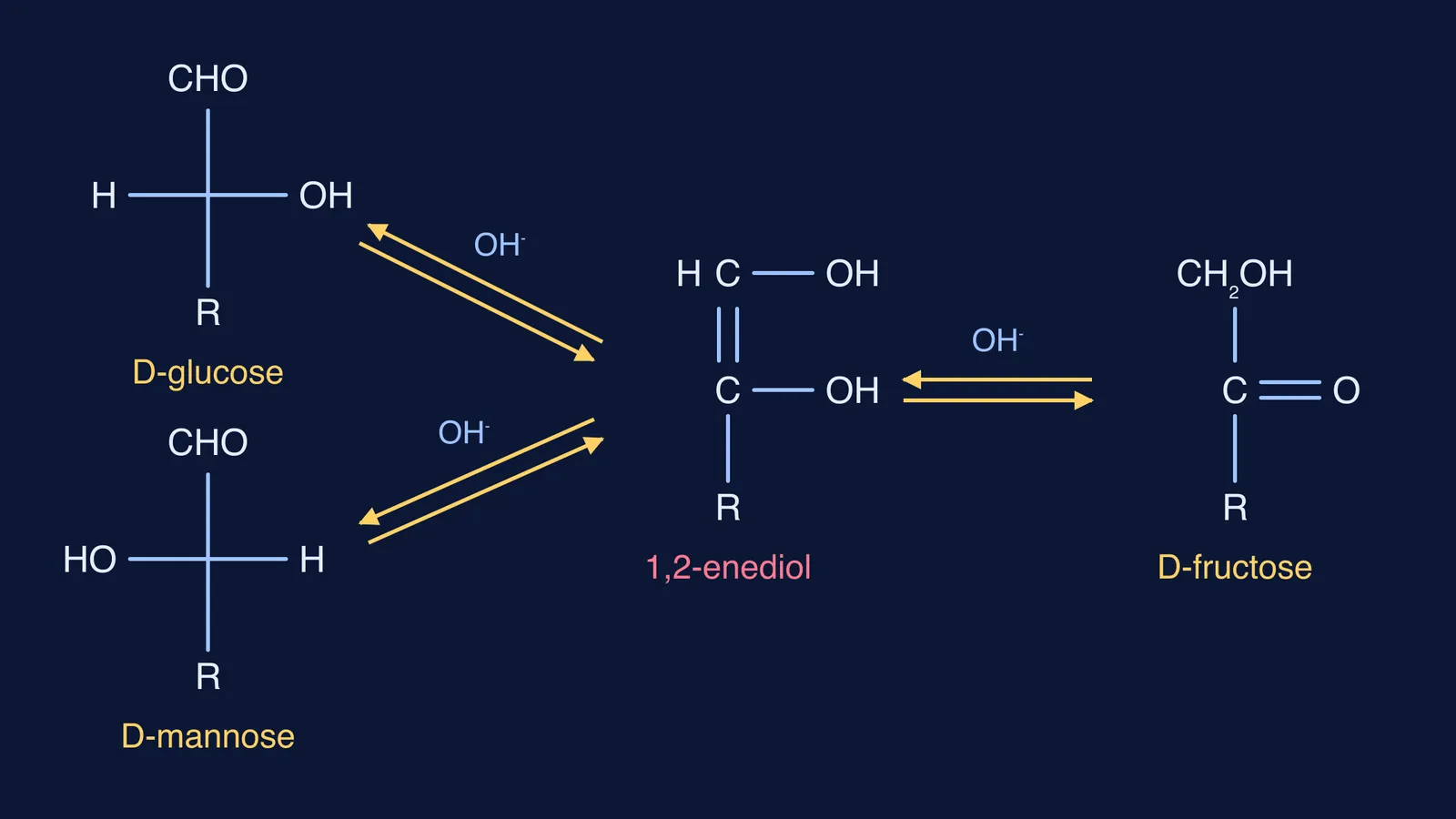
Only carbons 1 and 2 take part. Carbons 3 to 6 stay exactly as they were, which is why the hero diagram shows them as R. Here is the mechanism as a sequence you can write in an exam:
The ring of glucose opens to the open-chain form, which has a free aldehyde (CHO) at C1.
Hydroxide removes the hydrogen on C2. That hydrogen sits next to the C=O, so the negative charge it leaves behind spreads onto the oxygen.
The anion picks up a proton on oxygen. Now C1 and C2 are joined by a double bond and each carries an OH: this is the 1,2-enediol.
C2 in the enediol is flat, so its stereochemistry is gone. Put a hydrogen back on C2 from one face and you get glucose again; from the other face you get mannose.
Or the enediol can move a hydrogen to C1 instead and turn the C2 OH into C=O. C1 becomes CH2OH and C2 becomes a ketone: that is fructose.
Glucose and mannose differ only at C2, so they are C2 epimers. Our post on the difference between epimers and anomers explains that term in more depth. Fructose has the same C3 to C6 as both of them; see the open-chain and furanose structure of fructose.
If the word epimer or the idea of a planar carbon losing its configuration still feels shaky, the Fermi Concept Library has a lesson on every concept in chemistry, each placed in its map, so you can fill the gap before going on.
Why does fructose reduce Tollens' reagent if it is a ketone?
Tollens' reagent is silver ions in aqueous ammonia, a basic solution (Wikipedia: reducing sugar). That basic medium is exactly the condition for the rearrangement. LibreTexts puts it directly: because of "the facile interconversion of ketoses and aldoses under the basic conditions of this test, ketoses such as fructose also react and are classified as reducing sugars" (LibreTexts, carbohydrate reactions/Carbohydrates/Important_Reactions)).
So the sequence in the test tube is: fructose goes to the enediol, then to glucose or mannose, and their aldehyde group reduces Ag+ to metallic silver. The same logic applies to Benedict's reagent, which is also basic (Lumen, properties of monosaccharides), and to Fehling's solution, which is made strongly alkaline with sodium hydroxide (Wikipedia: Fehling's solution).
How do you tell glucose and fructose apart, then?
Not with Tollens', Fehling's or Benedict's: all three are basic, so both sugars pass. The usual school answer is Seliwanoff's test, which runs in acid; our guide on how to distinguish glucose and fructose with chemical tests walks through it.
How should you write this in a board or JEE answer?
A five-line answer that covers the marks:
Name it: Lobry de Bruyn–van Ekenstein rearrangement.
Condition: dilute alkali (OH⁻).
Intermediate: a common 1,2-enediol formed by removing the C2 hydrogen.
Products: glucose, mannose and fructose in equilibrium; only C1 and C2 change.
Consequence: fructose gives positive Tollens' and Fehling's tests because it isomerises to aldoses in the alkaline reagent.
Then check your answer against these common slips:
Writing that fructose "has an aldehyde group". It does not; it forms aldoses in base.
Leaving mannose out of the equilibrium.
Claiming alkali converts glucose into galactose.
Describing full conversion. The real outcome is a mixture: fructose yields reached at most 31% in the 2022 NaOH kinetics study.
To practise, take a past question on reducing sugars and work through it in the Fermi Problem Library, where the step-by-step solver explains the reasoning rather than printing an answer.


