

On this page
Glucose and fructose share the exact same molecular formula, C₆H₁₂O₆, but they possess distinctly different chemical structures. Glucose is an aldohexose, which means its carbon chain includes an aldehyde functional group. In contrast, fructose is a ketohexose, as its structure contains a ketone group instead. When you need to distinguish between these two sugars in a chemistry practical laboratory or during a board exam, you must rely on chemical tests that exploit how these specific functional groups react under different conditions.
Why do Tollens' and Benedict's tests fail here?
If you are given an unknown sugar, you might instinctively reach for Tollens' reagent or Benedict's solution to see if it is a reducing sugar. However, both glucose and fructose will yield a positive result with these common reagents. Tollens' reagent forms a distinct silver mirror on the glass with both sugars, and Benedict's reagent produces a brick-red precipitate with both.
Why does a ketone like fructose reduce these reagents? The reactions for both Tollens' and Benedict's tests take place in strongly alkaline conditions. In a basic solution, fructose tautomerises into an aldose—specifically converting into a mixture of glucose and mannose. Because the fructose molecule transforms into an aldehyde before the oxidation can even occur, it behaves as a reducing sugar exactly like glucose does. Therefore, alkaline tests simply cannot tell them apart. You need tests that operate in acidic or neutral conditions where tautomerisation cannot occur.
How do you distinguish glucose and fructose?
To definitively distinguish glucose from fructose, you must use a reagent that takes advantage of the inherent chemical difference between an aldehyde and a ketone, all without forcing the ketone to tautomerise. The two standard laboratory methods for this purpose are Seliwanoff's test and the bromine water test.
Seliwanoff's test specifically looks for the ketone group in a highly acidic medium, while bromine water acts as a mild oxidising agent that targets the aldehyde group without affecting the ketone.
How does Seliwanoff's test identify ketoses?
Seliwanoff's test uses a reagent made of resorcinol dissolved in concentrated (usually 6 M) hydrochloric acid. When you add the sugar to this acidic reagent and heat the mixture, the strong acid aggressively dehydrates the sugar molecules.
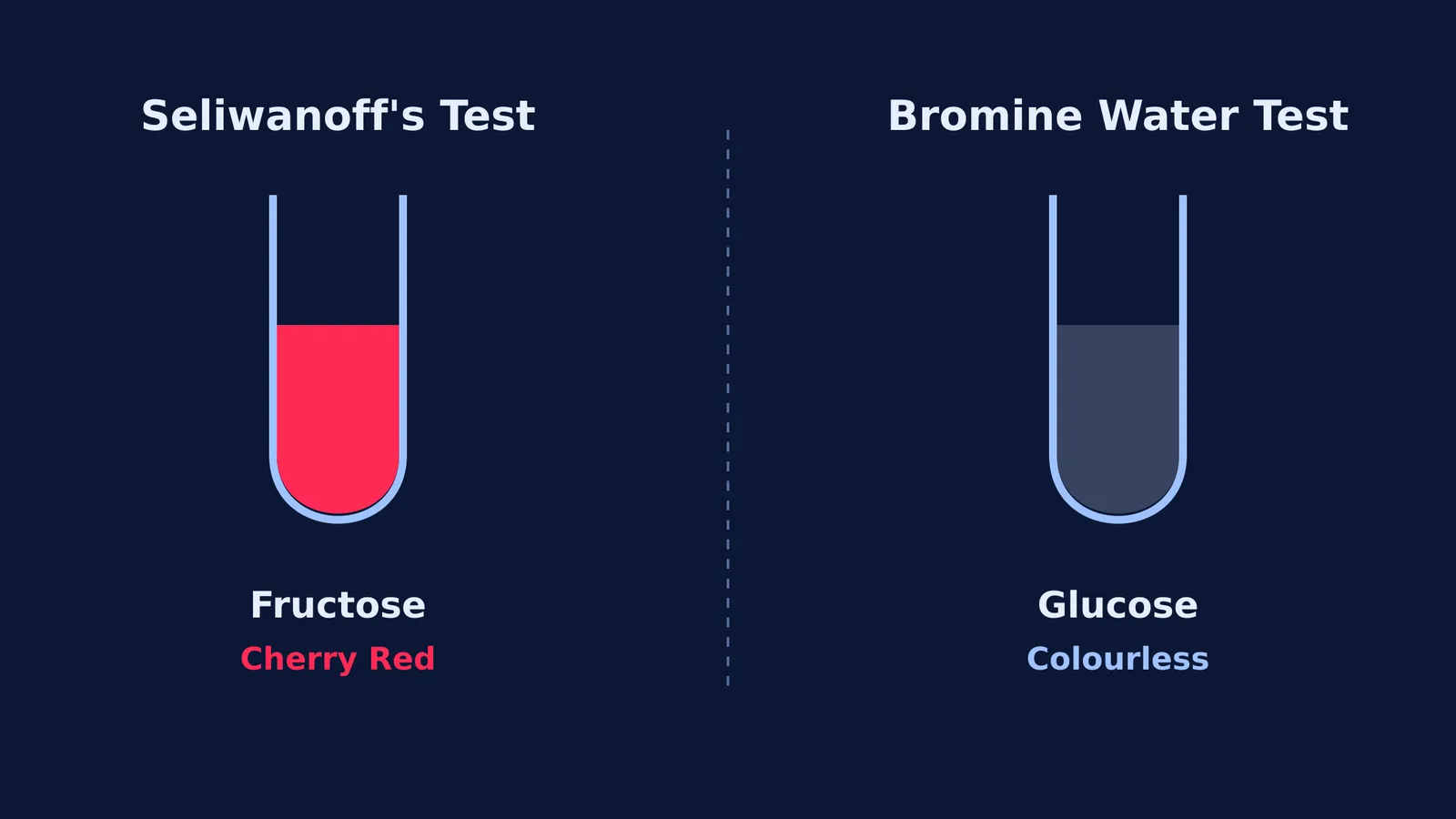
The key to the test is that ketoses like fructose undergo dehydration much more rapidly than aldoses. The fructose molecule loses three molecules of water to form an intermediate compound called hydroxymethylfurfural (HMF). The formyl group of this HMF then rapidly condenses with two equivalents of the resorcinol present in the reagent to form a deep, cherry-red complex. With fructose, this bright red colour appears very quickly, typically within one minute of heating.
Aldoses like glucose react incredibly slowly in comparison. If you boil a glucose solution with Seliwanoff's reagent for an extended period, it may eventually produce a faint pink or yellow colour, but it will never give the rapid cherry-red result. The speed and intensity of the colour change make it exceptionally easy to identify the ketose.
How does bromine water distinguish aldoses?
Bromine water is an intense brown or yellow aqueous solution containing diatomic bromine (Br₂). In organic chemistry, it serves as a mild but effective oxidising agent.
Because aldehydes are much easier to oxidise than ketones, bromine water will selectively oxidise the aldehyde group of glucose. During this reaction, the glucose is oxidised to gluconic acid, which is a six-carbon chain ending in a carboxylic acid group. As the bromine molecules are consumed to facilitate this oxidation, the characteristic yellow-brown colour of the bromine water fades entirely, leaving behind a colourless solution.
Fructose, being a ketone, cannot be oxidised by a mild reagent like bromine water. When you add bromine water to a fructose solution, absolutely no chemical reaction occurs, and the solution retains its yellow-brown hue.
A step-by-step testing plan
When you are provided with two unknown solutions in the laboratory and told one is glucose and the other is fructose, follow this exact sequence:
Check for reducing sugars: Add a few drops of Benedict's reagent to both test tubes and warm them in a water bath. If both solutions turn brick red, you have confirmed that both are indeed reducing sugars.
Apply the bromine water test: Take fresh samples of both unknown solutions in clean test tubes. Add bromine water drop by drop. The solution that actively turns the yellow bromine water colourless is glucose. The solution that stays yellow is fructose.
Confirm with Seliwanoff's test: Take fresh samples once again. Add Seliwanoff's reagent and heat the tubes in a boiling water bath. The solution that rapidly turns a deep cherry red is fructose. The solution that remains clear or slowly turns a faint pink is glucose.
For a deeper look into the chemistry of functional groups, the Fermi Concept Library explains how molecular structures dictate reactivity. You can also explore the mechanism behind the Schiff's reagent test for aldehydes and the history of Stanley Benedict's reagent to understand how other common qualitative tests operate in the laboratory.


