

On this page
Before 1909, detecting sugar in a patient's urine required boiling the sample with a harsh, unstable chemical mixture. That year, an American chemist named Stanley Benedict found a gentler alternative. His single-bottle formula simplified diabetes diagnosis and remains a staple of school biology labs today.
Who was Stanley Benedict?
Stanley Rossiter Benedict was a researcher in the early 20th-century American biochemistry movement. He spent the majority of his career at Cornell University Medical College in New York.
Beyond his laboratory discoveries, Benedict shaped the broader scientific community by serving as the managing editor of the Journal of Biological Chemistry. While his wider research focused on the chemistry of human metabolism and the composition of blood and urine, it was his 1909 formulation for sugar detection that secured his place in chemical history.
What was the problem with Fehling's solution?
In the early 1900s, doctors and chemists relied on Fehling's solution to test for glycosuria (sugar in the urine). The test worked, but it was temperamental and difficult to use in a fast-paced clinical setting. Because the chemicals deteriorated quickly when combined, clinicians had to store two separate solutions—a copper sulfate solution and an alkaline tartrate solution—and mix them immediately before testing.
More importantly, Fehling's solution was corrosive. It used sodium hydroxide (caustic soda), a strong alkali that could destroy small quantities of sugar before they could be properly measured. This extreme alkalinity also provoked unintended reactions with other naturally occurring waste compounds like uric acid and creatinine, frequently causing misleading false positive results.
How did Stanley Benedict change the formula?
Benedict set out to create a reagent that was both stable and sensitive to minute amounts of glucose. In 1909, he published his recipe in a paper titled "A Reagent for the Detection of Reducing Sugars" in the Journal of Biological Chemistry91645-5).
His formulation relied on two vital chemical swaps. First, he replaced the harsh sodium hydroxide with sodium carbonate. This much milder base prevented the destruction of the sugar molecules while still providing the necessary alkaline environment for the reaction. Second, he substituted sodium citrate in place of tartrate (Rochelle salt). The citrate effectively complexes with the copper ions, keeping them dissolved in the liquid without degrading.
According to his 1909 paper, the qualitative reagent uses 17.3 grams of copper sulfate, 173.0 grams of sodium citrate, and 100.0 grams of anhydrous sodium carbonate per liter according to his paper91645-5). These calculated changes yielded a single, stable solution that could sit on a laboratory shelf for months—or even years—without losing its potency.
If you are revising chemical tests for your biology practicals and find the reaction mechanisms confusing, the Fermi Concept Library contains every concept in physics, chemistry, biology, mathematics and computing, each with its own lesson and its place in the map.
How does Benedict's reagent work?
The test identifies reducing sugars—carbohydrates that contain a free aldehyde or ketone group—such as glucose, fructose, and galactose, through a straightforward redox (reduction-oxidation) reaction. Benedict's solution is naturally bright blue because it is rich in dissolved copper(II) ions (Cu²⁺). Non-reducing sugars, such as sucrose (table sugar), lack this free reactive group and will not trigger the colour change unless they are first broken down into simpler sugars using an acid.
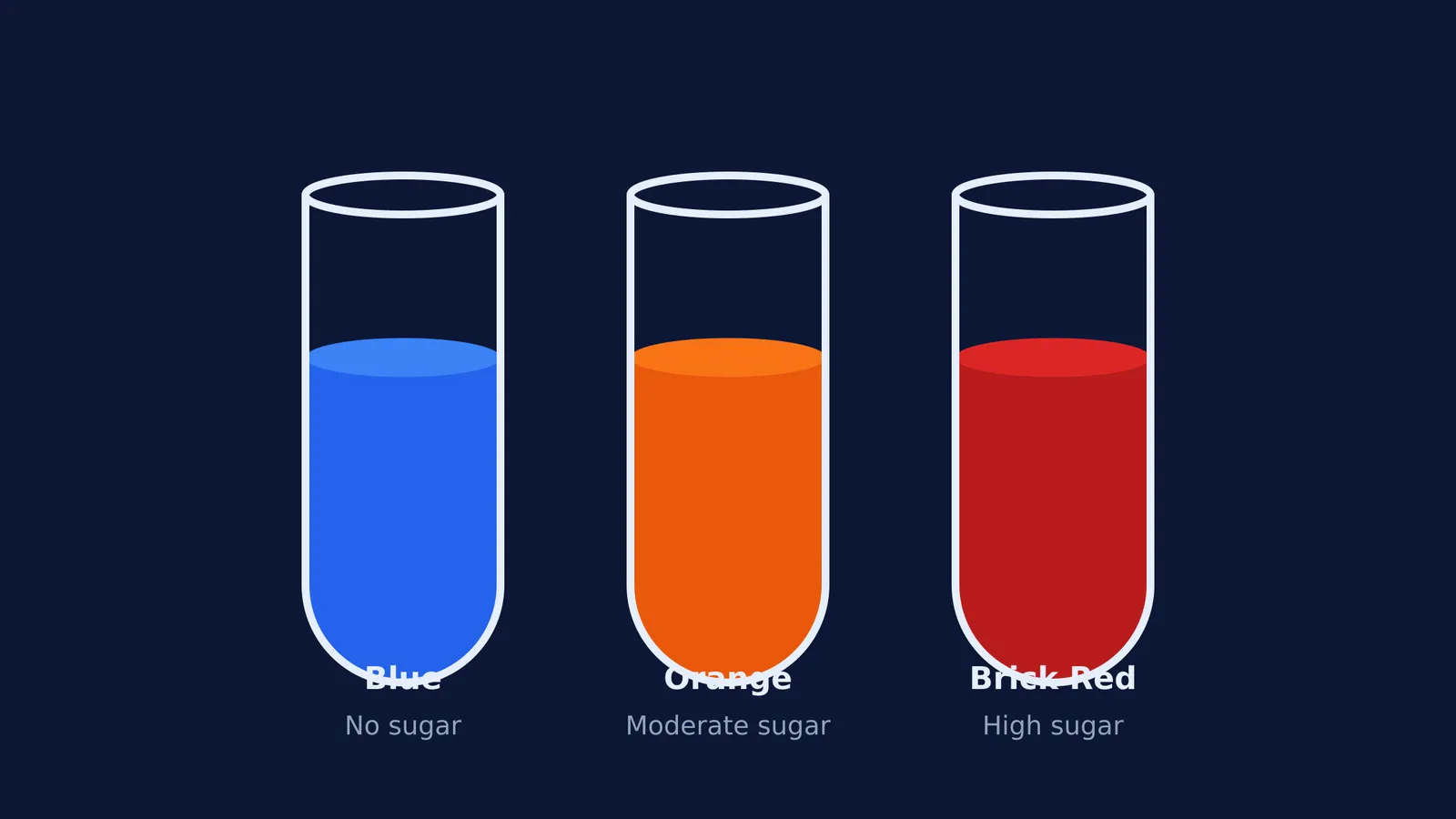
When you heat the blue reagent in a boiling water bath alongside a reducing sugar, the sugar acts as a chemical reducing agent. It forces the copper(II) ions to accept electrons and become copper(I) ions (Cu⁺), while the sugar itself is oxidized into a carboxylic acid. These newly formed copper(I) ions rapidly precipitate out of the liquid as copper(I) oxide (Cu₂O), which forms an insoluble, brick-red solid at the bottom of the test tube.
For decades, this reliable colour change gave doctors a quick, visual way to estimate a patient's glucose levels and manage their diabetes. By simply matching the test tube's final colour to a standardized chart, clinicians could determine if a patient's condition was stabilizing or worsening.
While modern medical clinics now rely on digital electronic glucose meters and enzymatic test strips for instant results, Benedict's 1909 formula remains one of the most widely taught chemical tests in science education worldwide. It stands as a clear example of how targeted chemical substitutions can solve practical problems in medicine.


