

On this page
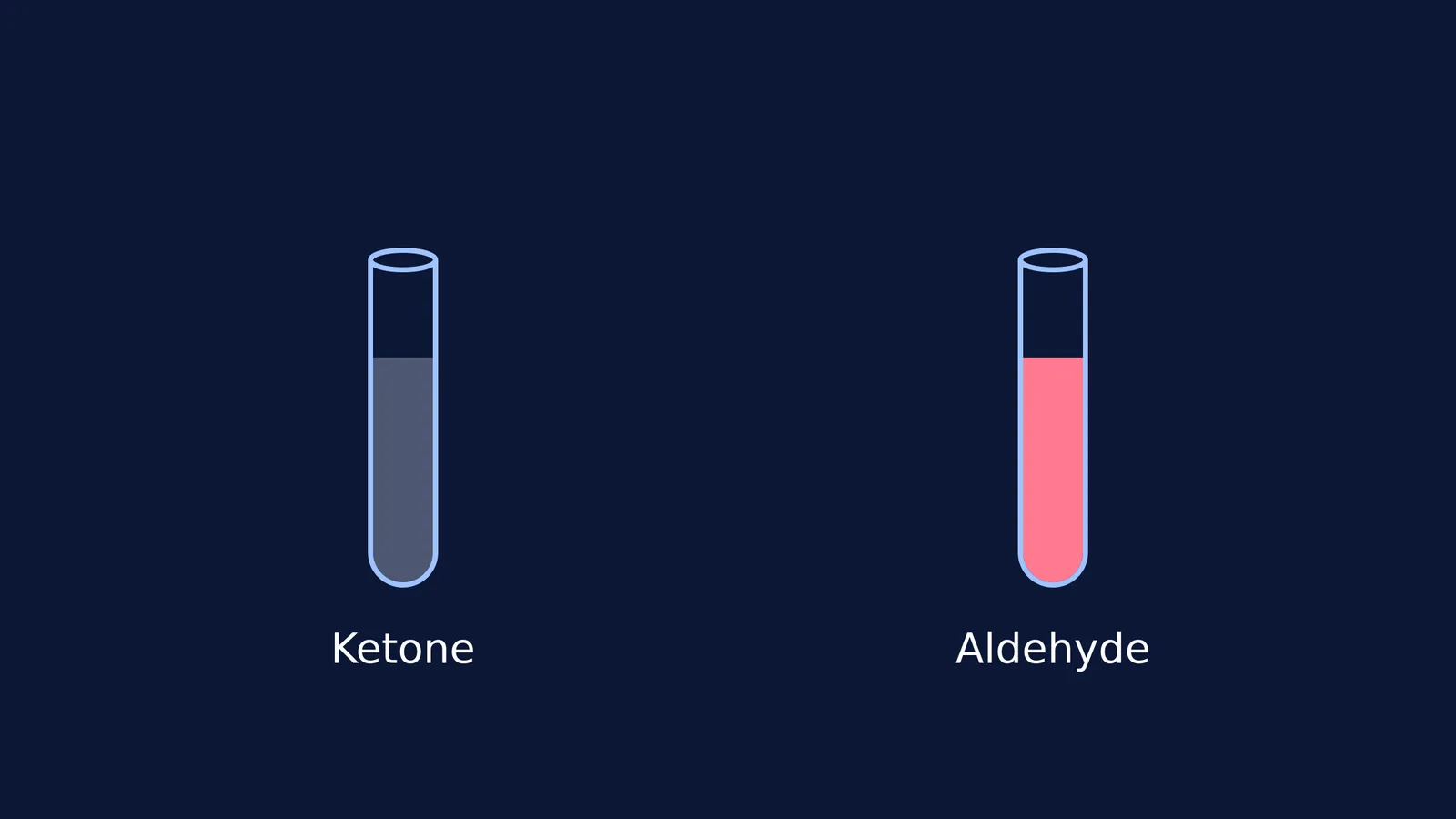
Telling aldehydes and ketones apart is a classic laboratory task for chemistry students. Both families of compounds feature a carbonyl group—a carbon atom double-bonded to an oxygen atom—but aldehydes are inherently more reactive. While there are several ways to spot an aldehyde, the Schiff's reagent test for aldehydes is one of the most striking because of its vivid pink colour change.
What is Schiff's reagent?
To perform the Schiff's reagent test for aldehydes, you first need to prepare the reagent itself. The starting material is a magenta dye called p-rosaniline hydrochloride, which is also commonly known as Basic Fuchsin (Source).
In its natural state, this dye has an extensive network of alternating single and double bonds. This arrangement is known as π-conjugation, and it is what allows the molecule to absorb certain wavelengths of light and reflect a deep magenta colour.
To make Schiff's reagent, chemists pass sulfur dioxide (SO₂) gas through an aqueous solution of the dye, or add sodium bisulphite. The bisulphite ions attack the central carbon atom of the dye molecule, attaching a sulphonic acid group. This chemical addition breaks the continuous π-conjugation. Without that extended network of double bonds, the molecule can no longer absorb visible light in the same way. The result is a completely colourless liquid: this is the active Schiff's reagent.
Why does the Schiff's reagent test for aldehydes give a pink colour?
When you add an aldehyde to this colourless reagent, the solution quickly turns magenta or pink. For decades, chemists debated exactly what the new pink molecule was and how it formed.
In 1980, researchers used nuclear magnetic resonance (NMR) spectroscopy to finally pin down the structure (Source). They proved that the aldehyde molecules attach to the uncharged amine groups on the dye to form an α-anilinoalkylsulfonic acid adduct.
This complex reaction forces the central carbon of the dye to shed its attached sulphonic acid group. When that group leaves, the central carbon regains its double bond, which instantly restores the extended π-conjugation across the entire molecule. With the double bonds linked up again, the complex absorbs light once more, and the intense pink colour returns.
Why do ketones fail the test?
If you add a ketone to Schiff's reagent, the liquid stays colourless. Ketones also contain a carbonyl group, but they behave differently for two main reasons. First, ketones are less electrophilic than aldehydes, meaning they are less driven to react with the dye's amine groups. Second, ketones have two bulky alkyl groups attached to the carbonyl carbon (steric hindrance), which stops them from physically fitting into the adduct required to restore the dye's conjugation.
If you find chemical tests hard to memorise, the Fermi Concept Library breaks down organic mechanisms step by step. When you can visualise how the electrons move, you understand why reactions happen rather than just rote-learning the colours. You can also explore Tollens' and Fehling's tests: which carbonyl compounds pass them to compare how other reagents target the carbonyl group.
What about glucose?
There is one famous exception that frequently appears in board exams. Glucose is an aldohexose, meaning its open-chain chemical formula clearly contains an aldehyde group. However, glucose gives a negative result with Schiff's reagent.
This happens because glucose in solution exists almost entirely in a stable cyclic hemiacetal form. The ring structure ties up the aldehyde group, leaving virtually no "free" aldehyde available to react with the dye. There is not enough free aldehyde present to push the reaction forward and create the pink adduct.
How do you interpret your lab results?
When performing tests for organic functional groups in the chemistry practical, always run the Schiff's test at room temperature. Heating the test tube is a common mistake; it can drive off the dissolved SO₂ gas. Without the SO₂, the original dye reforms on its own, giving you a false positive pink colour even if no aldehyde is present.
Here is a checklist for interpreting your observations:
Immediate pink colour: An aliphatic aldehyde is present.
Slow pink colour: An aromatic aldehyde (such as benzaldehyde) is present, as the bulky aromatic ring slows the reaction down.
Stays colourless: A ketone, or a cyclic sugar like glucose, is present.
If you are preparing for your practical exams, you can ask Fermi's AI tutor to run through mock viva questions with you. It works out what you already know and builds a plan for the session, catching gaps in your understanding before the examiner does.


