

On this page
Fructose is one of the most common simple sugars, sharing the same molecular formula (C₆H₁₂O₆) as glucose. However, their structural differences completely change how they react and form rings. While glucose forms a six-membered pyranose ring, fructose typically forms a five-membered furanose ring when it builds disaccharides like sucrose.
What makes fructose a ketohexose?
Carbohydrates are classified by their carbonyl group and the number of carbon atoms. Glucose is an aldohexose because it has an aldehyde group at the first carbon (C-1). Fructose, on the other hand, is a ketohexose. Its carbonyl group is a ketone located at the second carbon (C-2) Wikipedia. Both have six carbons, making them isomers, but the position of the double-bonded oxygen dictates how the chain folds into a ring.
What is the open-chain structure of fructose?
In its straight-chain form, fructose consists of a six-carbon backbone with five hydroxyl (–OH) groups and one ketone group. It belongs to the D-series because the configuration of its highest-numbered chiral centre (C-5) matches that of D-glyceraldehyde and D-glucose. It is naturally laevorotatory, meaning it rotates plane-polarised light to the left, which is why it is properly written as D-(–)-fructose Wikipedia.
If you need a refresher on how to represent molecular bonds at a fundamental level before tackling long carbon chains, our review of electron dot structures of covalent molecules in Class 10 is a good place to start. For more complex structures, learning how to draw them from their IUPAC names or Fischer projections takes practice. The Fermi Concept Library holds interactive lessons on every biomolecule, where the AI tutor works through problems alongside the student.
How does the furanose ring form?
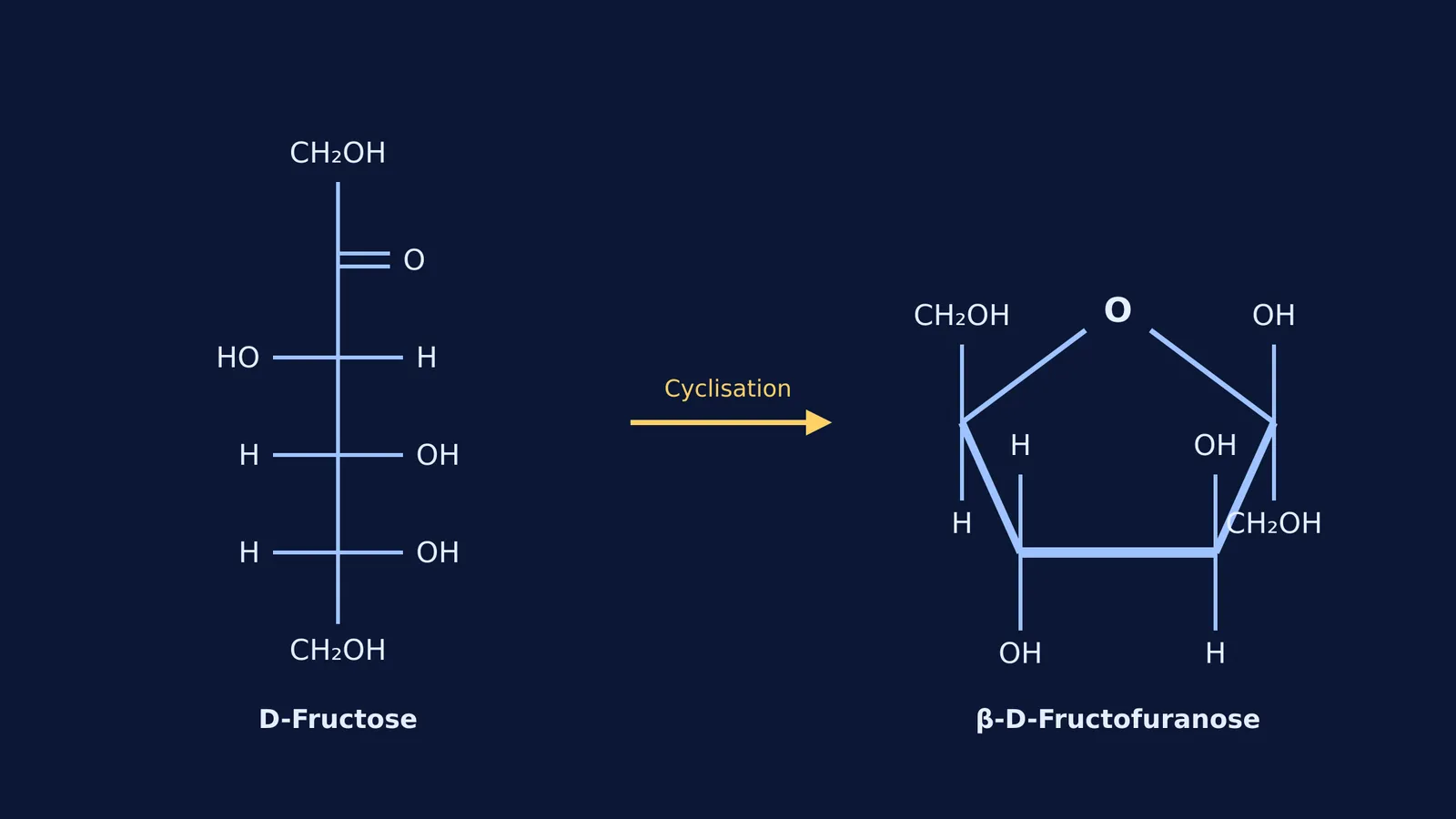
Fructose rarely stays as a straight chain in nature. Instead, it undergoes an intramolecular reaction where the hydroxyl group at C-5 attacks the ketone group at C-2 to form a hemiketal Wikipedia.
This cyclisation creates a five-membered ring containing four carbon atoms and one oxygen atom. Because this shape resembles the cyclic ether furan, it is called a furanose ring Wikipedia. While fructose can also form a six-membered pyranose ring in free solution, the furanose form is the one found in sucrose. This specific linkage is also the reason why sucrose behaves differently in chemical tests; to see how this works, read our guide on reducing and non-reducing sugars: why sucrose fails Tollens' test.
What happens to fructose in solution?
When crystalline fructose dissolves in water, it undergoes a process called mutarotation. The ring opens into the straight-chain form and closes again, continuously interconverting between different cyclic structures until the solution reaches an equilibrium.
In an aqueous solution, the six-membered pyranose form dominates. About 70% of the fructose molecules exist as β-D-fructopyranose, while only about 22% take the β-D-fructofuranose form. The alpha anomers and the open-chain form make up the small remaining percentage Wikipedia.
Interestingly, the shape of the ring affects how the sugar tastes. The pyranose form is significantly sweeter than the furanose form. When a fructose solution is heated, the equilibrium shifts towards the furanose form, which is why warm fructose solutions taste less sweet than cold ones Wikipedia.
What are the alpha and beta anomers of fructose?
When the straight chain closes into a ring, the C-2 carbon becomes a new chiral centre, known as the anomeric carbon. This gives rise to two stereoisomers, or anomers, depending on which way the newly formed –OH group points:
α-D-(–)-fructofuranose: In the standard Haworth projection, the –OH group at C-2 points down, on the opposite side of the ring from the –CH₂OH group at C-5.
β-D-(–)-fructofuranose: The –OH group at C-2 points up, on the same side as the –CH₂OH group.
If you keep getting the Haworth projections of alpha and beta anomers wrong, the Fermi Problem Library has worked problems with a step-by-step solver that explains the reasoning rather than printing an answer. It helps you see how the left- and right-pointing groups in the Fischer projection translate directly to the up- and down-pointing groups in the cyclic ring.


