

On this page
Older tube lights with a magnetic ballast have a heavy little box wired in series with the tube: the choke. Its job is to stop the current through the tube from running away. A resistor could also limit current. So why use a coil instead, and why does it matter in Class 12 physics? The answer is the power factor.
What is wattless current?
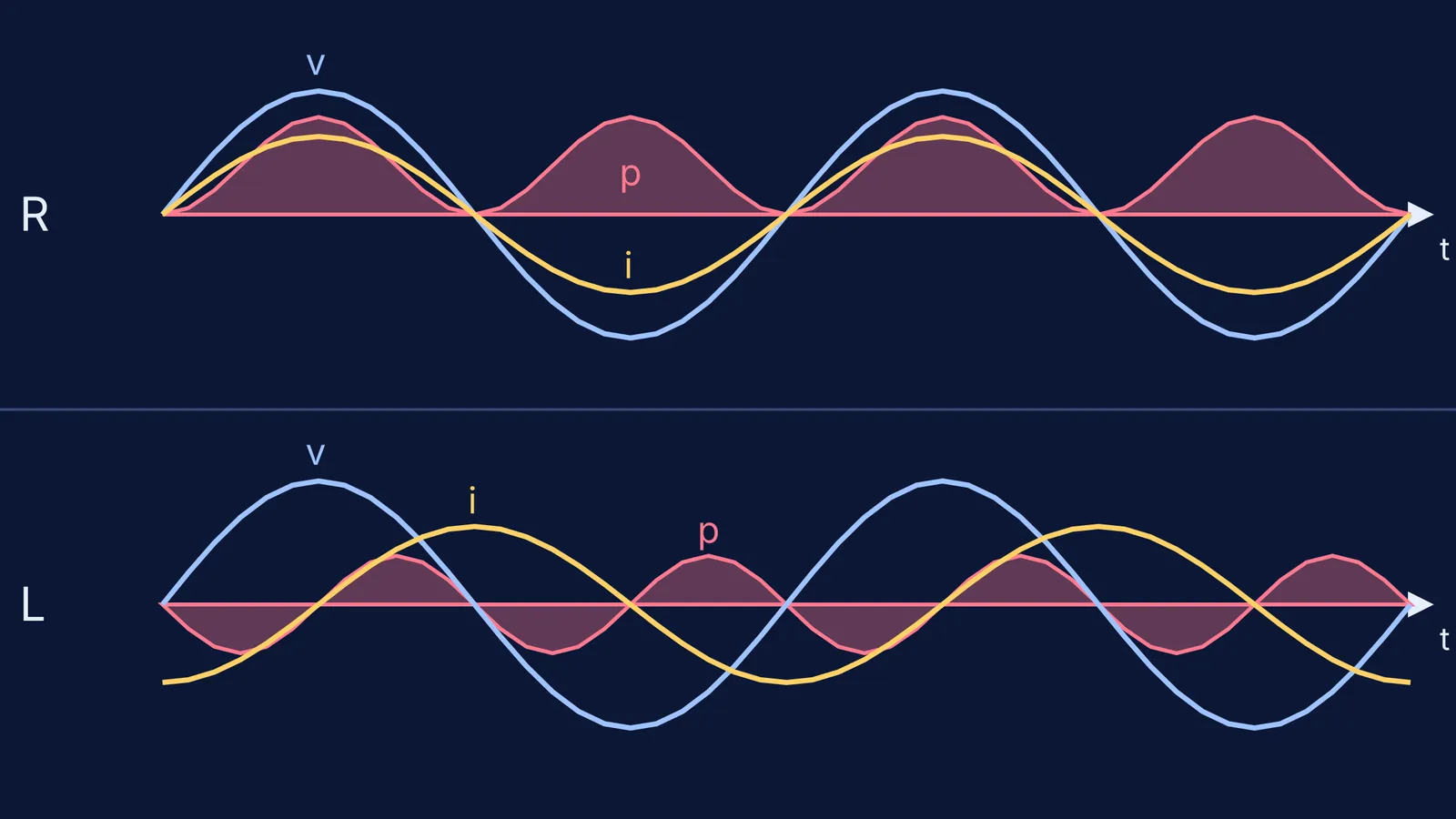
In an AC circuit, the average power is P = V I cos φ, where V and I are rms values, φ is the phase difference between them, and cos φ is called the power factor (NCERT Class 12 Physics, Section 7.7).
For a circuit with only an inductor, the phase difference is π/2, so cos φ = 0 and no power is dissipated even though a current flows; NCERT says this is sometimes called wattless current (NCERT, Section 7.7, Case ii).
The picture behind it: for a quarter cycle the inductor stores energy in its magnetic field, and for the next quarter cycle it gives it back. A resistor never gives energy back. Its current is in phase with the voltage, so cos φ = 1 and every joule becomes heat. If rms values need a refresher, start with RMS values and power in AC circuits.
Why is the power factor of a choke coil nearly zero?
A real choke is usually many turns of copper wire on a soft-iron core, so it has a large inductive reactance X_L = 2πνL and a small winding resistance r. Its power factor is cos φ = r/Z (NCERT, Example 7.7), where Z = √(r² + X_L²). Because X_L is much larger than r, cos φ is close to zero. The energy it does lose is the I²r heat in the copper, plus a little in the core.
The article on electrical ballasts agrees: in fluorescent lamp chokes, the reactance limits the power to the lamp with only minimal losses in the inductor.
How much energy does a resistor waste compared with a choke?
The supply below matches the examples in the NCERT alternating current chapter (220 V, 50 Hz); the tube values are assumed round numbers, not data for a particular lamp.
Assume the lit tube needs 110 V and draws 0.4 A, so it uses 110 × 0.4 = 44 W.
Option 1: a series resistor. Resistor and tube voltages are in phase and simply add, so the resistor must drop the other 110 V. Its resistance is 110/0.4 = 275 Ω, and it wastes 110 × 0.4 = 44 W as heat.
Option 2: a choke. The choke's voltage leads the current by π/2 while the tube's is in phase with it, so they add like perpendicular vectors, as in NCERT's Example 7.6. The choke voltage is √(220² − 110²) ≈ 190.5 V, so X_L = 190.5/0.4 ≈ 476 Ω and L = X_L/(2π × 50) ≈ 1.52 H. An ideal choke wastes nothing. With an assumed winding resistance of 20 Ω, its loss is 0.4² × 20 = 3.2 W, and its own power factor is 20/476.7 ≈ 0.04.
Over a year, at 10 hours a day:
Resistor: 44 W × 10 h × 365 = about 161 kWh wasted
Choke: 3.2 W × 10 h × 365 = about 12 kWh wasted
One catch: with an ideal choke, the whole circuit's power factor is 110/220 = 0.5, because only the tube dissipates power. NCERT's Example 7.7 explains that a low power factor means more current for the same power, and that a suitable capacitor in parallel cancels the lagging wattless component. For the phasor method, see our guide to AC circuits, phasors and impedance.
Why does a tube light need a current limiter at all?
Once the arc in a gas discharge strikes, its voltage falls as the current rises, so without something in series the current would climb to a destructive level, as the ballast article explains. In some circuits the choke has a second job: when the current through it is cut suddenly, as when a tube light's starter opens, the voltage spike helps strike the arc. A resistor stores no energy, so it cannot do that.
How to answer the choke coil question in an exam
Use this checklist for a short written answer:
State P = V I cos φ and name cos φ as the power factor.
Say that for an inductor φ is nearly π/2, so cos φ is nearly zero.
Conclude that the average power lost in the choke is very small.
Contrast with a resistor: cos φ = 1, loss I²R.
If marks allow, add the starting spike from L dI/dt.
If phase still feels slippery, the Fermi Concept Library gives each concept, from reactance to power factor, its own lesson and its place in the map. To practise, the Fermi Problem Library has worked problems with a step-by-step solver that explains the reasoning rather than printing an answer. Then try resonance, where cos φ = 1, in LCR resonance and quality factor.


