

On this page
Why import coal to make electricity when the wind blows across Denmark for free? Poul la Cour, a village science teacher, answered that in the 1890s with a windmill, a hydrogen tank and two home-built wind tunnels.
Who was Poul la Cour?
Poul la Cour (1846-1908) was an inventor, deputy manager of the Danish Meteorological Institute from 1872 to 1877 and later a science teacher at Askov Folk High School, says the Carlsberg Foundation, whose first grant funded his telegraphy work.
A Poul la Cour Museum paper by Povl-Otto Nissen tells how the wind work began. La Cour won state support of 4,000 kroner for wind research, and his first electricity-producing windmill was working at Askov by May 1891.
How did Poul la Cour use wind power to make hydrogen?
The wind does not always blow, and batteries were too expensive, says the museum paper. His answer was electrolysis: the windmill's current splits water into hydrogen and oxygen, which can be burned later. It is the reaction you meet in a school lab, where hydrogen comes off at twice the volume of oxygen.
The museum paper says the gases travelled through 300 metres of lead pipe to special lamps in the school buildings. It ran from 1895 to 1902, with a 12 cubic metre hydrogen tank, according to Wikipedia's biography of la Cour.
It was risky: an explosion once blew out a number of windows, and la Cour then chose batteries instead (Carlsberg Foundation).
What did his wind tunnel show about windmill blades?
In 1896 millwright Chr. Sørensen asked la Cour to test his twelve-sailed rotor (Poul la Cour Museum). It worked better with some sails removed, a surprise: millwrights and the accepted formula said more sail area meant more power.
He went on to build two wind tunnels of his own. Both were 2.20 metres long; one was 1 metre across and the other 0.50 metres (Poul la Cour Museum). The same paper says his Kratostat, a regulator he invented in 1902, held the air flow steady to within about one part in a thousand.
What he found:
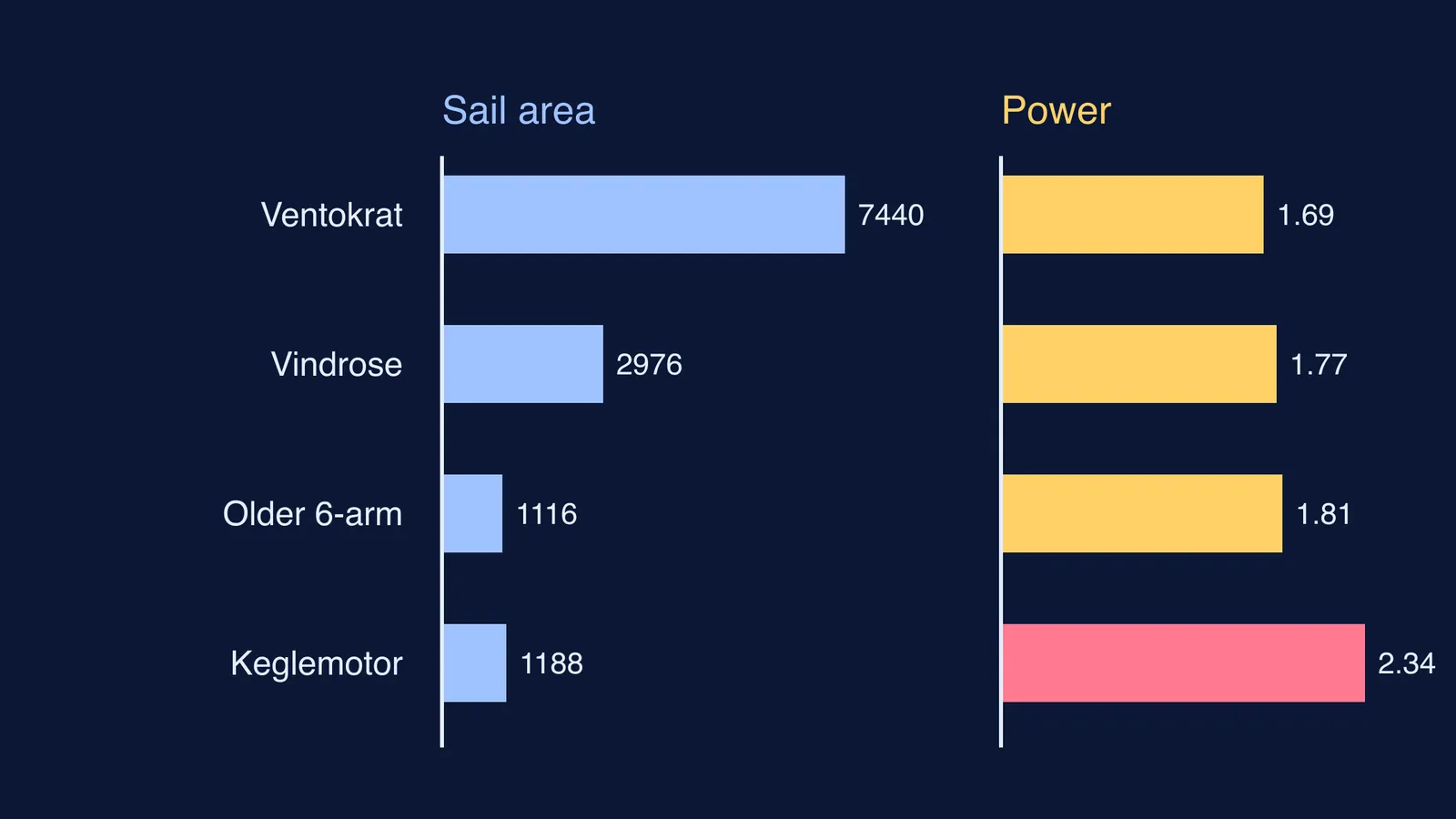
Total sail area was the wrong thing to maximise. Air flowing through the gaps between sails also pushed the rotor round.
Air passing a tilted sail leaves low pressure behind it. That is the force we now call lift, and the museum paper says he found it on mill sails 5-6 years before the Wright brothers flew.
His "ideal" mill had 4 narrow sails, set at 10 degrees near the tip and twisting steeper towards the hub.
The sail tips should move at about 2.4 times the wind speed, an idea now called the tip-speed ratio.
He published first results in the Danish journal Ingeniøren in March 1897 and the full report, Forsøgsmøllen, in 1900 (Poul la Cour Museum).
Worked example: how much power did la Cour's ideal mill make?
La Cour gave a rule of thumb: about 60 gram-metres per second of work per square metre of sail at a wind speed of 1 m/s, growing with the cube of the wind speed (Poul la Cour Museum). His own example was 4 sails, each 8 m long and 2 m wide, in a 6 m/s wind.
Sail surface: it starts a quarter of the way out, so each sail is 6 m x 2 m. Four give 48 square metres.
Work rate: 60 x 48 x 6³ = 622,080 gram-metres per second, about 622 kilogram-metres per second. La Cour's figure is 8.3 horsepower.
In SI units: 622 kg x 9.81 m/s² x 1 m/s is about 6,100 W, or 6.1 kW.
Wind power available: the rotor sweeps a circle of radius 8 m, about 201 square metres. With air at about 1.2 kg per cubic metre (Engineering ToolBox), P = ½ x density x area x v³ = 0.5 x 1.2 x 201 x 216, about 26 kW.
Efficiency: 6.1 divided by 26 is about 23%. Betz's law, published in 1919, shows no rotor can capture more than 16/27, or 59.3%, of the wind's kinetic energy.
At 5 m/s, a wind la Cour said was also common, power falls to (5/6)³, about 58%, of 6.1 kW: roughly 3.5 kW. For more practice, the Fermi Problem Library has worked problems with a step-by-step solver that explains the reasoning rather than printing an answer.
Why does Poul la Cour matter to Danish wind turbines today?
From 1904 until 1916, Askov ran a yearly course for country electricians (Poul la Cour Museum), about 20 a year according to Wikipedia. One student in that first class, 17-year-old Johannes Juul, went on to build the three-bladed Gedser turbine in the 1950s, which the museum paper calls the "mother" of today's turbines.
Wind power supplied 43.6% of Denmark's net electricity use in 2021, according to the Danish Energy Agency. Compare Charles Brush's 1888 wind turbine that lit a house, or see how wind turbines make electricity from moving air.
If lift is hard to picture, the Fermi Simulation Lab has interactive simulations for ideas that are easier to see than to read.


