On this page
In 1888, the Cleveland inventor Charles F. Brush, already known for electric arc lighting, powered his mansion with the wind (Wikipedia: Charles F. Brush). He built a giant windmill in his grounds, connected it to a dynamo and stored the electricity in basement batteries.
The best record of the machine is an article in Scientific American of 20 December 1890, titled "Mr. Brush's Windmill Dynamo" (full scan of the issue, Internet Archive). Every number below comes from that article unless another link is given.
What did Charles Brush build in 1888?
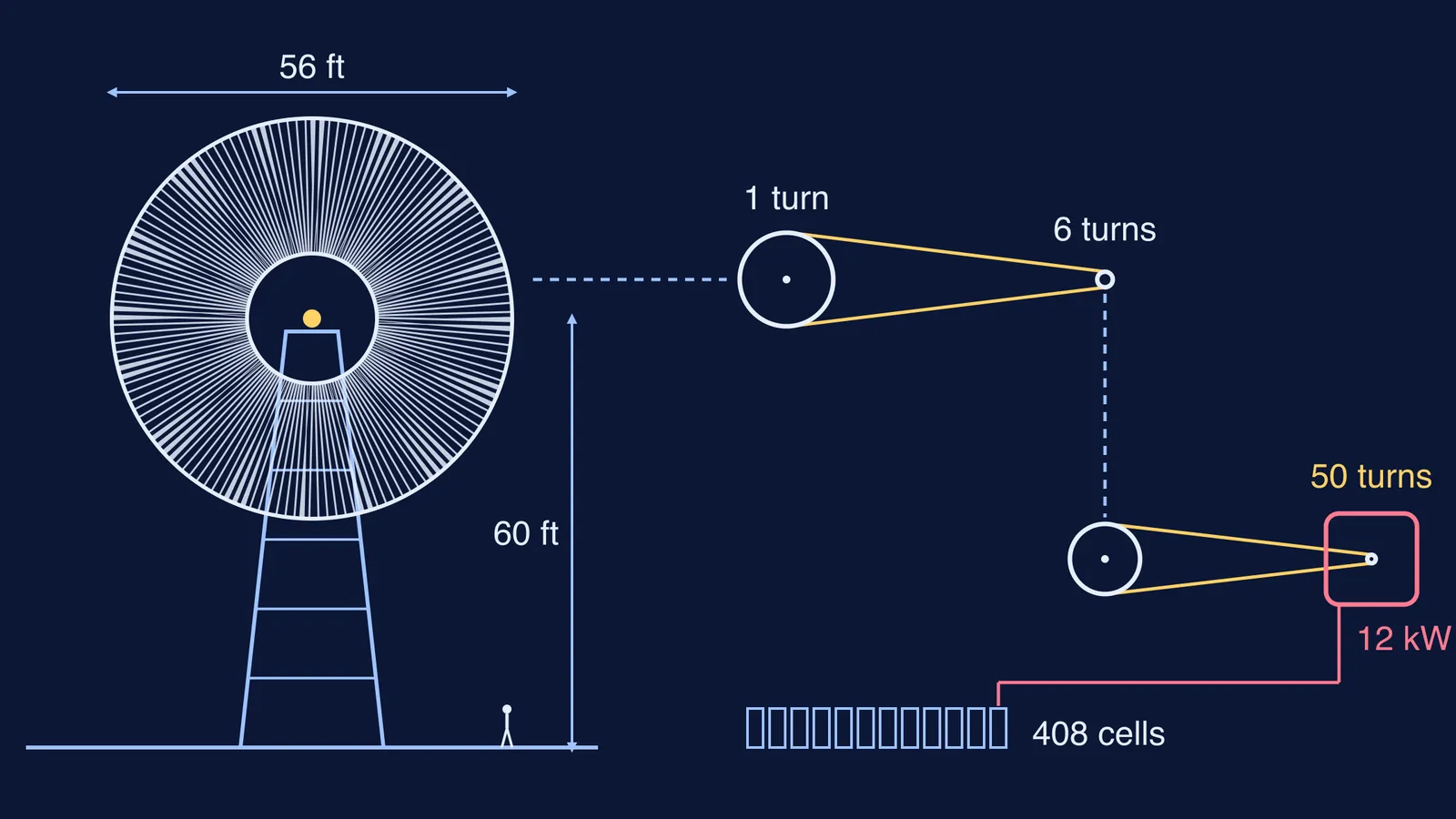
The wheel was 56 feet (about 17 metres) across and carried 144 blades "twisted like those of screw propellers" (Scientific American, 1890). The sail surface of the wheel was about 1,800 square feet.
It sat on a tower about 60 feet high and weighing 80,000 pounds, which turned on a wrought-iron pin set in masonry, so a 60-foot tail could steer the wheel into the wind. Apart from Brush's plant, the editors wrote, "we do not know of a successful system of electric lighting operated by means of wind power."
How did Brush's wind turbine make electricity?
A big wheel turns slowly, but a dynamo needs to spin fast. Brush solved this with belts and pulleys (Scientific American, 1890):
An 8-foot pulley on the wheel's shaft drove a 16-inch pulley on a countershaft below it. That alone multiplies the speed by 6 (96 inches divided by 16).
Two 6-foot pulleys on the countershaft then belted the dynamo.
Overall, "the dynamo makes fifty revolutions to one of the wheel."
At full load the dynamo ran at 500 revolutions per minute and its normal capacity was 12,000 watts.
The plant ran itself: switches put the dynamo into action at 330 revolutions a minute, a regulator stopped it going above 90 volts, and a side vane turned the wheel edgewise to the wind in a heavy gale.
Worked example: how fast did the wheel turn? Use the 50-to-1 ratio from the article.
Full load: 500 ÷ 50 = 10 turns of the wheel per minute, or one turn every 6 seconds.
Cut-in: 330 ÷ 50 = 6.6 turns per minute, about one turn every 9 seconds.
Speed multiplied, turning force divided, as in any pulley problem.
Why did Brush's windmill need batteries?
Wind comes and goes; a house wants light every evening. His basement held 408 battery cells, arranged as 12 batteries of 34 cells each, charged and discharged in parallel, and each cell had a capacity of 100 ampere-hours (Scientific American, 1890).
The house had 350 incandescent lamps, of which about 100 were in everyday use, plus two arc lamps and three electric motors.
Worked example: how much energy could the batteries hold? Cells in series add voltage but keep the same ampere-hours. So each 34-cell battery held 100 Ah, and 12 batteries in parallel held 12 × 100 = 1,200 Ah.
The article says the working circuit closed automatically at 75 volts and opened at 70 volts. Taking 70 volts as a rough figure gives 1,200 Ah × 70 V = 84,000 watt-hours, or about 84 kWh on paper. That is 84 "units" on an electricity bill (see how to calculate an electricity bill in kWh). Real batteries cannot be fully drained, so the usable amount was less. At the dynamo's full 12 kW, refilling that much would take about 7 hours of strong wind.
Was the Brush wind turbine a success?
Technically, yes. By December 1890 it had been "in constant operation more than two years," and the attention it needed was "practically nothing" (Scientific American, 1890).
Cheap, it was not. The same article warns that the cost of the plant was so great as to "more than offset the cheapness of the motive power." John Lienhard's radio series on the history of technology notes that Brush stopped using it in 1908, once the city of Cleveland was selling cheap electricity (Engines of Our Ingenuity, episode 552). For context on what a central supply looked like, read about Thomas Edison's Pearl Street Station of 1882.
What can a student learn from Brush's windmill?
Brush's machine is one long energy chain. Try this four-step trace on any device (Brush's figures from Scientific American, 1890):
Source: where does the energy come from? (Wind's kinetic energy.)
Converter: what changes its form? (Blades turn it into rotation; the dynamo turns rotation into electrical energy by induction.)
Matcher: what fixes the speed or voltage? (Pulleys giving 50 to 1; the regulator capping 90 volts.)
Store and use: where does it wait, and what finally uses it? (408 cells; lamps and motors.)
The physics in step 2 goes back to Faraday's discovery of electromagnetic induction in 1831. If a spinning coil making a current is hard to picture, the Fermi Simulation Lab has interactive simulations for ideas that are easier to see than to read. To practise ratio and energy numericals like the two above, the Fermi Problem Library has worked problems with a step-by-step solver that explains the reasoning.