

On this page
In 1820, Hans Christian Ørsted demonstrated that an electric current creates a magnetic field. For years, scientists across Europe tried to reverse the process: they wanted to create an electric current from a magnetic field. Electricity at the time could only be generated by chemical batteries, which were expensive and provided limited power 1.
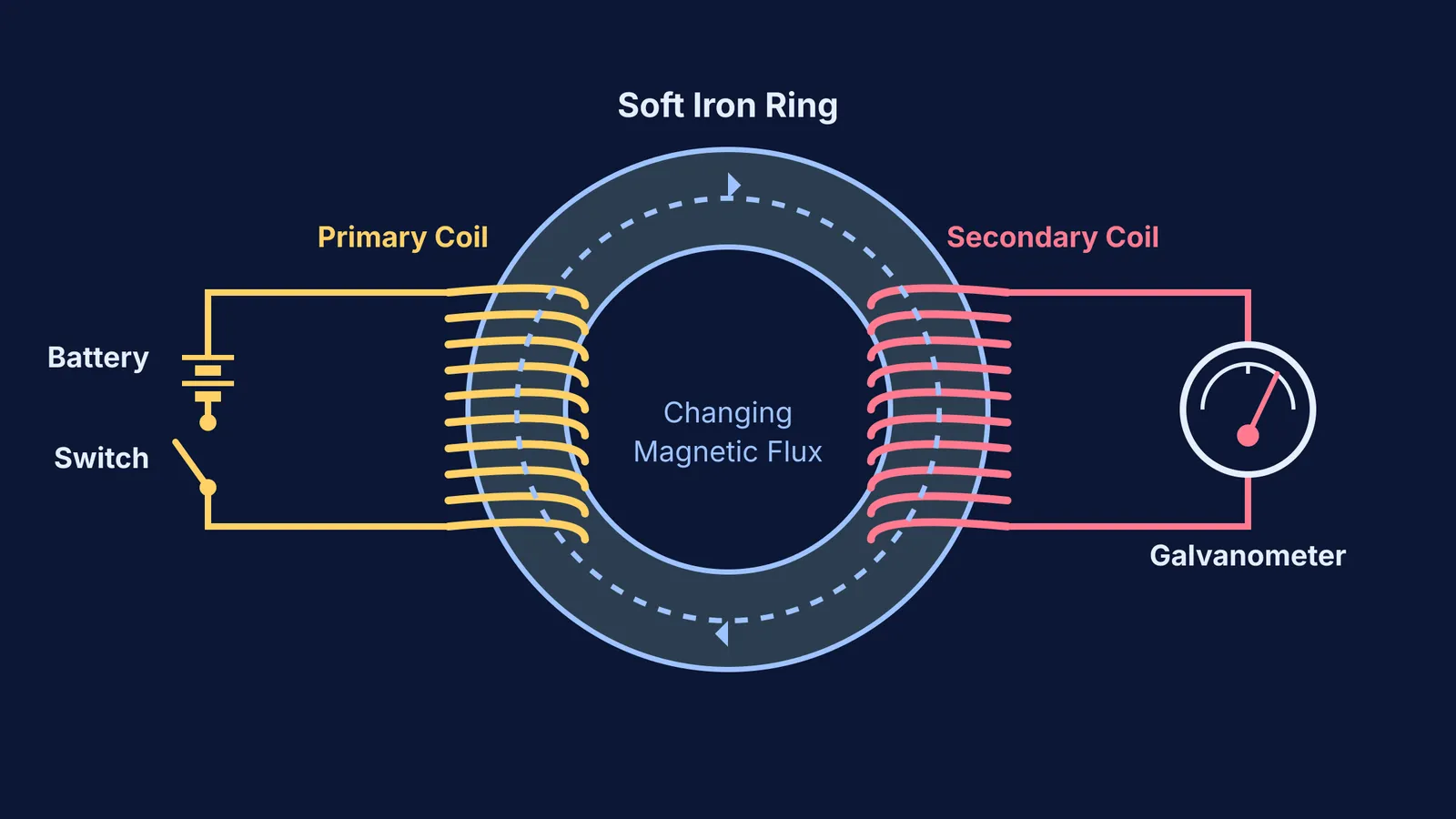
On August 29, 1831, Michael Faraday achieved the breakthrough with his famous iron ring experiment 1. He took a soft iron ring and wound two separate coils of insulated copper wire around opposite sides 1. He connected the first coil (the primary) to a battery, and the second coil (the secondary) to a galvanometer to detect current 1.
How did Faraday's iron ring experiment work?
When a steady current flowed through the primary coil, nothing happened in the secondary coil. However, Faraday noticed that the galvanometer needle deflected momentarily at the exact instant he connected the battery, and deflected in the opposite direction when he disconnected it 1.
This was the discovery of mutual induction. Faraday realised that a steady magnetic field does not produce electricity; the field must be changing. The starting or stopping of the current in the primary coil created a changing magnetic flux in the iron ring, which then induced a transient current in the secondary coil 1. He called this a "wave of electricity" that was generated only when the magnetic influence was rising or falling 2.
If you struggle to picture how this invisible field transfers energy between coils without physical contact, the Fermi Simulation Lab lets you interact with magnetic flux and see the induced current as you change the field strength. You can explore more about how Faraday visualised these invisible forces in our post on Michael Faraday and field lines: how a bookbinder pictured force.
What was the moving magnet experiment?
To confirm that it was strictly the changing magnetic field causing the induction—and not some property of the battery—Faraday conducted another landmark experiment 1. He took a hollow cylinder made of paper, wound a coil of copper wire around it, and connected the ends to his galvanometer 1.
He then pushed a cylindrical bar magnet into the coil. As the magnet moved in, the galvanometer needle deflected in one direction 1. When he pulled the magnet out, the needle deflected the other way 1. If he held the magnet perfectly still inside the coil, the needle returned to zero 1.
This confirmed his earlier finding. The relative motion between the permanent magnet and the coil created a changing magnetic field, which in turn generated an electric current 1. This proved that a permanent magnet could produce electricity just as effectively as an electromagnet. This principle is the foundation of modern power generation, from early dynamos to the massive turbines in hydroelectric and nuclear power stations today.
If you are preparing for your physics exams and get stuck on problems involving the direction of these induced currents, read our guide on Faraday's and Lenz's laws: finding the induced current direction.
How is Faraday's discovery used in modern physics?
Faraday's qualitative observations were later formulated mathematically by James Clerk Maxwell as Faraday's law of induction, one of the four fundamental equations of electromagnetism 1. It states that the induced electromotive force (EMF) in a closed loop is directly proportional to the rate of change of magnetic flux through the loop. You can see how this mathematical relationship applies to different geometries in our post on Faraday's law for a changing B: the circulating E inside a solenoid.
This discovery bridged the gap between electricity and magnetism, proving they are two sides of the same coin. It allowed electricity to be generated from mechanical motion, paving the way for the electric grid that powers our world today.
Understanding this concept requires a solid grasp of how fields change over time. If you are learning this and find the mathematics overwhelming, Fermi's AI tutor can work out what you already know and build a plan for the session, guiding you step-by-step through the reasoning. The tutor teaches rather than answers, ensuring you build a strong intuition for electromagnetic induction before tackling complex numerical problems.


