

On this page
Electricity before 1882 was mostly used for telegraphs or arc lamps in isolated spots. Thomas Edison wanted to sell electricity to homes and businesses, replacing gas lighting. To do this, he needed a central station that generated power and a network to distribute it reliably. This concept—a single large source of energy serving many independent consumers—was a major shift for its time and laid the foundation for the modern utility industry.
When did the Pearl Street Station open?
The Pearl Street Station began operations on September 4, 1882, at 3:00 PM. Built by the Edison Illuminating Company, the station was located at 255–257 Pearl Street in the Financial District of Manhattan (ETHW). The project was backed by investors from the Edison Electric Light Company, including prominent financiers like J. P. Morgan and Anthony Drexel, who provided the capital for the underground network (Wikipedia).
The project required installing 100,000 feet of underground wiring and conduits, at a total construction cost of approximately $300,000 (ETHW). On its first day, the station served an initial load of 400 lamps to 82 customers in an area bounded by Spruce Street, the East River, Wall Street, and Nassau Street. As the system proved reliable, demand grew rapidly. By 1884, it was serving 508 customers with 10,164 lamps (Wikipedia).
How did the first electric power plant work?
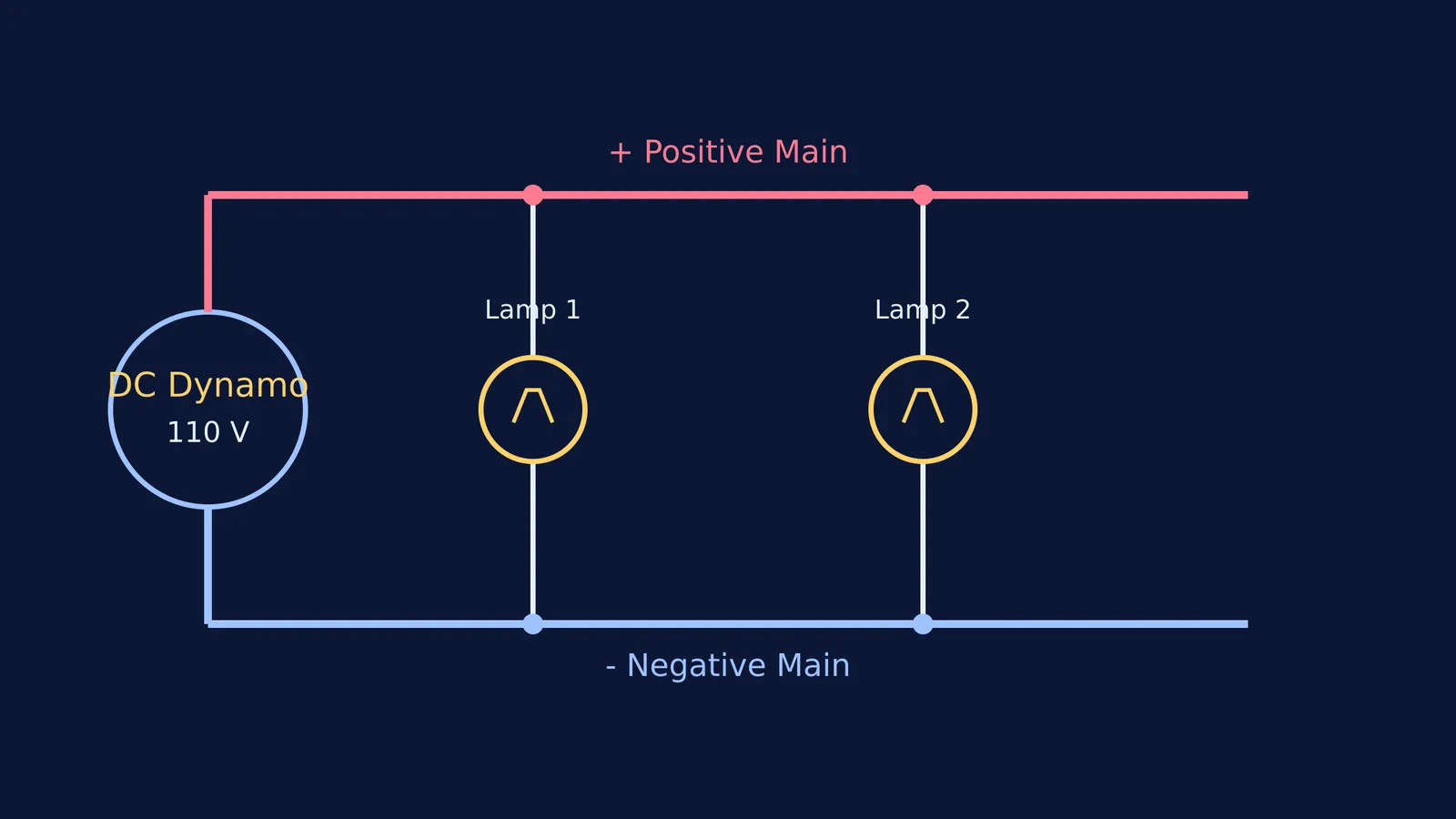
Before Edison, early lighting systems often used arc lamps connected in series. In a series circuit, the current is constant everywhere, but if one lamp breaks, the entire circuit fails. Edison realised this would never work for household lighting. He designed his network as a parallel circuit. In a parallel circuit, the voltage remains constant across all branches, allowing each customer to switch their lights on and off independently without affecting their neighbours.
This required a generator that could supply a constant voltage regardless of the current drawn. Edison's team developed the "Jumbo" dynamo specifically to meet this need. The system distributed electricity at 110 volts direct current (DC), marking the first underground urban electrical network (ETHW).
What powered the dynamos at Pearl Street?
The station was a multi-level industrial facility designed to maximise a small 50 by 100 foot footprint. The first level housed the coal-fired boilers, while the second level contained the reciprocating steam engines and the electrical generators (Wikipedia).
Edison used six of these generators. Each Jumbo dynamo weighed 27 tons and had a capacity of 100 kilowatts (kW), capable of powering about 1,200 lights (ETHW). Initially, the station used custom-made Porter-Allen high-speed steam engines to spin the dynamos. However, these proved unstable because of sensitive governors, so they were soon replaced by more reliable engines from Armington & Sims (Wikipedia).
Why was direct current (DC) a problem for expansion?
Despite its technical success, the Pearl Street Station highlighted a critical flaw in direct current distribution. Because of the inherent resistance of the copper wires, a DC power station experienced significant voltage drop over distance. To prevent the voltage from dropping too low at the ends of the lines, the station could only serve customers within an area of about one square mile (ETHW).
This constraint soon led to the "War of the Currents." While Edison defended his DC system, competitors argued that alternating current (AC) was far superior for widespread distribution. AC champions like Nikola Tesla and George Westinghouse showed that alternating current could be stepped up to very high voltages for long-distance transmission, minimising energy loss, and then stepped back down for safe use in homes.
Over the next decade, AC power largely won out for long-distance transmission, but the concept of the central generating station pioneered at Pearl Street remained the blueprint for the world's electrical grids. Later innovations, such as the steam turbine developed by Charles Parsons, replaced the bulky reciprocating steam engines, making central generation even more efficient.
The Pearl Street Station itself met a dramatic end. It burned down in 1890, a fire that destroyed all but one of its original Jumbo dynamos. The surviving dynamo is currently on display at the Greenfield Village Museum in Dearborn, Michigan (Wikipedia). Though the station was rebuilt and resumed service, the rapid rise of AC power and the construction of larger power plants nearby rendered it obsolete. It was permanently decommissioned in 1895.
When you study electricity today, the problems you solve are direct descendants of Edison's engineering challenges. Calculating the total current drawn when you add more parallel branches, or finding the power loss due to the heating effect of current in transmission lines, are exact calculations Edison's engineers had to perform to keep Pearl Street running.
Understanding parallel circuits and power loss is a core part of physics. If you bring a problem set on circuit diagrams, Fermi's AI tutor works out what you already know, builds a plan for the session, and teaches through it.


