

On this page
If you have done the NCERT Class 10 electrolysis activity, you have seen one test tube fill with gas twice as fast as the other. In Activity 1.7 of the NCERT Class 10 Science chapter on chemical reactions, carbon electrodes sit in water with a few drops of dilute sulphuric acid, connected to a 6 volt battery. The same chapter then asks why the gas in one tube is double the amount in the other.
Why is hydrogen volume twice oxygen in electrolysis of water?
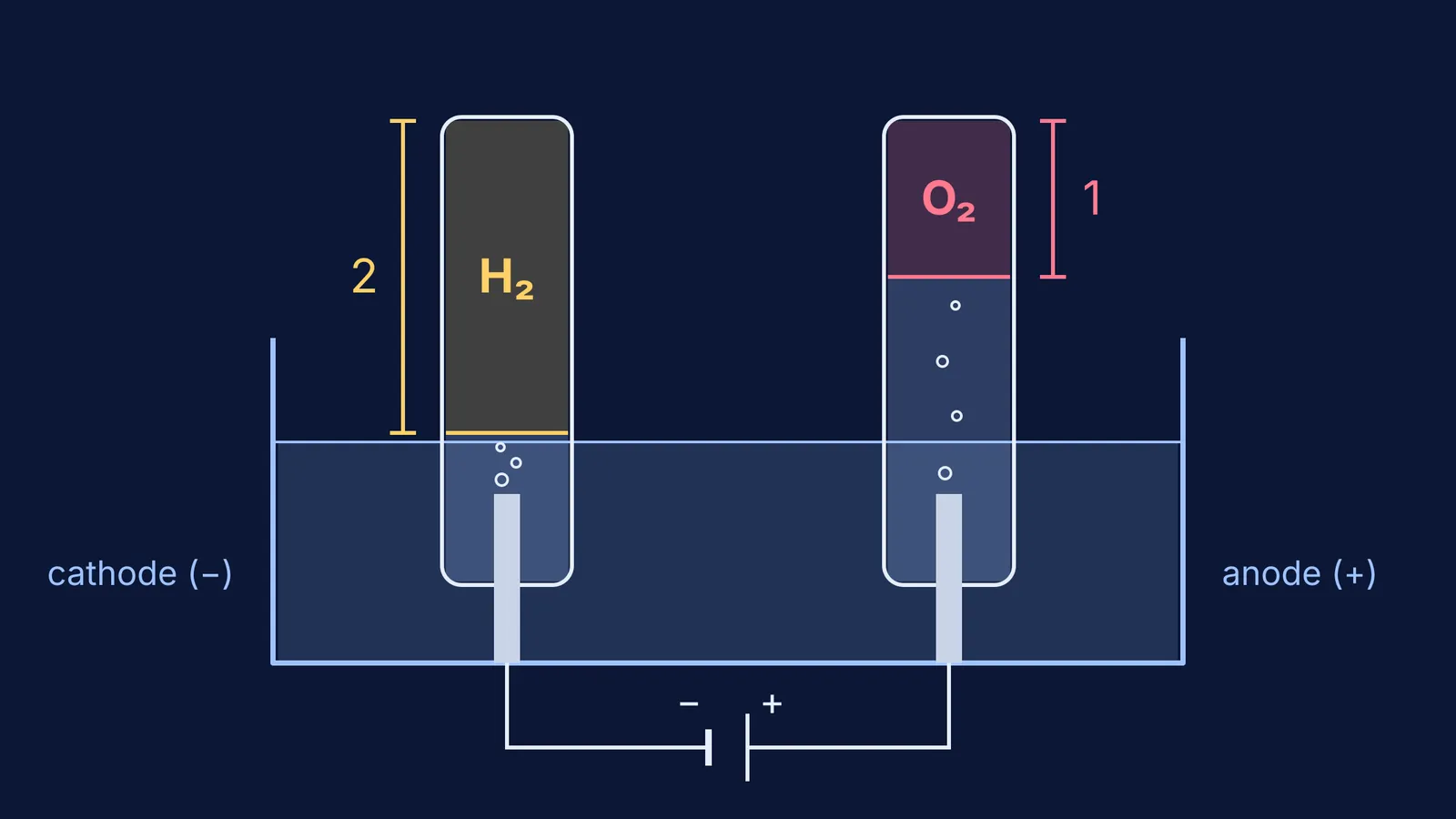
Start with the balanced equation: 2H₂O(l) → 2H₂(g) + O₂(g). The Wikipedia article on electrolysis of water explains that, assuming ideal faradaic efficiency, the amount of hydrogen generated is twice the amount of oxygen, and both are proportional to the total charge passed. In real cells, side reactions can make the measured ratio drift a little from 2:1.
That gives a 2:1 ratio of moles. To turn moles into volumes you need one more idea. Avogadro's law states that "equal volumes of all gases, at the same temperature and pressure, have the same number of molecules" (Avogadro's law). Both tubes stand in the same water at very nearly the same temperature and pressure, so twice the molecules means twice the volume.
In acid, the half-reactions are (source):
Cathode (reduction): 2H⁺(aq) + 2e⁻ → H₂(g)
Anode (oxidation): 2H₂O(l) → O₂(g) + 4H⁺(aq) + 4e⁻
The same current flows through both electrodes. One H₂ molecule needs 2 electrons, while one O₂ molecule releases 4, so every 4 electrons give two H₂ and one O₂.
Which gas collects at the cathode and which at the anode?
The cathode is the electrode joined to the negative terminal of the battery. It supplies electrons at its surface, and H⁺ ions from the solution pick them up, so hydrogen collects at the cathode. The anode is joined to the positive terminal. It pulls electrons out of water molecules, so oxygen collects at the anode. The labelled diagram in the NCERT chapter shows the same arrangement: oxygen over the anode and hydrogen over the cathode.
How do you test for hydrogen and oxygen?
There is a separate test for each gas (laboratory splint tests)):
Hydrogen: hold a lighted splint at the mouth of the tube. The gas burns with a distinctive "squeaky pop".
Oxygen: put a glowing splint, not a burning one, into the tube. Concentrated oxygen makes the glowing ember flare up and relight.
NCERT's version brings a burning candle near each tube, and marks this step as one for the teacher to do.
Why is a little acid added to the water?
Pure water barely conducts. Its conductivity is only about 0.055 μS/cm, because very few of its molecules split into ions (electrolysis of water). A few drops of dilute sulphuric acid supply plenty of ions, so current can flow.
The acid does not change which gases you get. Sulfate ions are hard to oxidise, so water is oxidised at the anode instead, and you still get oxygen. Add up the two half-reactions above and the H⁺ cancels, leaving only 2H₂O → 2H₂ + O₂. The acid carries the current but is not used up.
Do not use common salt instead. In a sodium chloride solution, chloride ions are oxidised to chlorine rather than water to oxygen (source), so the 2:1 picture breaks down. A University of Washington lecture demo uses dilute sodium sulfate instead, which does the same job as the acid.
How do you write this answer for full marks?
A worked example: suppose 0.004 mol of electrons pass through the cell.
Cathode: 2 mol of electrons make 1 mol of H₂, so 0.004 mol of electrons make 0.002 mol of H₂.
Anode: 4 mol of electrons are released for each 1 mol of O₂, so 0.004 mol of electrons go with 0.001 mol of O₂.
The mole ratio is H₂ : O₂ = 0.002 : 0.001 = 2 : 1.
Both gases are at the same temperature and pressure, so by Avogadro's law the volume ratio is also 2 : 1. If the hydrogen tube holds 20 mL, the oxygen tube should hold about 10 mL.
Before you hand in a written answer, check that it includes:
the balanced equation 2H₂O → 2H₂ + O₂
which gas forms at which electrode, with the battery sign (cathode negative, anode positive)
the 2:1 mole ratio, linked to volume through Avogadro's law
why acid is added: pure water conducts poorly
the tests: squeaky pop for hydrogen, a glowing splint relighting for oxygen
When the question asks for a mass or a charge instead, see electrolysis and Faraday's laws with mass-deposited problems. This reaction is also the standard decomposition example in types of chemical reactions in Class 10.
If ratio questions keep tripping you up, the Fermi Problem Library has worked problems with a step-by-step solver that explains the reasoning rather than printing an answer. If the gap is moles or the gas laws themselves, the Fermi Concept Library gives each concept its own lesson.


