On this page
A Van de Graaff generator is a belt that carries charge into a hollow metal dome, where it piles up until the dome sits far above earth potential. The odd part is that the dome keeps accepting charge even at a huge voltage. Two concentric spheres explain why.
What is the working principle of a Van de Graaff generator?
According to HyperPhysics at Georgia State University, a pulley drives an insulating belt past a sharply pointed metal comb that has been given a positive charge by a power supply, and a similar comb at the top lets that charge spread to the dome. The same page says a demonstration model can produce more than 100,000 volts, enough for sparks several centimetres long.
The principle is a property of conductors: excess charge on a hollow conductor sits on its outer surface. Wikipedia's article on the generator explains it with Gauss's law and Faraday's ice-pail experiment: the charge delivered inside ends up on the outer surface of the outer shell. HyperPhysics adds that the electric field inside a conducting sphere is zero and the potential inside equals its surface value. For the Gauss's law step, see the electric field of a charged spherical shell using Gauss's law.
Why does charge flow from the inner sphere to the outer shell?
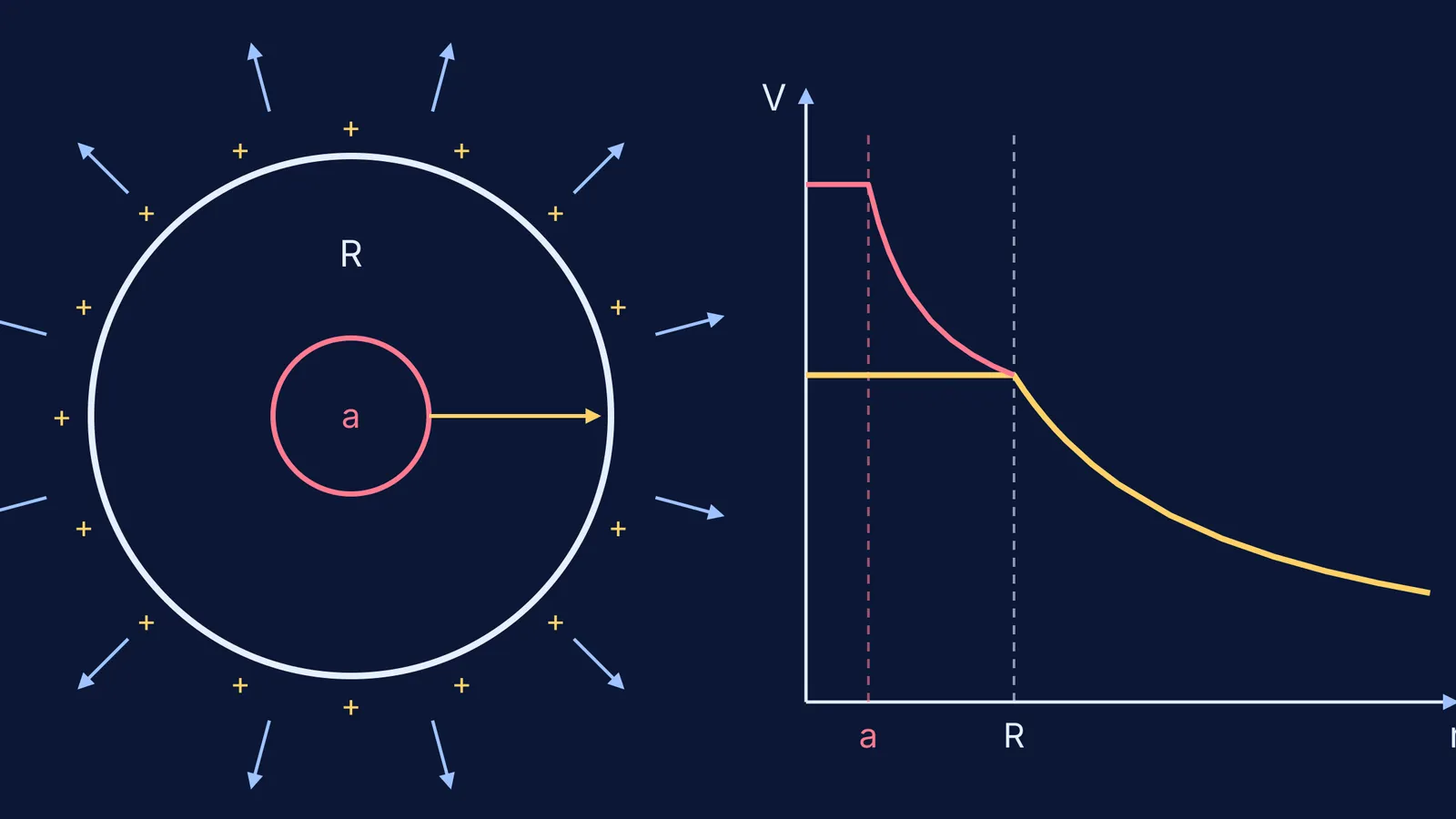
Model the top comb as a small sphere of radius a carrying charge q, sitting inside the dome, a shell of radius R carrying charge Q. Write k = 1/4πε₀ = 9 × 10⁹ N m²/C².
Potential of the inner sphere: V(a) = kq/a + kQ/R, since the shell adds kQ/R everywhere inside it.
Potential of the outer shell: V(R) = kq/R + kQ/R.
Subtract: V(a) − V(R) = kq(1/a − 1/R).
Since a is smaller than R, this difference is positive whenever q is positive. Q has cancelled. So when the two are joined, positive charge flows from the inner sphere to the shell, whatever the shell's voltage, until q is zero and all the charge sits on the outside.
The diagram above plots this: before the wire is connected (pink), the potential climbs towards the inner sphere; after (yellow), it is flat inside. Our post on whether outer shell charge changes the potential difference works through more cases like this one.
How many volts can a Van de Graaff dome reach?
Wikipedia gives the breakdown field of air at standard temperature and pressure as about 30 kV/cm, or 3 × 10⁶ V/m, and a rough ceiling of V_max = R × E_max (source). Here is the worked example for a polished dome 30 cm across, so R = 0.15 m.
Field at the surface of a charged sphere: E = kQ/R², and its potential is V = kQ/R, so V = E × R.
Ceiling: V_max = (3 × 10⁶ V/m)(0.15 m) = 4.5 × 10⁵ V, about 450 kV. This matches the 450 kV Wikipedia gives for the same dome.
Charge on the dome at that point: Q = VR/k = (4.5 × 10⁵ × 0.15) / (9 × 10⁹) = 7.5 × 10⁻⁶ C (7.5 μC).
Now take a top comb modelled as a sphere with a = 1 cm carrying q = 1 nC. Then V(a) − V(R) = (9 × 10⁹)(10⁻⁹)(1/0.01 − 1/0.15) = 9 × 93.3 ≈ 840 V.
The comb is 840 V above a 450 kV dome, so charge still flows outward.
How did Van de Graaff reach millions of volts?
By making R bigger, since the ceiling grows with the radius. According to Wikipedia, Robert J. Van de Graaff built a 1929 prototype that reached 80,000 volts, and his 1931 twin-sphere machine reached 1.5 million volts. The same article says generators enclosed in pressurised tanks reach 25 MV, since the dense gas around the dome withstands a stronger field than open air.
Guinness World Records lists the largest Van de Graaff generator as two conjoined 4.5 m aluminium spheres on 6.7 m columns, built by Van de Graaff himself, which can reach 2 million volts. Real domes stay below the R × E_max ceiling: Wikipedia notes that charge builds only until leakage and corona discharge carry it away as fast as the belt brings it.
A checklist for concentric-shell questions
Write the potential at each surface as a sum of kq/r terms, one per charge.
Joined conductors end at equal potentials, not equal charges.
Joining an inner sphere to an outer shell always sends all of the inner charge outward.
Earthing a shell sets its potential to zero, not its charge.
For a voltage limit, use V_max = E_max × R and check your units: kV/cm to V/m multiplies by 100.
If a step in your own working goes wrong, the Fermi Problem Library has worked problems with a step-by-step solver that explains the reasoning, and the Fermi Concept Library gives each physics concept, including electric potential, its own lesson. Try the 1 nC example again with a = 2 cm before you check your answer: you should get about 390 V.