

On this page
Here is the classic setup. A small sphere of radius a carries charge q. Around it, sharing the same centre, sits a thin shell of radius b carrying charge Q. The question asks for the potential difference between them, and many students start writing Q terms everywhere. They all cancel. Here is why, with numbers you can check yourself.
Does the outer shell's charge change the potential difference?
No. Two facts about a charged conducting sphere settle it, both stated on the HyperPhysics page on the potential of a charged sphere.
Outside a charged sphere, the potential is the same as that of a point charge at its centre, kQ/r.
Inside it, the field is zero, so the potential stays constant at the value it has at the surface, kQ/b.
So the shell's charge Q adds exactly kQ/b to every point at r ≤ b. That includes the inner sphere and the shell itself. Both potentials rise (or fall, if Q is negative) by the same amount, and a difference ignores a shift that both terms share. The Amrita Virtual Lab theory page on the Van de Graaff generator puts it in one line: "The potential due to Q is constant upto radius R and so cancels out in the difference."
Write out the three lines and the cancellation is visible:
V(inner) = kq/a + kQ/b
V(outer) = kq/b + kQ/b
V(inner) − V(outer) = kq(1/a − 1/b)
Here k = 1/(4πε₀), which OpenStax University Physics gives as 8.99 × 10⁹ N·m²/C²; we round it to 9 × 10⁹ below.
What does a worked example look like?
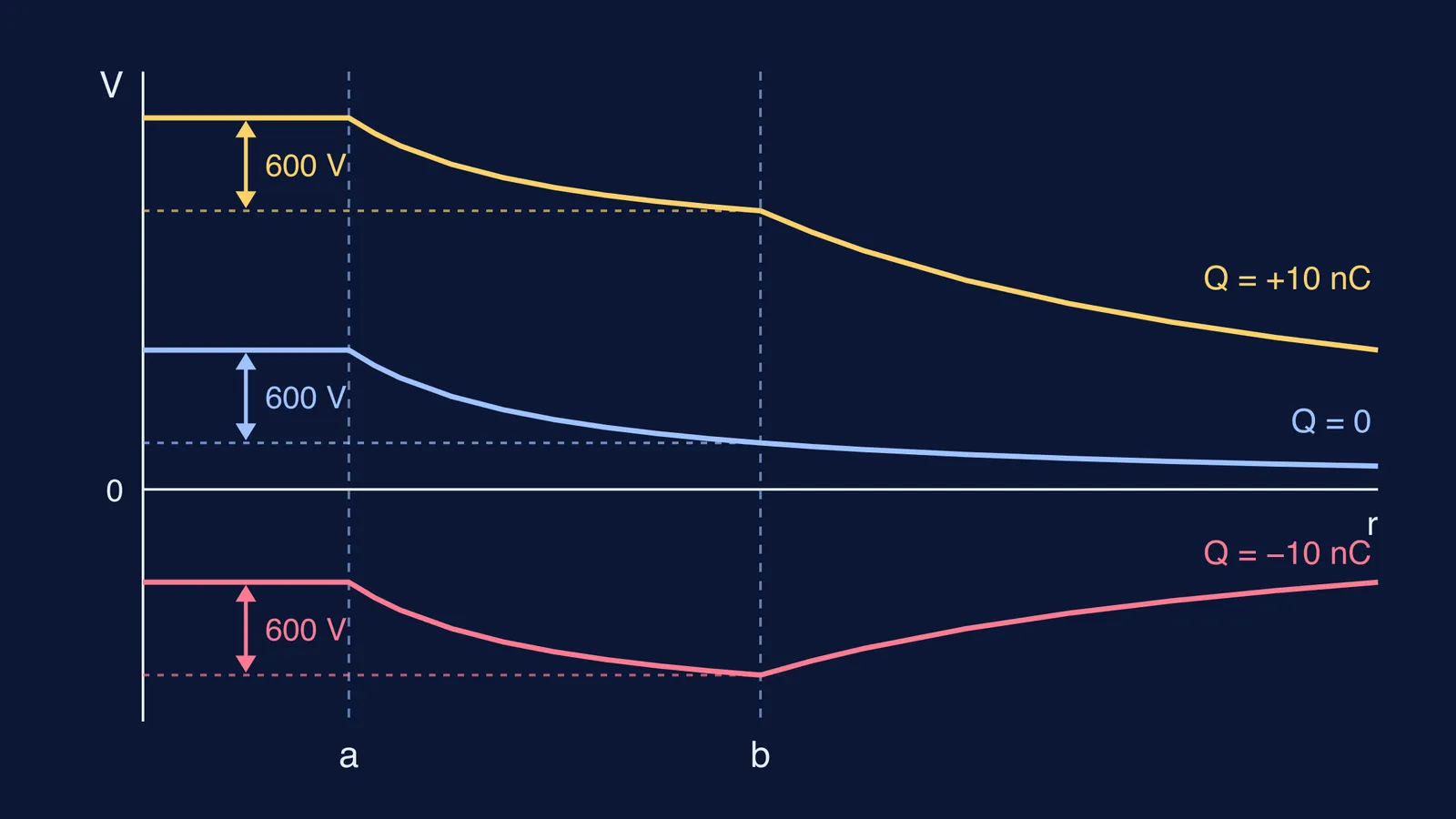
Take a = 2 cm, b = 6 cm and q = +2 nC, and try three values of Q. With k rounded to 9 × 10⁹ N·m²/C² (the OpenStax value is 8.99 × 10⁹), the inner charge alone gives kq/a = 900 V and kq/b = 300 V.
Q = +10 nC adds kQ/b = 1500 V to both: V(inner) = 2400 V, V(outer) = 1800 V, difference 600 V.
Q = 0 adds nothing: V(inner) = 900 V, V(outer) = 300 V, difference 600 V.
Q = −10 nC subtracts 1500 V from both: V(inner) = −600 V, V(outer) = −1200 V, difference 600 V.
Check with the formula: kq(1/a − 1/b) = 18 × (50 − 16.7) ≈ 600 V. The hero graph above plots these three cases. Inside the shell the curves are the same shape, just slid up or down.
If the outer conductor is a thick shell, use its inner radius for b in the difference. The field is zero inside the metal, so no potential is lost crossing it.
To try your own variations and see each step explained, the Fermi Problem Library has worked problems with a step-by-step solver that explains the reasoning rather than printing an answer.
Why does this make a Van de Graaff generator work?
The same result explains the machine. The Amrita Virtual Lab page notes that however much charge Q has built up on the large sphere, a small positively charged sphere inside it is always at a higher potential. Connect the two with a wire, and positive charge flows outward onto the big sphere, even if Q is already large. So the outer sphere keeps collecting charge and its potential keeps rising, until the field at its surface breaks down the surrounding air.
When does the outer charge matter?
The outer charge drops out of the difference, not out of the problem. Watch for these cases:
Absolute potentials. If the question asks for V(inner) on its own, Q is in the answer.
Earthing the inner sphere. Earthing fixes V(inner) = 0, so q must adjust, and the new q depends on Q. Then the difference does change. Our post on concentric spherical shells, charges, potentials and earthing one works through this.
Points outside the shell. For r > b, both charges count: V = k(q + Q)/r.
Two results follow directly from the difference depending on q alone. The field between the spheres is kq/r², which you can confirm with the Gauss's law derivation for a charged spherical shell. And the capacitance q/ΔV depends only on a and b, as in our derivation of spherical and cylindrical capacitors.
A four-step check for any concentric-sphere question
Mark the point where you need the potential.
For each shell, ask: is the point inside it (use kQ/R, the surface value) or outside it (use kQ/r)?
Add the contributions. If the question wants a difference, cross out any term that appears in both potentials before you calculate.
If something is earthed, set its potential to zero and solve for the unknown charge before anything else.
If step 2 still feels shaky, the Fermi Concept Library gives every concept in physics its own lesson and shows its place in the map. Work through the example above once by hand, then change Q and watch the difference stay put.


