

On this page
If you have ever watched a teacher turn a hand crank in a school physics laboratory until a brilliant violet spark snaps between two brass spheres, you were watching a Wimshurst influence machine. For over a century, electrostatic demonstrations relied on rubbing glass rods with silk. But friction was finicky: on humid mornings in Delhi or damp afternoons in London, moisture films dissipated charges before an electroscope could even twitch. James Wimshurst solved this by replacing friction with electrostatic induction across counter-rotating discs, producing reproducible potential differences of 50,000 to over 100,000 volts from a few hand turns.
Who was James Wimshurst?
James Wimshurst (1832–1903) was a British marine engineer and shipwright. The son of Henry Wimshurst—the shipbuilder who launched the *SS Archimedes*, the first screw-propelled steamship—he apprenticed at the Thames Iron Works shipyard and served 25 years as Chief Shipwright Surveyor to the British Board of Trade (Linda Hall Library). In his home workshop in Clapham, South London, he spent his evenings improving electrostatic generators. Earlier machines by Wilhelm Holtz and Robert Voss required an external starter charge, reversed polarity unexpectedly, and failed in damp air. Near the end of 1882, Wimshurst built a machine with two contra-rotating glass discs that generated reliable sparks. His breakthrough was announced in the journal *Engineering* in January 1883 and confirmed in *Nature* (Buckton, 1885).
How does the Wimshurst machine work?
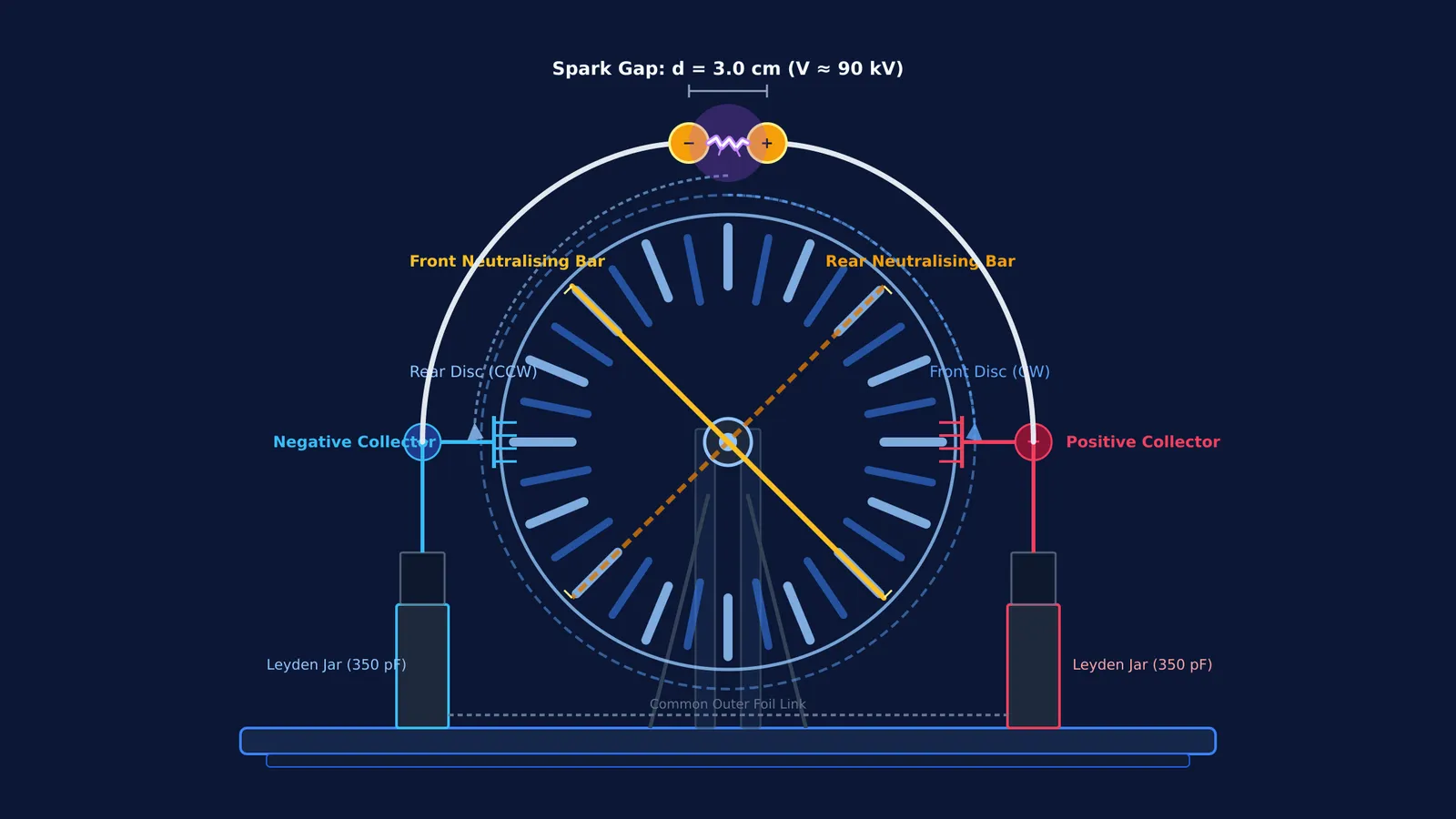
The machine operates via cross-coupled electrostatic induction on two counter-rotating insulating discs fitted with radial metal foil sectors:
Initial asymmetry: Tiny stray charges—often picocoulombs from environmental static—exist on the sectors.
Induction across discs: A slightly negative sector on the rear disc repels electrons on a passing front sector that is touching the front neutralising bar.
Charge transfer: Repelled electrons travel along the brass neutralising rod to the opposite sector 180° away, leaving the first sector positive and the opposite sector negative.
Regenerative multiplication: As the discs rotate in opposite directions, these charged front sectors induce opposite charges across the rear neutralising bar. Analysis by Markus Zahn and colleagues (Zahn et al., 1974) demonstrates that this positive feedback multiplies sector charges exponentially.
Collection: At the horizontal axis, collector combs with sharp metal needles ionise the air through corona discharge, transferring identical charges from both discs into storage capacitors.
Why did the Wimshurst machine beat earlier static generators?
Earlier electrostatic generators failed whenever humidity formed a conductive moisture film on the plates. Wimshurst resolved this through several design innovations documented in his experimental papers (Wimshurst, 1893):
Contra-rotation doubled the relative sector velocity for a given crank speed, doubling charge transfer per turn.
Self-excitation ensured that any background charge asymmetry triggered immediate, spontaneous buildup without an external priming rod.
Symmetrical geometry kept terminal polarity stable throughout continuous operation.
Wimshurst shared his work openly, describing his generators to the Physical Society of London and publishing further designs in the *Philosophical Magazine*. His machine integrated Pieter van Musschenbroek's Leyden jar into its base, rivalling Nicholas Callan's induction coil as a laboratory high-voltage source.
For students visualising how charge distributes across moving conductors, the Fermi Simulation Lab provides interactive simulations for ideas that are easier to see than to read.
Worked example: how much energy is stored in a Wimshurst spark?
Consider a classroom Wimshurst machine with spherical electrodes separated by a gap of d = 3.0 cm (0.030 m). In dry air, dielectric breakdown across spherical electrodes occurs at an electric field of approximately E_break = 30 kV/cm (3.0 × 10⁶ V/m) (Robinson, 1962).
Terminal voltage:
V = E_break × d = 30 kV/cm × 3.0 cm = 90 kV = 9.0 × 10⁴ V.
Equivalent capacitance:
Two glass Leyden jars (each C_jar = 350 pF) in series across the gap yield: C_eq = C_jar / 2 = 175 pF = 1.75 × 10⁻¹⁰ F.
Stored charge and energy:
Using the relation for stored electrostatic energy in capacitors: Q = C_eq × V = (1.75 × 10⁻¹⁰ F) × (9.0 × 10⁴ V) ≈ 15.8 μC. U = (1/2) C_eq V² = 0.5 × (1.75 × 10⁻¹⁰ F) × (9.0 × 10⁴ V)² ≈ 0.71 Joules.
Instantaneous power:
The ionised spark discharges this 0.71 J in roughly Δt = 1.0 microsecond (1.0 × 10⁻⁶ s):
Peak current: I = Q / Δt ≈ 15.8 μC / 1.0 μs = 15.8 A.
Peak power: P = U / Δt ≈ 0.71 J / 1.0 μs = 7.1 × 10⁵ W = 710 kW.
Releasing 0.71 J in one microsecond produces hundreds of kilowatts of peak power, causing the loud acoustic snap.
Students tackling capacitor networks can practice step-by-step solutions that explain the reasoning in the Fermi Problem Library.
How did Wimshurst's machine power the first X-ray tubes?
Following Wilhelm Röntgen's 1895 discovery of X-rays, medical researchers needed steady high voltages to excite Crookes vacuum tubes. While induction coils produced erratic pulses that cracked delicate glass, multi-disc Wimshurst machines supplied a steady direct-current discharge. During the Boer War in 1899, the Royal Army Medical Corps deployed portable hand-cranked Wimshurst machines to South African field hospitals to locate shrapnel in wounded soldiers (Linda Hall Library). In 1898, Wimshurst was elected a Fellow of the Royal Society (Nature, 1898).
To explore how electrostatic induction and capacitor energy connect across physics, students can explore each topic and its place in the map in the Fermi Concept Library.


