On this page
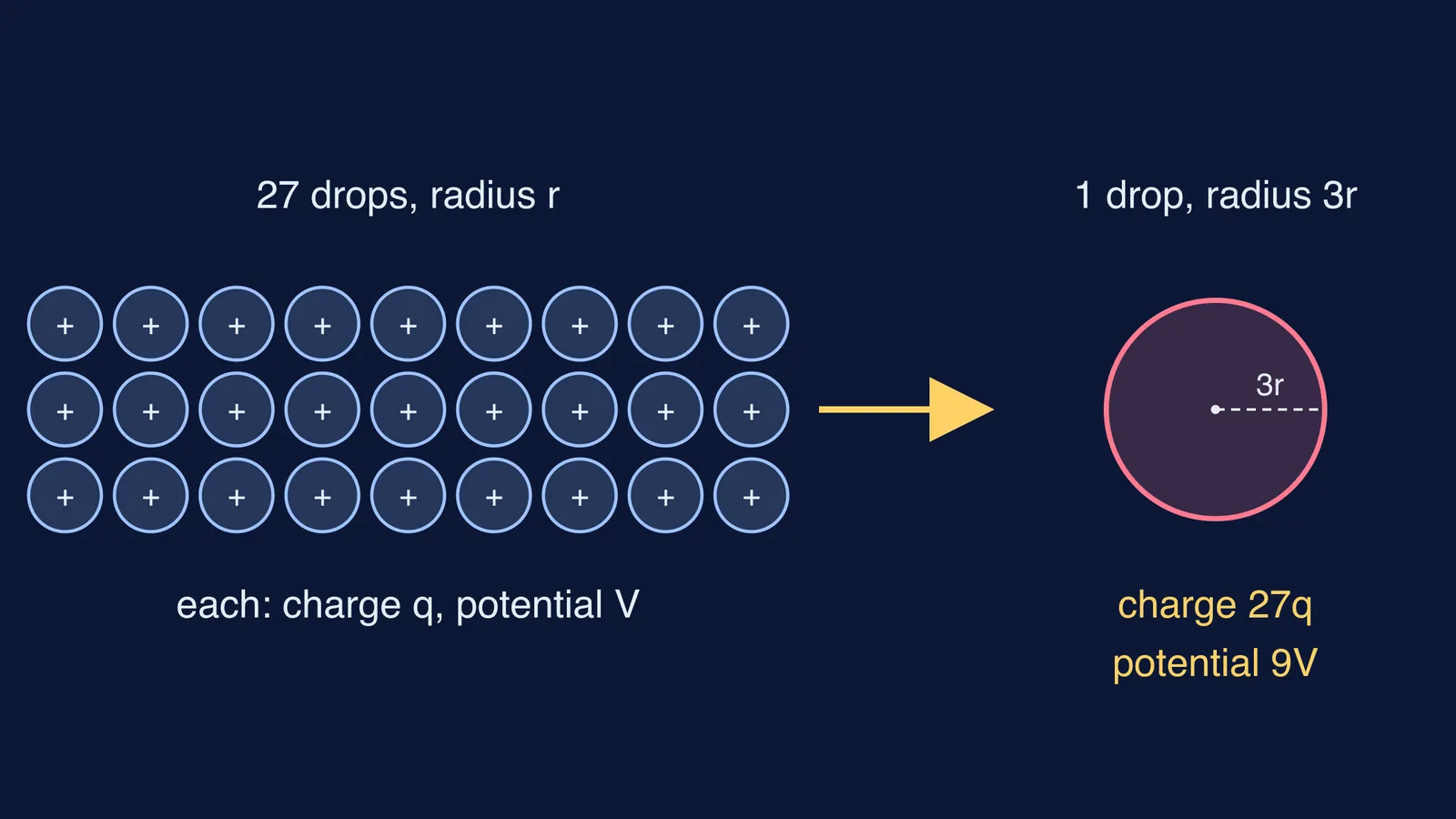
The trick in this problem is that two things scale in two different ways. Charge is conserved, so it simply adds. Size is set by volume, so the radius grows much more slowly than the number of drops. Potential depends on both, and that is where the n^(2/3) comes from.
Why is the charge n times but the potential only n^(2/3) times?
Start with what each drop is. A charged drop of water or mercury is a conductor, and outside a charged conducting sphere the field and the potential are the same as for a point charge at its centre (HyperPhysics, Georgia State University). So the potential at its surface is V = kq/r, where k is about 8.99 x 10^9 N m^2/C^2 (OpenStax University Physics, Vol. 2, section 7.3).
Now merge n drops, each with charge q and radius r, into one big drop of charge Q and radius R.
Charge is conserved: Q = nq.
Volume is conserved, because the liquid does not compress: (4/3)πR^3 = n x (4/3)πr^3, so R = n^(1/3) r.
Potential of the big drop: V_big = kQ/R = k(nq)/(n^(1/3) r) = n^(2/3) x kq/r.
So V_big = n^(2/3) V. The top of the fraction grows n times, but the bottom also grows n^(1/3) times, and n divided by n^(1/3) is n^(2/3).
How do you solve the 27 drops numerical?
Here is the classic version: 27 identical drops of mercury, each of radius 1 mm and charged to 10 V, merge into one drop. Find the potential of the big drop and the change in stored energy. We use V = kq/r and k from OpenStax section 7.3.
Radius: R = 27^(1/3) x 1 mm = 3 mm.
Potential: V_big = 27^(2/3) x 10 V = 9 x 10 V = 90 V.
Charge on one small drop: q = Vr/k = (10 x 0.001)/(8.99 x 10^9), about 1.11 x 10^-12 C.
Charge on the big drop: Q = 27q, about 3.00 x 10^-11 C.
Check step 2 another way: V = kQ/R = (8.99 x 10^9 x 3.00 x 10^-11)/0.003, which is about 90 V. Both routes agree.
Does the energy increase or decrease when charged drops combine?
It increases. A charged sphere stores energy like a capacitor: an isolated conducting sphere has capacitance C = 4πε0R (HyperPhysics), and the energy stored in a capacitor is U = QV/2 = Q^2/2C (OpenStax University Physics, Vol. 2, section 8.3).
For the 27 drops:
One small drop: U = (1/2) x 1.11 x 10^-12 C x 10 V, about 5.56 x 10^-12 J.
All 27 small drops together: 27 x 5.56 x 10^-12 J, about 1.50 x 10^-10 J.
Big drop: U = (1/2) x 3.00 x 10^-11 C x 90 V, about 1.35 x 10^-9 J.
Increase: about 1.20 x 10^-9 J. The big drop holds 9 times the energy of all the small drops together.
In general, the big drop has n^(5/3) times the energy of one small drop, while the small drops together have n times, so the ratio is n^(2/3). For n = 27 that ratio is 9 again.
Where does the extra energy come from? All the drops carry like charges and repel each other. Pushing them together means doing work against that repulsion, and the work ends up stored in the field of the big drop. The same reasoning sits behind the self-energy of a charged sphere. It runs opposite to surface tension: when uncharged drops merge, surface area falls and surface energy is released, as our post on merging drops and surface energy explains. Exam questions on charged drops usually ask only for the electrical part.
What mistakes do students make with this problem?
Taking the potential as n times because the charge is n times. The radius changes too.
Taking R = nr. Volume adds, not radius.
Adding the potentials of the small drops. Charge is conserved; potential is not.
Mixing up the two energy ratios: n^(5/3) compared with one small drop, n^(2/3) compared with all the small drops together. Read which one the question asks for.
Confusing merging with two connected spheres sharing charge, where the spheres stay separate and end at a common potential.
A quick self-test, using the same OpenStax relation V = kq/r: 8 drops, each at 20 V, merge into one. You should get radius 2r, charge 8q, potential 4 x 20 V = 80 V, and energy 4 times the total of the 8 small drops.
If your answer to a problem like this keeps coming out n times, the setup is going wrong, not the arithmetic. The Fermi Problem Library has worked problems with a step-by-step solver that explains the reasoning rather than printing an answer. The Fermi Concept Library has a lesson on each idea used here, from electric potential to capacitance.