

On this page
In the autumn of 1879, a 23-year-old physics student in Baltimore tested a claim in Maxwell's Electricity and Magnetism and found it wanting. Edwin Hall showed that a magnet acts on the electric current itself, not only on the wire. The sideways voltage he measured still tells physicists what carries the current, and how densely packed the carriers are.
How did Edwin Hall discover the Hall effect in 1879?
Hall described it in On a New Action of the Magnet on Electric Currents, in the American Journal of Mathematics in 1879. While reading Maxwell's Electricity and Magnetism for Henry Rowland's lectures, he hit this line: “The only force which acts on electric currents is electromotive force.” Hall found this “contrary to the most natural supposition” and asked Rowland, who said he doubted it too.
His first try failed. From 7 to 11 October he looked for a rise in the resistance of a flat coil of wire in a strong field, and across thirteen series of forty readings found no real change. So he changed the question: if the current were pushed sideways but could not move, there should be a small voltage between the two edges of the conductor. Rowland advised gold leaf mounted on glass. On 28 October, Hall wrote, he obtained “a decided deflection of the galvanometer needle”. It was steady, reversed with the magnet, and looked, in his words, as though the current were “pressed, but not moved, toward one side of the conductor.”
The National Academy of Sciences memoir of Hall by P. W. Bridgman fills in the rest. Hall, born on 7 November 1855, had joined Johns Hopkins as a graduate student under Rowland in 1877, and the effect became the subject of his thesis; he received his PhD in 1880. Bridgman records Lord Kelvin's verdict on measurements Hall reported in 1881: “by far the greatest discovery that has been made in respect to the electrical properties of metals since the times of Faraday.”
Why did gold leaf work when thicker metal failed?
Rowland had tried the edge-voltage test earlier and failed. In his paper, Hall blamed the metal disk's “considerable thickness”; Bridgman cites a lack of sensitivity “primarily due to too great thickness of the conductor”. With a copper strip of the same length and breadth as the gold but 4 mm thick, the galvanometer picked up no sideways current. His rough calculation put the ratio of the voltage along the strip to the voltage across it at about 3,000 to 6,500, so even in thin gold the effect was tiny.
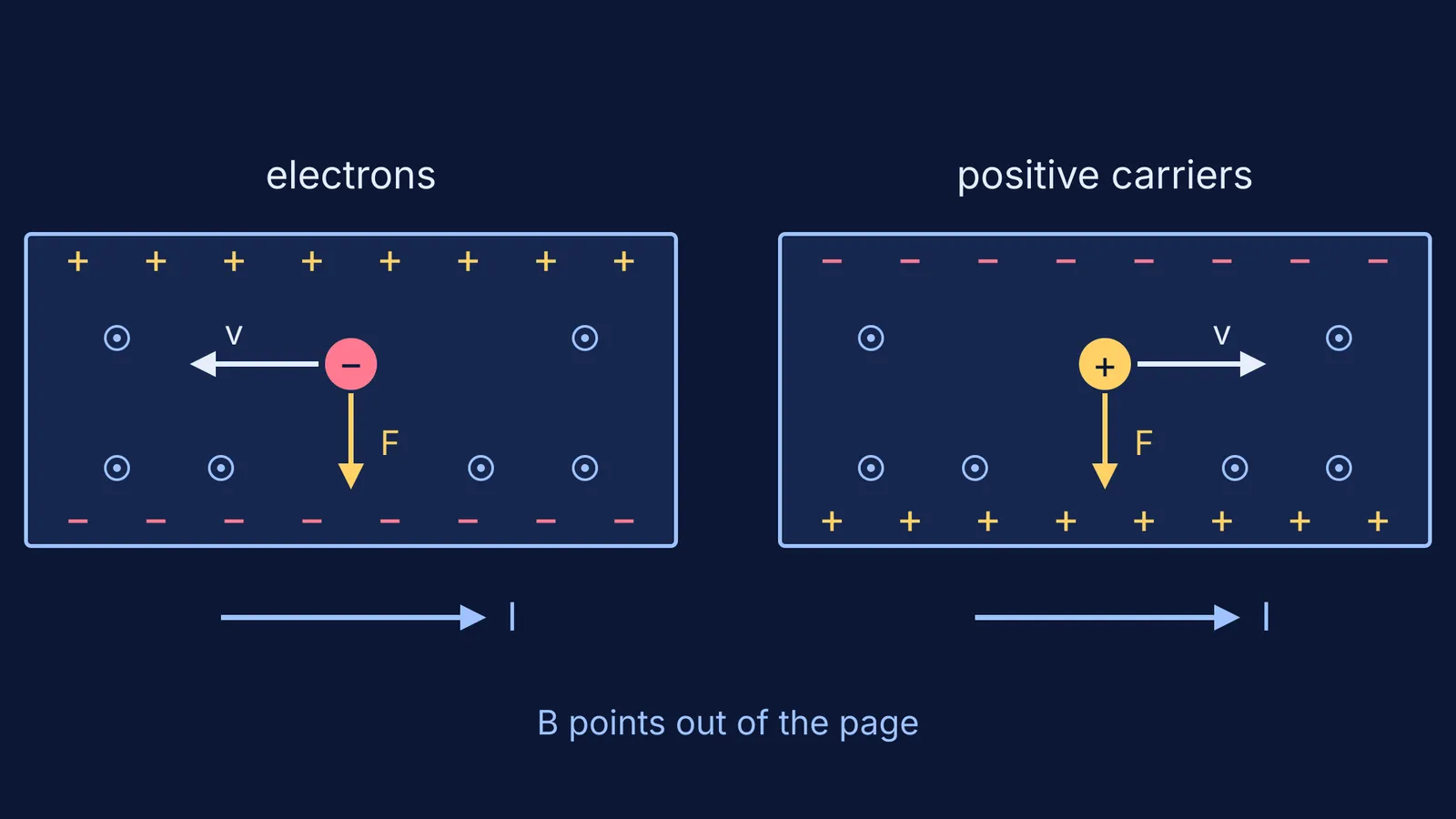
The magnetic force piles drifting charges up on one edge; that build-up makes an electric field that pushes back, and the pile stops growing when the two forces balance, just as in a velocity selector, where a charge passes straight through crossed E and B fields. The result, as given by NIST's Hall effect reference page, is a Hall voltage of size IB/(qnd), where I is the current, B the field, q the carrier charge, n the carrier density and d the thickness. A thinner strip (smaller d) gives a bigger voltage.
What does the Hall voltage tell you about charge carriers?
Sign: for the same current, positive and negative carriers are pushed to the same edge, so that edge charges up with opposite signs. According to NIST, the Hall voltage is negative for n-type semiconductors and positive for p-type ones.
Density: rearranging gives n = IB/(qd|VH|), so a small Hall voltage means many carriers.
In 1879 the true direction of the current was an open question; Hall's paper says his result reads differently depending on which direction you assume, and that it was “too early to decide”.
How do you work out carrier density from a Hall measurement?
Suppose a semiconductor slab gives these readings (made-up numbers), and use the NIST value q = 1.602 × 10⁻¹⁹ C:
I = 1.0 × 10⁻³ A, B = 0.50 T, d = 5.0 × 10⁻⁴ m; measured Hall voltage −6.25 mV.
Sign first: negative means electrons carry the current, so the sample is n-type.
Density: n = (1.0 × 10⁻³ × 0.50) / (1.602 × 10⁻¹⁹ × 5.0 × 10⁻⁴ × 6.25 × 10⁻³).
Top 5.0 × 10⁻⁴, bottom about 5.0 × 10⁻²⁵, so n ≈ 1.0 × 10²¹ carriers per cubic metre.
A metal has far more free carriers, so the same current and field give a far smaller Hall voltage. That is why Hall needed a strip as thin as gold leaf.
Where does Hall's discovery lead next?
Read how Klaus von Klitzing found a resistance set by nature's constants. To practise the carrier-density side, try these n-type and p-type carrier concentration problems.
If charges piling up on one edge is hard to picture, the Fermi Simulation Lab has interactive simulations for ideas easier to see than to read. If your numbers come out wrong, the Fermi Problem Library has a step-by-step solver that explains the reasoning rather than printing an answer.


