

On this page
Dive to the bottom of the deep end of a swimming pool to retrieve a sunken ring, and you will usually feel a sharp, squeezing ache in your ears. This familiar discomfort is not a sign of water getting into your head—it is a direct result of the water's weight pressing against a pocket of trapped air.
The pain is a mild form of ear barotrauma, a physical mismatch between the changing pressure of the water and the static pressure inside your body.
How does water pressure change with depth?
Water is incredibly heavy. As you swim toward the bottom of a pool, the mass of the fluid above you presses down. In physics, this is called hydrostatic pressure.
According to OpenStax University Physics, the pressure p at a given depth in a fluid of constant density is calculated using the formula p = p₀ + ρgh. In this equation, p₀ is the atmospheric pressure pressing on the pool's surface, ρ (rho) is the density of the water, g is the acceleration due to gravity, and h is your depth below the surface. Because water cannot be easily compressed, its density remains constant, meaning the pressure increases linearly the deeper you go.
Understanding how pressure changes with depth is a core part of fluid mechanics. Visualising invisible forces like hydrostatic pressure can be tricky when you are first learning them. In the Fermi Simulation Lab, you can change the depth and fluid density to see exactly how pressure vectors act on submerged surfaces.
Why do your ears hurt when you dive deep in a pool?
Your ear is divided into sections, separated by a thin, watertight membrane called the eardrum (tympanic membrane). Behind the eardrum lies the middle ear, an enclosed cavity filled with air.
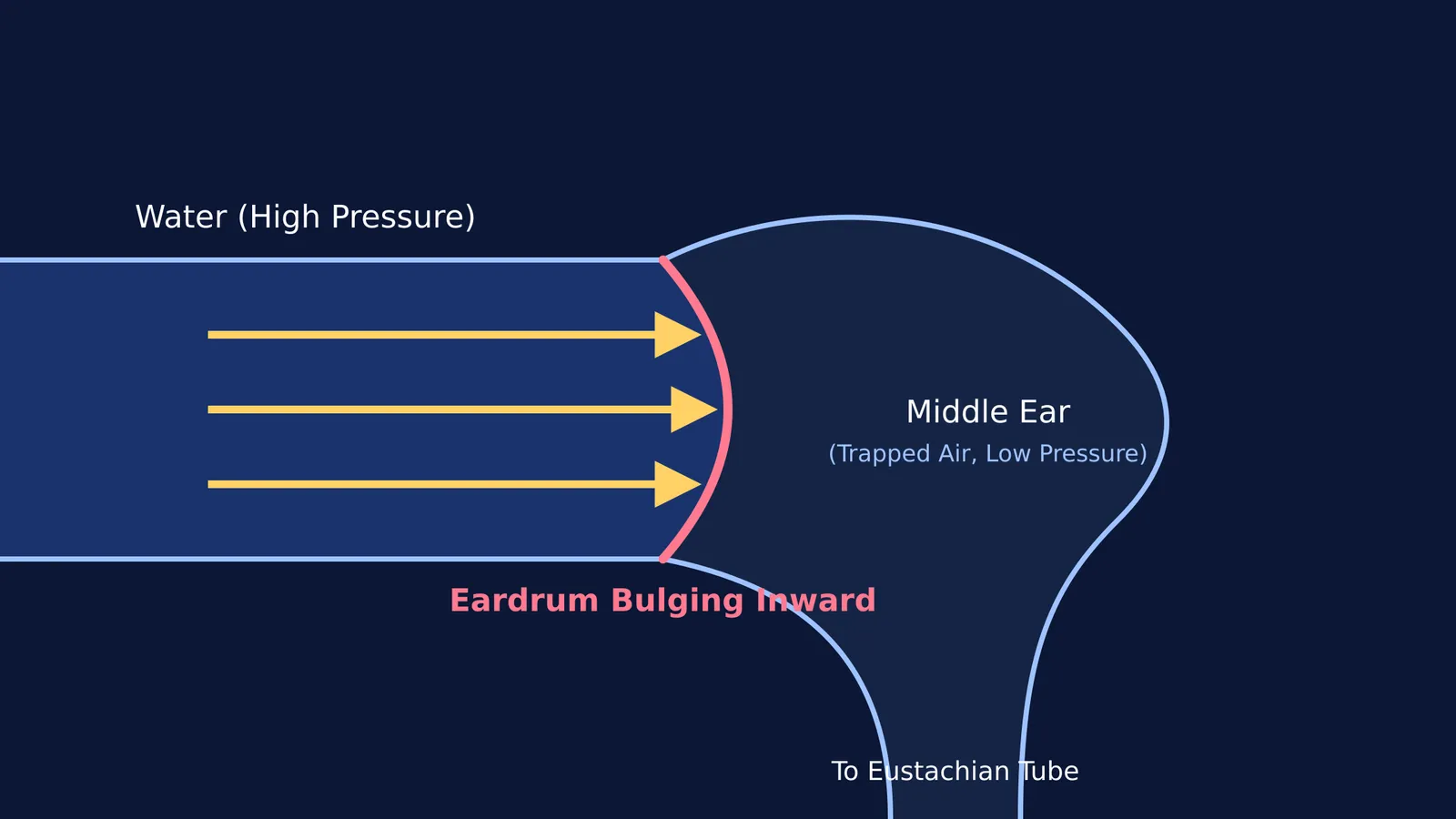
Before you jump into the pool, the air pressure inside your middle ear matches the atmospheric pressure outside (p₀). But when you dive deep, the external water pressure rapidly rises to p₀ + ρgh. Because the air inside your middle ear is trapped, its pressure does not change to match the water.
This creates a vacuum effect. The higher pressure of the water pushes inward, forcing the eardrum to bulge into the middle ear cavity. The Mayo Clinic notes that this stretching of the sensitive eardrum is what causes the sharp pain, a condition known as ear barotrauma. If the pressure difference becomes too extreme, it can cause severe pain or damage to the middle or inner ear.
The role of the Eustachian tube
To stop the eardrum from stretching, your body needs a way to add air to the middle ear, raising its internal pressure to match the water pressure outside. It does this using the Eustachian tube, a narrow passage that connects the middle ear to the back of the nose and throat.
When you swallow or yawn, muscles pull the Eustachian tube open, allowing a small amount of air to flow in and equalize the pressure. However, the external water pressure can squeeze this soft tube shut, making it difficult for air to pass. Furthermore, the Mayo Clinic warns that if you have a cold, sinus infection, or allergies, tissue swelling and mucus can block the Eustachian tube entirely, making equalization nearly impossible.
How can you stop your ears hurting underwater?
If you are diving, you have to actively open the Eustachian tubes before the pain becomes severe. Divers use a few reliable techniques to force air into the middle ear:
The Valsalva maneuver: Pinch your nostrils shut, close your mouth, and gently try to blow air out through your nose. This creates positive pressure in your throat that forces air up the Eustachian tubes. Do not blow too hard, as this can damage the inner ear.
Swallowing, yawning, and chewing gum: Swallowing naturally pulls on the muscles that open the tubes. Yawning or chewing gum can also help open them and break the seal.
Do not force it: If you cannot clear your ears, ascend to a shallower depth. Continuing to dive with blocked ears can cause lasting damage.
Understanding how pressure acts across boundaries is useful far beyond the swimming pool. In fluid mechanics, these same principles explain everything from why ships float to how Pascal's law in hydraulic machines allows a small push to lift a car. If you are calculating pressures for complex systems in physics, working through problems like finding the density of two immiscible liquids in a manometer can show you how to apply p = p₀ + ρgh step by step.


