

On this page
In the winter of 1942–1943, French naval officer Jacques-Yves Cousteau and engineer Émile Gagnan developed the first commercially successful open-circuit scuba system. By adapting a valve meant for car engines, they built the Aqua-Lung, a device that "cut the cord" to the surface and made extended underwater exploration a reality.
Why was diving so difficult before the Aqua-Lung?
Before 1943, divers faced severe physical and technical limits. Surface-supplied hard-hat diving tethered the diver to a pump on a boat, making them heavy and immobile on the seafloor.
Early independent scuba systems used either a constant flow of air or low-pressure tanks. The earlier Rouquayrol-Denayrouze apparatus, for example, was limited to dives of just 30 minutes 1.
Closed-circuit rebreathers offered another alternative, but they circulated pure oxygen. Breathing pure oxygen becomes toxic to the central nervous system below a depth of about 6 metres 4, strictly limiting how deep a diver could go.
How did the demand valve solve the pressure problem?
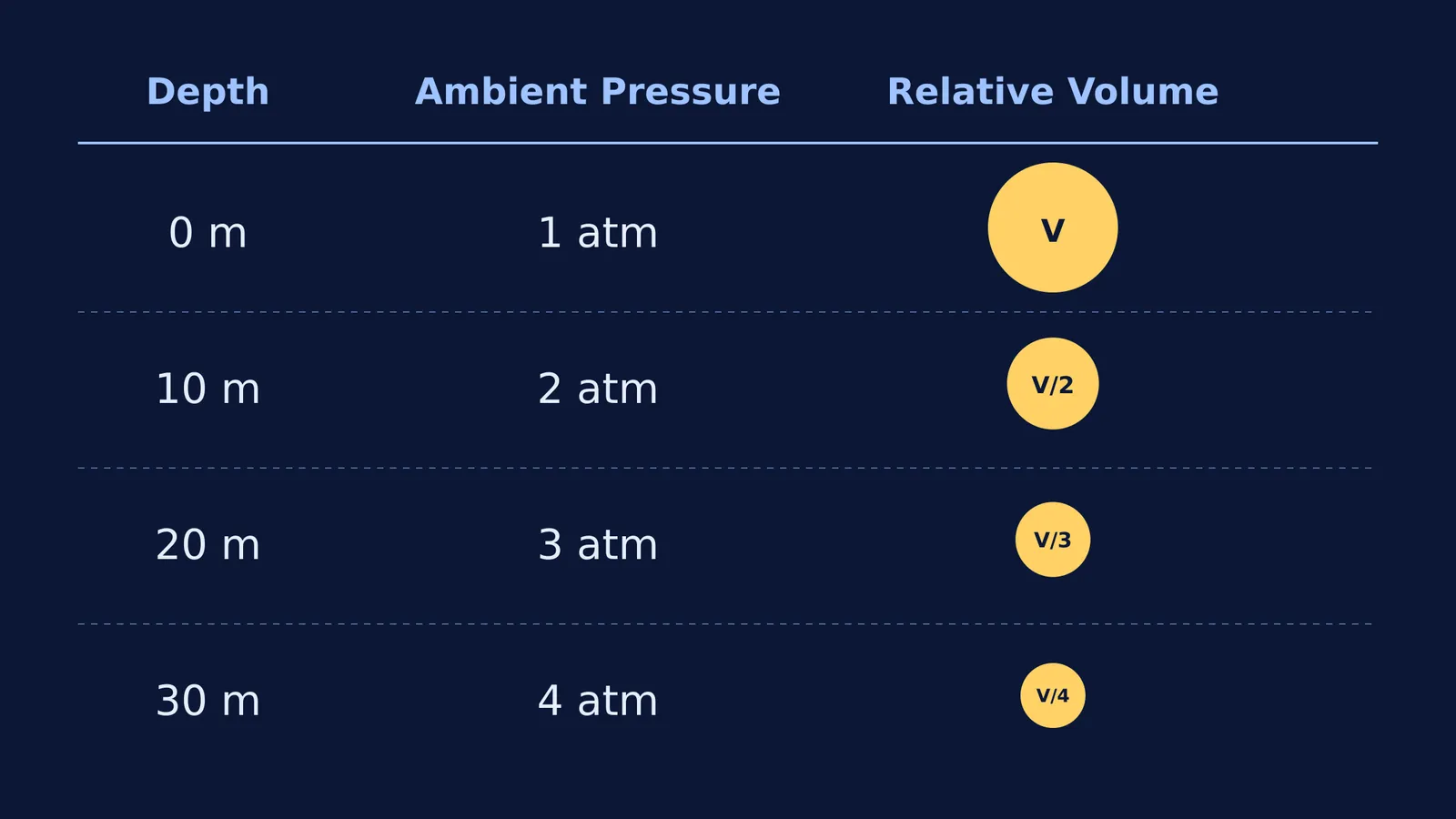
Water pressure increases by roughly 1 atmosphere (atm) for every 10 metres of depth 5. At 20 metres down, the ambient pressure is 3 atm. If a diver tries to breathe air supplied at surface pressure (1 atm) at that depth, the surrounding water pressure will crush their chest, making it impossible to expand the lungs.
Émile Gagnan, working for the Air Liquide company, had built a demand regulator to feed cooking gas into car engines to bypass wartime fuel shortages 2. Cousteau and Gagnan realised this valve could be modified to regulate breathing air under varying pressure conditions 2.
The resulting demand valve used a flexible diaphragm that separated the water outside from the air chamber inside. When the diver inhaled, the internal pressure dropped slightly below the ambient water pressure. The water then pushed the diaphragm inward, moving a lever that opened a valve connected to the air cylinder.
This ensured the diver received air at exactly the ambient pressure of the surrounding water, allowing the lungs to inflate naturally. The air tanks used with the Aqua-Lung could hold a pressure capacity of 200 atmospheres 1. This was a significant upgrade from the 30 atmospheres of earlier systems 1.
What happens to the air volume at depth?
A consequence of breathing air at ambient pressure is Boyle's Law, which states that the volume of a given mass of gas is inversely proportional to its pressure 6.
At 20 metres (3 atm), the air in a diver's lungs is three times as dense as it is at the surface. Because the demand valve delivers air at this higher pressure, each breath pulls three times as much air mass from the tank. This is why a diver's air supply depletes much faster on a deep dive than on a shallow one.
If you are studying fluid mechanics and gas laws, understanding how pressure dictates volume is essential. The Fermi Problem Library has worked problems with a step-by-step solver that explains the reasoning rather than printing an answer. The Fermi Simulation Lab has interactive simulations for the ideas that are easier to see than to read.
How do you calculate dive time using Boyle's Law?
You can predict how depth affects air supply using a simple framework based on ambient pressure. If a scuba tank lasts 60 minutes at the surface, how long does it last at 20 metres 5?
Find the ambient pressure: Water adds 1 atm of pressure for every 10 metres of depth. At 20 metres, the water exerts 2 atm. Add the 1 atm of atmospheric pressure at the surface to get a total ambient pressure of 3 atm.
Apply Boyle's Law: The physical volume of the diver's lungs remains constant, but the air filling them is now three times as dense.
Calculate the consumption rate: Each breath takes three times as much mass of air from the tank compared to breathing at the surface.
Find the new time: A tank that provides 60 minutes of air at 1 atm will last exactly one third of that time (60 / 3 = 20 minutes) at 3 atm.
When was the Aqua-Lung first tested?
The first prototypes were manufactured by Air Liquide and tested in the Mediterranean Sea in 1943 3. The demand valve proved highly effective, and the system enabled a diving duration of over 1 hour 1. Cousteau and Gagnan were issued their first patent for the device that same year 1.
In 1946, the first mass-produced model was released. It was named the CG45, standing for Cousteau-Gagnan 1945 1. The CG45 officially introduced the "Aqua-Lung" trade name for English-speaking markets, setting the mechanical foundation for all modern open-circuit scuba regulators 1.
For more on how pressure behaves in enclosed fluids, see our guide to Pascal's law in hydraulic machines. If you are calculating pressure differences yourself, this worked example of two immiscible liquids in a manometer shows how to set up the equations. You can also explore how gas laws plot on different axes in our review of converting PV, PT and VT graphs of ideal gas processes.


