

On this page
A hospital oxygen cylinder holds 30 L of gas. Its gauge reads 15 atm at 27 °C. Some oxygen is used, and later the gauge reads 11 atm at 17 °C. How much oxygen was drawn off? This is an NCERT Class 11 Kinetic Theory exercise. It is a two-state ideal gas problem: find the number of moles before and after, then subtract. Along the way it raises a question many students skip: should you use the gauge reading or the absolute pressure? The answer here is about 0.14 kg either way, and it is worth knowing why.
How do you find the gas used from two pressure readings?
The cylinder's volume does not change, but the amount of gas inside it does. So the useful form of the gas law is the one that gives the number of moles directly:
n = pV/(RT)
Work out n₁ for the first reading and n₂ for the second. The gas withdrawn is Δn = n₁ − n₂, and its mass is Δn × M, where M = 0.032 kg mol⁻¹ for O₂.
Three conversions come first:
Volume: 30 L = 0.030 m³.
Temperature: 27 °C = 300 K and 17 °C = 290 K. Kelvin is not optional here.
Pressure: 1 atm = 1.013 × 10⁵ Pa.
If you are unsure which gas-law form to reach for, see PV = nRT vs PV = NkT vs P = ρRT/M.
Should you use gauge pressure or absolute pressure?
PV = nRT needs absolute pressure, the total pressure the gas exerts. A gauge reads the pressure above atmospheric: p_gauge = p_abs − p_atm. That is why a flat tyre reads zero, as explained in gauge pressure vs absolute pressure.
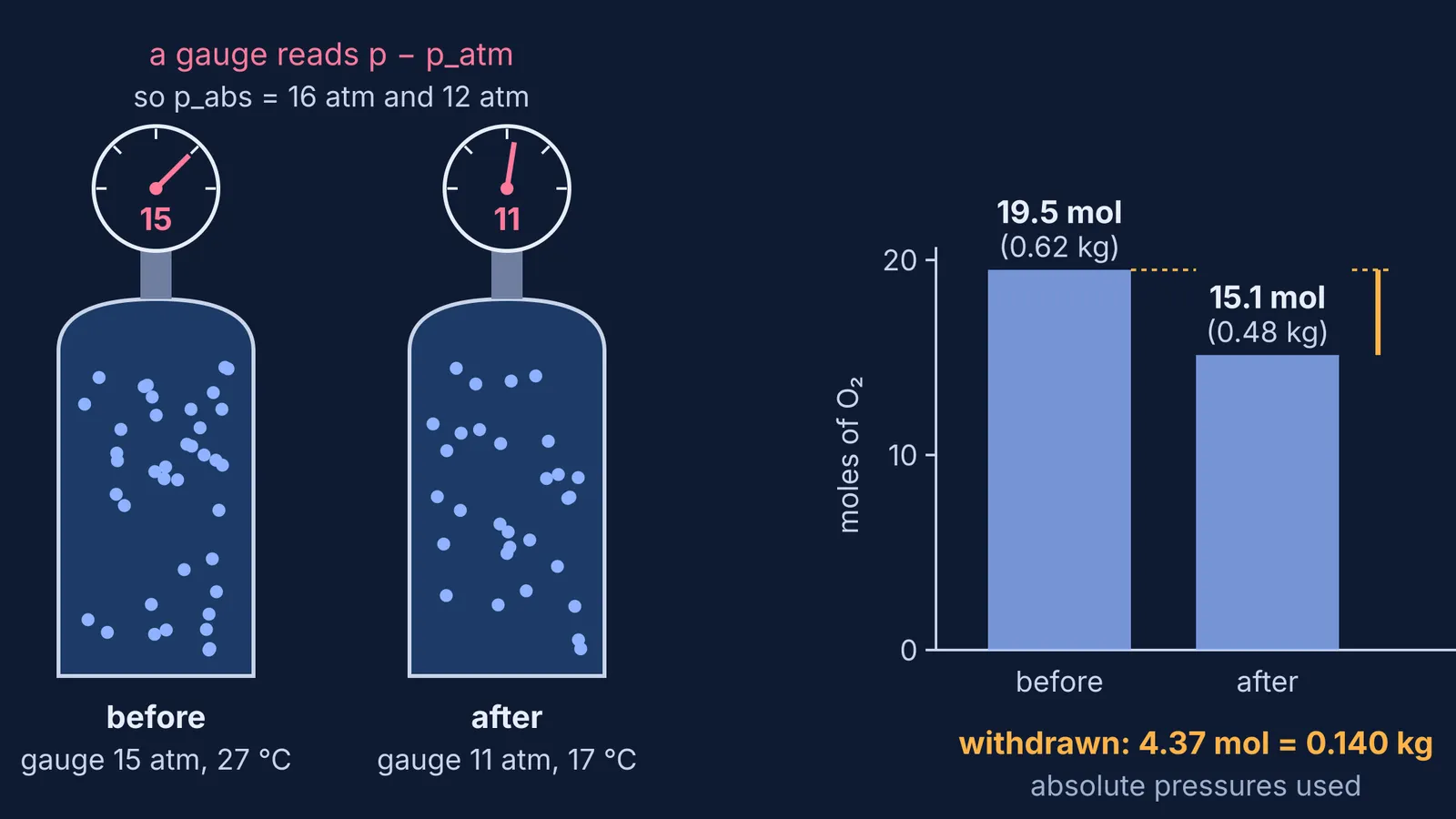
So strictly, 15 atm gauge means 16 atm absolute, and 11 atm gauge means 12 atm absolute.
NCERT's solution plugs in 15 and 11 atm as if they were absolute. That is not correct physics, but in this problem it barely changes the answer. You will see why after the numbers.
Worked example: the mass of oxygen withdrawn
Data: V = 0.030 m³, R = 8.314 J mol⁻¹ K⁻¹, M(O₂) = 32 g mol⁻¹.
Route 1, NCERT's numbers (gauge readings used as pressure)
Before: n₁ = (15 × 1.013 × 10⁵ × 0.030)/(8.314 × 300) ≈ 18.28 mol.
After: n₂ = (11 × 1.013 × 10⁵ × 0.030)/(8.314 × 290) ≈ 13.86 mol.
Moles withdrawn: Δn = 18.28 − 13.86 ≈ 4.41 mol.
Mass withdrawn: 4.41 × 0.032 ≈ 0.141 kg, NCERT's answer.
Route 2, correct absolute pressures (16 and 12 atm)
Before: n₁ = (16 × 1.013 × 10⁵ × 0.030)/(8.314 × 300) ≈ 19.49 mol, which is about 0.62 kg of O₂.
After: n₂ = (12 × 1.013 × 10⁵ × 0.030)/(8.314 × 290) ≈ 15.13 mol, about 0.48 kg.
Moles withdrawn: Δn ≈ 4.37 mol.
Mass withdrawn: 4.37 × 0.032 ≈ 0.140 kg.
Check the units: (Pa × m³)/(J mol⁻¹ K⁻¹ × K) = J/(J mol⁻¹) = mol. The two routes differ by less than 1%. About 22% of the gas was used, and at room pressure and 17 °C the 0.140 kg of oxygen would fill roughly 104 L.
Why does the extra 1 atm hardly matter here?
Compare the two routes. Using absolute pressure adds the same 1 atm to both readings. That adds an extra (1 atm × V)/(RT₁) moles to n₁ and (1 atm × V)/(RT₂) to n₂. When you subtract, these almost cancel:
extra term in Δn = (p_atm·V/R) × (1/T₁ − 1/T₂)
If T₁ and T₂ were equal, the extra term would be exactly zero, and gauge readings would give exactly the right Δn. Here the temperatures differ only slightly, 300 K and 290 K, so the extra term is only about −0.042 mol, roughly 1.3 g of oxygen.
That luck does not always hold. It breaks down when the pressures are low or the temperature change is large. Take a cylinder that goes from 2 atm gauge at 27 °C to 1 atm gauge at −3 °C. The gauge-as-absolute route gives about 34.7 g withdrawn, while the correct absolute route gives about 30.3 g, an error of roughly 14%. So the safe habit is simple: convert to absolute pressure every time.
Why is the gas colder after some is drawn off?
The question gives a lower temperature after the withdrawal, 17 °C instead of 27 °C. It is tempting to say the cylinder lost heat to the room, but that gets the cause wrong.
As oxygen flows out, the gas that stays behind expands to fill the whole cylinder. While it expands, it pushes the outgoing gas out through the valve, and so does work on it. The flow is fast, so there is little time for heat to come in from the metal walls or the room. With no heat coming in, the work done comes out of the internal energy of the remaining gas, and its temperature drops. Over time the cylinder warms back up toward room temperature by taking heat from the surroundings, not by losing it.
An LPG cylinder also gets cold in use, but there the main cause is different: liquid boiling inside takes latent heat, as described in why your LPG cylinder gets cold or frosty when used.
For more two-state gas problems where the conversions decide the answer, the Fermi Problem Library has a step-by-step solver that explains the reasoning at each stage.
Quick checklist
Gas used: Δn = n₁ − n₂ with n = pV/(RT), then multiply by M = 0.032 kg mol⁻¹.
30 L = 0.030 m³; 27 °C = 300 K; 17 °C = 290 K.
PV = nRT needs absolute pressure: p_abs = p_gauge + 1 atm.
NCERT's route gives 0.141 kg; absolute pressures give 0.140 kg.
The two agree here only because T barely changes; with low pressures or big temperature changes they do not.
The temperature drops because the remaining gas does work as it expands, not because heat leaks out.


