

On this page
Most gas questions in Class 11 physics, chemistry and JEE Main can be done with any of these three equations. Picking the one that matches the data saves you a conversion step.
Are PV = nRT, PV = NkT and P = ρRT/M the same equation?
Yes. All three describe the same ideal gas, just counted in different ways.
PV = nRT counts the gas in moles, n.
PV = NkT counts the gas in molecules, N.
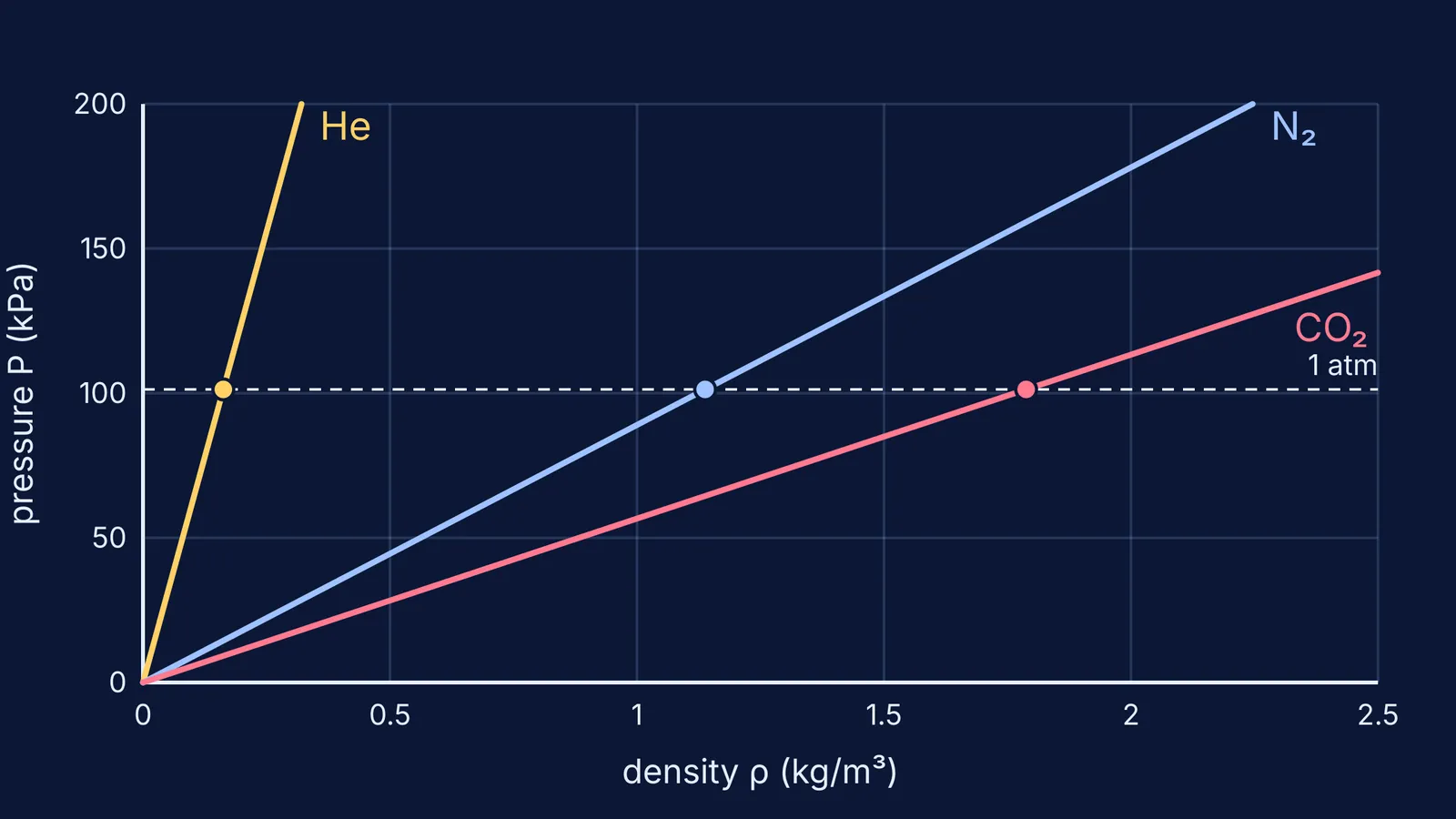
P = ρRT/M counts the gas by mass per unit volume, ρ.
The link between the first two is Avogadro's number. N = n × N_A, so nR = Nk only if k = R/N_A. NIST gives the molar gas constant R as 8.314 462 618... J mol⁻¹ K⁻¹, the Avogadro constant as 6.022 140 76 × 10²³ mol⁻¹ and the Boltzmann constant as 1.380 649 × 10⁻²³ J K⁻¹, and lists all three as exact. Divide the first by the second and you get the third. Our post on the relation between the Boltzmann constant and the gas constant goes through this step by step.
The density form comes from writing moles as mass over molar mass. Put n = m/M into PV = nRT to get PV = (m/M)RT. Divide both sides by V, and because m/V is the density ρ, P = ρRT/M. Engineers often fold R/M into one "specific gas constant". NASA's Glenn Research Center writes the equation of state in terms of density as p = r × R × T, with a specific gas constant for air of 0.286 kJ per kg per kelvin.
Which form of the gas equation is quickest to use?
Read the question and circle what it gives you and what it asks for. Then:
Moles, mass with a molar mass, or a container volume? Use PV = nRT.
Number of molecules, number density, or energy per molecule? Use PV = NkT, or P = n_v kT, where n_v = N/V is molecules per cubic metre. Kinetic theory questions usually want this form.
Density, molar mass from density, or comparing gases of different M? Use P = ρRT/M. Questions about vapour density, balloons and "which gas is heavier" are quickest this way.
If it gives two of these, match the quantity it asks for.
Worked examples: one condition, three forms
Take an ideal gas at 300 K. These numbers use NIST's R = 8.314 J mol⁻¹ K⁻¹ and k = 1.380 649 × 10⁻²³ J K⁻¹.
Example 1 (nRT). What volume do 0.5 mol take up at 1.0 × 10⁵ Pa? V = nRT/P = (0.5 × 8.314 × 300) / (1.0 × 10⁵) ≈ 0.0125 m³, which is about 12.5 L.
Example 2 (NkT). How many molecules are in 1 cm³ of that gas at the same pressure? 1 cm³ = 1.0 × 10⁻⁶ m³. N = PV/kT = (1.0 × 10⁵ × 1.0 × 10⁻⁶) / (1.380 649 × 10⁻²³ × 300) ≈ 2.4 × 10¹⁹ molecules. With nRT you would need an extra step through N_A.
Example 3 (ρRT/M). What is the density of carbon dioxide, treated as an ideal gas, at 1 atm and 300 K? NIST gives the standard atmosphere as exactly 101 325 Pa, and the NIST Chemistry WebBook gives CO₂ a molecular weight of 44.0095, so M = 0.044 01 kg/mol. ρ = PM/RT = (101 325 × 0.044 01) / (8.314 × 300) ≈ 1.79 kg/m³, the same as 1.79 g/L.
To go the other way and find M from a measured density, rearrange to M = ρRT/P. Our guide to finding the molar mass of a gas from its density works several of these through.
What mistakes make students pick the wrong answer?
Celsius instead of kelvin. Every form needs absolute temperature. Here is why kelvin must be used in gas law calculations.
M in g/mol with P in pascals. With SI pressure and R = 8.314 J mol⁻¹ K⁻¹, M must be in kg/mol, or your density comes out 1000 times too big.
Mixing the constants. R goes with moles and k goes with molecules. PV = nkT with n in moles will not balance.
Two meanings of n. Chemistry books use n for moles. Physics books often use n for number density. Write n_v or N/V for number density so you cannot mix them up.
Wrong R for the units. R = 8.314 needs pascals and cubic metres. Since 1 atm is 101 325 Pa, for atm and litres divide by 101.325 to get about 0.0821 L atm mol⁻¹ K⁻¹.
If the idea behind the three forms still feels shaky, the Fermi Concept Library has a lesson for each concept in physics and chemistry, and shows where it sits in the map. When the trouble is choosing a method under time pressure, the Fermi Problem Library has worked problems with a step-by-step solver that explains the reasoning rather than printing an answer.
Next time you see a gas numerical, circle what it gives you before you write an equation.


