

On this page
When a gas gets hotter, it expands, or its pressure rises. Two fundamental rules describe this behaviour: Charles's law says volume is directly proportional to temperature, and Gay-Lussac's law says pressure is directly proportional to temperature.
But there is a catch. If you change the temperature of a gas from 10 °C to 20 °C, its volume does not double.
To calculate the new volume or pressure accurately, you must convert every temperature to the Kelvin scale. Here is why Celsius breaks the maths, and how the Kelvin scale fixes it.
Why must temperature be in Kelvin for gas laws?
A direct proportion means that when one value doubles, the other must double. This mathematical rule only works if both scales start at a true, physical zero.
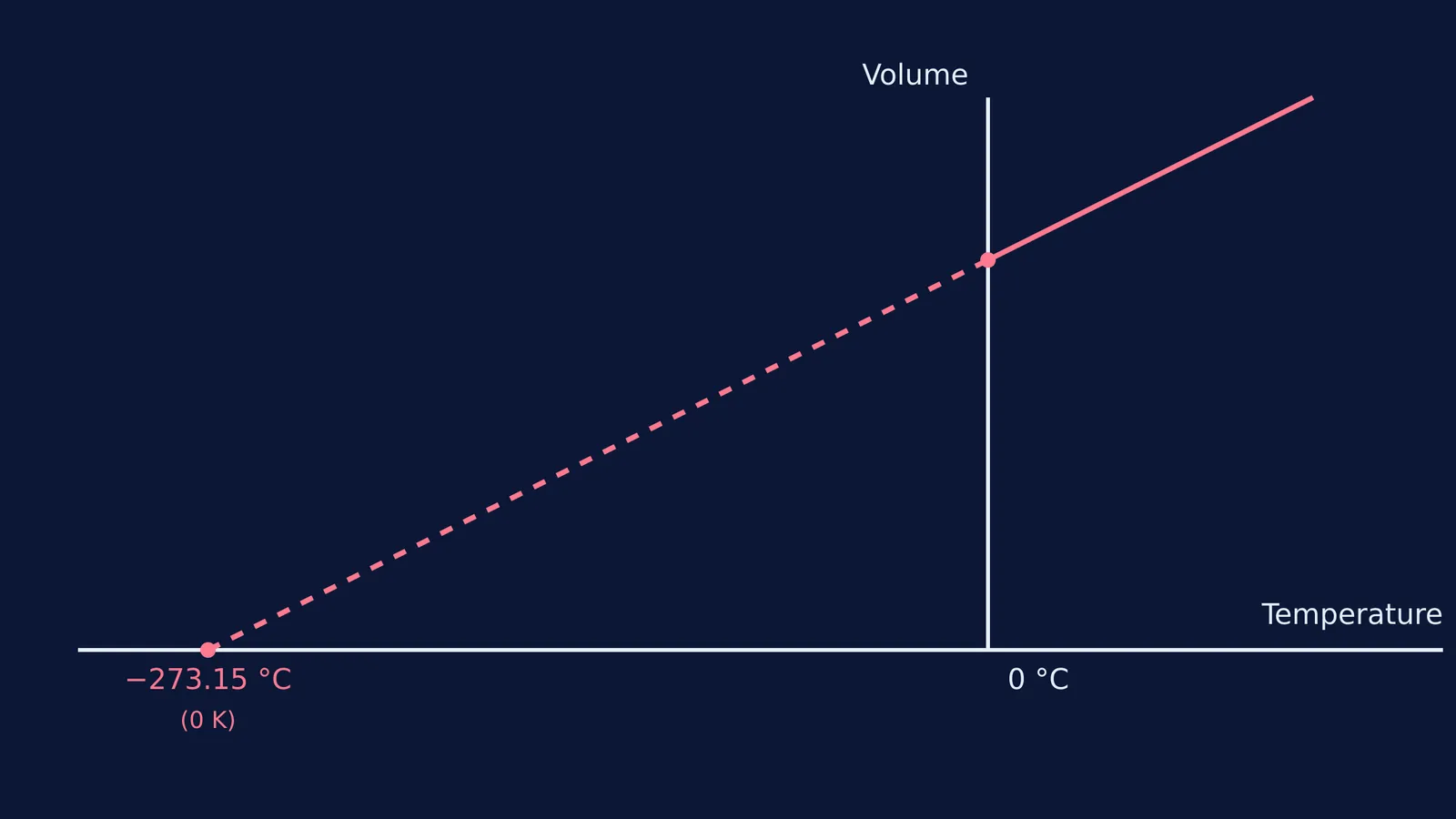
The Kelvin scale is an absolute temperature scale: 0 K represents absolute zero, the theoretical point where molecular motion stops and a gas would have zero volume. The OpenStax Chemistry textbook notes that volume is directly proportional to temperature on the Kelvin scale.
The Celsius scale, by contrast, has an arbitrary zero point based on the freezing point of water. Because 0 °C is not the bottom of the temperature scale, a reading of 20 °C does not mean there is double the heat energy as at 10 °C. The ratio of the temperatures on the Celsius scale does not match the true ratio of the thermal energies inside the gas.
If you try to substitute a Celsius value into an equation like PV = nRT when calculating the average molar mass of a gas mixture, the Fermi Problem Library offers worked problems with a step-by-step solver that explains the reasoning rather than printing an answer, helping you correct the method before moving on.
What happens if you use Celsius in Charles's law?
First, consider cooling a gas below zero. If you have 5 litres of gas at 10 °C and cool it to −10 °C, using a negative number in the formula would yield a negative volume. A gas cannot take up less than zero space.
Second, consider what happens at exactly 0 °C. If the final temperature (T₂) is zero, multiplying by it gives a zero volume. Worse, if the starting temperature (T₁) is 0 °C, the equation becomes undefined because you cannot divide by zero. In reality, a gas at 0 °C has a perfectly measurable, finite volume.
How do you convert between Celsius and Kelvin?
Converting is a straightforward addition. Absolute zero is defined exactly as −273.15 °C. Therefore, to change any Celsius temperature to Kelvin, you add 273.15.
For example, a room temperature of 25 °C becomes 298.15 K. If an exam problem states the temperature in Celsius, make this conversion your very first step before doing any algebra.
How does Celsius give the wrong answer in a calculation?
Suppose a balloon holds 2.50 L of helium at 20 °C, a classic setup described in chemistry texts. If it is moved to a hot room at 40 °C, what is the new volume?
If you wrongly use Celsius, you might assume the volume doubles because 40 is the double of 20. That mistaken logic would predict a final volume of 5.00 L.
Here is the correct method using the absolute scale:
Convert the initial temperature: 20 °C + 273.15 = 293.15 K.
Convert the final temperature: 40 °C + 273.15 = 313.15 K.
Rearrange Charles's law to solve for the final volume: V₂ = V₁ × (T₂ / T₁).
Calculate the result: V₂ = 2.50 × (313.15 / 293.15) = 2.67 L.
The volume increases only slightly, from 2.50 L to 2.67 L, because the absolute temperature only increased from 293.15 K to 313.15 K.
Does Gay-Lussac's law also require Kelvin?
Just like volume, pressure is caused by the kinetic energy of the gas molecules striking the walls of their container. Because this kinetic energy is directly tied to the absolute temperature, the pressure of an ideal gas falls to zero only at absolute zero.
If you use Celsius in Gay-Lussac's law, you run into the exact same mathematical traps: negative pressures at sub-zero temperatures, and undefined division at 0 °C.
To avoid these traps, simply remember that T in any gas equation—whether it is the ideal gas law, Charles's law, or Gay-Lussac's law—always stands for thermodynamic temperature in Kelvin. This principle is also critical when you are converting PV, PT and VT graphs of ideal gas processes, as the linear lines on those graphs must point towards absolute zero. If you need to review the kinetic theory behind these rules, the Fermi Concept Library offers every concept in physics, chemistry, biology, mathematics and computing, each with its own lesson and its place in the map.


