

On this page
You switch on the mixer for chutney and the kitchen fills with a howl. Behind it is a universal motor, and three facts about it explain what you notice: it runs on AC, it changes speed with the knob, and it is loud.
What kind of motor is inside a mixer grinder?
A universal motor is a series-wound motor: its field coils and its armature (the spinning rotor) are connected in series, and current reaches the rotor through brushes pressing on a commutator, as Wikipedia's universal motor article explains. Universal motors are used in home appliances such as "drink and food mixers", notes Electrical Easy.
Wikipedia lists why designers pick it: high starting torque, high speed, and a light, compact build. That suits a mixer, which must start under a jar of soaked rice. If the force on a coil is new to you, start with our derivation of the torque on a rectangular coil in a magnetic field.
Why does a mixer motor run on AC?
The force on a wire in a magnetic field depends on the directions of both current and field. Reverse one and the push reverses; reverse both and it stays the same. In a series motor one current flows through the field coils and the rotor, so when AC flips, both flip together, "in such a way that the direction of force experienced by armature conductors remains same", in the words of Electrical Easy.
Work through one cycle of the mains:
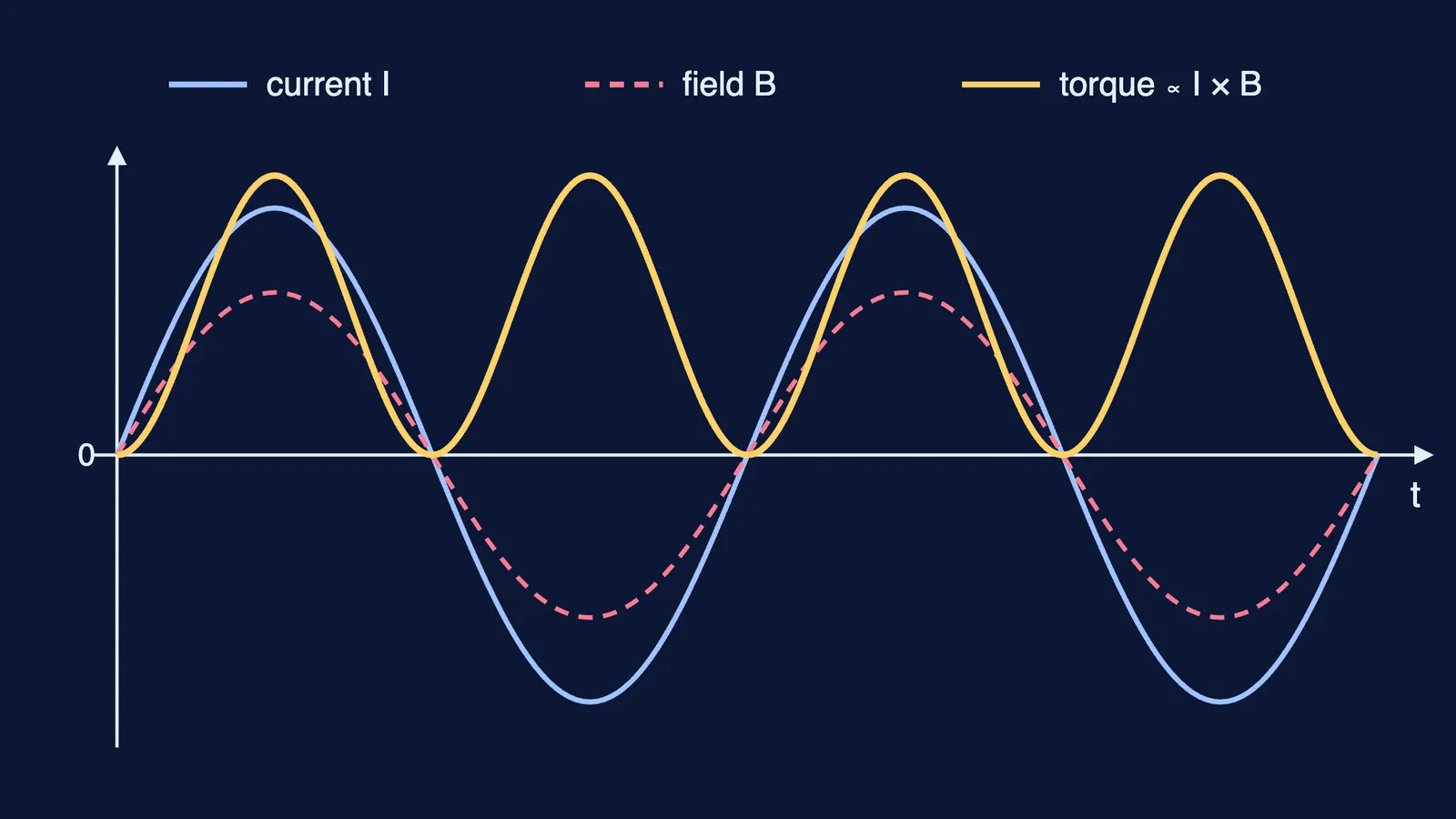
First half-cycle: current positive, field positive. Torque goes as (+) × (+), so it is positive.
Second half-cycle: current negative, field negative. Torque goes as (−) × (−), still positive.
The field follows the current, so torque rises as the square of the current, as Wikipedia notes for series motors. It pulses, but it never changes sign. That is the yellow curve in the diagram at the top.
India's grid has a nominal frequency of 50 Hz, and the Indian Electricity Grid Code band tops out at 50.05 Hz, as a CERC order of March 2025 records. So the torque pulses twice per cycle, about 100 times a second. The cost of AC: the whole magnetic path must be laminated against eddy currents, and the motor runs slower than on DC of the same voltage (Electrical Easy).
Why does a mixer grinder motor spin so fast?
AC synchronous and squirrel-cage induction motors cannot turn faster than the mains frequency allows; Wikipedia notes the limit is 3,600 rpm on a 60 Hz supply. On India's 50 Hz the same rule (speed = 60 × frequency for the fastest, two-pole design) gives 3,000 rpm. A universal motor has no such link to the mains: universal motors generally run at 4,000 to 16,000 rpm and can go over 20,000 rpm, the same article says. (The induction motor's limit comes from its rotating field: see how Galileo Ferraris's rotating magnetic field turns a motor.)
Worked example: suppose a blade tip sits 4 cm from the shaft and turns at 15,000 rpm. Tip speed = 2π × 0.04 m × 15,000 ÷ 60 ≈ 63 m/s, about 226 km/h.
How do the speed settings on a mixer work?
Series motors slow down as load rises and speed up as it falls. As the motor speeds up, the field weakens, so in theory it has no maximum speed, and running it with no significant load can over-speed and damage it, says Wikipedia.
For the knob, the same article notes that "multiple taps on the field coil provide (imprecise) stepped speed control", and that household blenders with many speeds often combine field taps with a diode that feeds the motor half-wave AC. Wiring differs between models. The idea: with a weaker field, the rotor must spin faster before its back emf balances the supply, so fewer field turns means more speed.
Why is a mixer grinder so loud?
Universal motors "are typically very noisy, both acoustically and electromagnetically", partly because of the commutator, according to Wikipedia. In a mixer, several likely sources of sound add up:
The commutator and brushes, where the current is switched and sparks can form.
A fan on the motor shaft, which Wikipedia notes also acts as a load that limits the speed in some small motors.
Blades and food striking the jar, and the base shaking the counter it stands on.
Use the physics: a checklist for your mixer
Do not run it empty for long. A series motor with no load races.
Start hard items on the lowest setting, then step up.
Grind in short bursts with pauses. Universal motors suit devices used intermittently, and small ones are only around 30% efficient, so much of the input becomes heat (Wikipedia). Our explainer on why your mixer jar gets hot while grinding covers the heat side.
Stand the base on a firm, flat surface so it rattles less.
Smell burning, see heavy sparking at the vents, or hear a hum with no spin? Switch off, unplug and get it serviced. Brushes wear out.
If the current-squared idea is hard to picture, the Fermi Simulation Lab has interactive simulations for ideas that are easier to see than to read. Unsure where magnetic force ends and AC begins? Fermi's AI tutor works out what you already know and builds a plan for the session.


