On this page
In the late summer of 1885, Galileo Ferraris, a professor in Turin, put a copper drum between two coils and watched it turn with nothing touching it. The Dictionary of Scientific Biography entry on Ferraris dates these tests to August and September 1885, with one coil fed by a small Siemens alternator and the other by a Gaulard transformer.
What did Galileo Ferraris build in 1885?
The IEEE Milestone citation sums it up: Ferraris's field was "produced by two stationary coils with perpendicular axes" and "driven by alternating currents phase-shifted by 90 degrees." He presented the work to the Academy of Sciences in Turin in March 1888, as "Electrodynamic rotations by means of alternating currents".
His first rotor was a small hollow copper cylinder; a later one weighed 10 lb and was 18 cm long and 8.9 cm across, according to Wikipedia's page on Ferraris' motor.
How do two out-of-phase currents make a magnetic field spin?
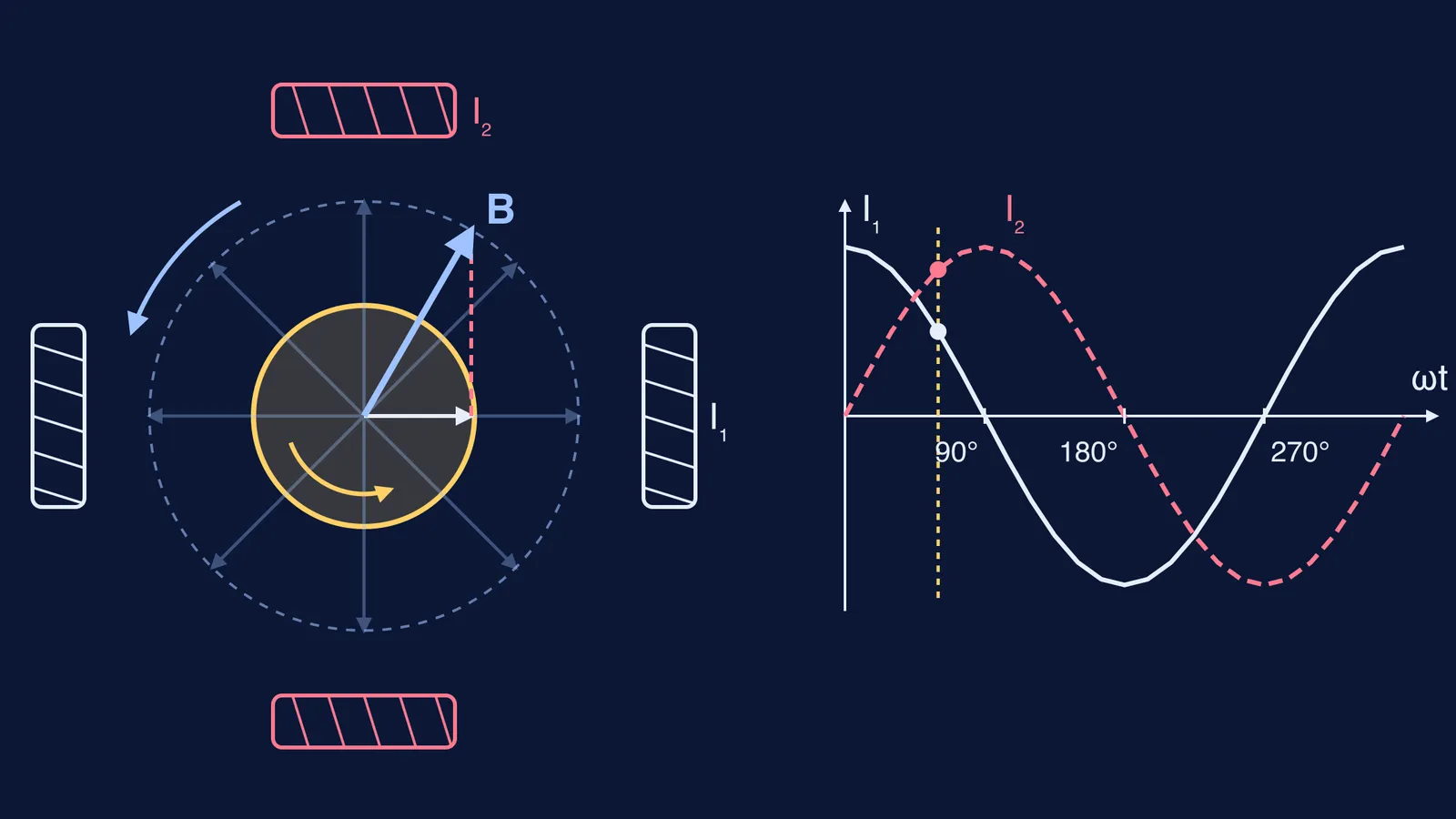
In the diagram at the top, coil pair 1 (left and right) makes a field along the horizontal axis and coil pair 2 (top and bottom) along the vertical axis, each proportional to its coil's current.
Let I1 = I0 cos ωt and I2 = I0 sin ωt. Sine lags cosine by exactly a quarter cycle, which is Ferraris's 90 degrees. The total field is the vector sum, B = B0 (cos ωt, sin ωt). Step through one cycle:
ωt = 0: I1 is at maximum, I2 is zero. B points right.
ωt = 45°: both currents are 0.71 of maximum. B points up and right.
ωt = 90°: I1 is zero, I2 is at maximum. B points straight up.
ωt = 180°: I1 is at its negative maximum. B points left.
ωt = 270°: I2 is at its negative maximum. B points down, and the cycle repeats.
The size of B never changes, because cos²ωt + sin²ωt = 1. Only its direction changes, one full turn per supply cycle, even though the coils themselves never move.
If the spinning arrow is hard to picture from a still diagram, the Fermi Simulation Lab has interactive simulations for ideas that are easier to see than to read.
Why does a copper drum chase a rotating magnetic field?
Copper is not pulled by a magnet the way iron is. Instead, the field sweeps past the drum, so the flux through every small loop in the copper keeps changing. That change induces swirling eddy currents. By Lenz's law, those currents oppose their cause, which is the field moving relative to the drum. The drum reduces that relative motion by turning the same way as the field.
It can never quite catch up. As Wikipedia's induction motor article puts it, "Since rotation at synchronous speed does not induce rotor current, an induction motor always operates slightly slower than synchronous speed." The gap is called slip, s = (ns − nr)/ns, where ns is the field's speed and nr the rotor's. The same article gives typical slip of about 0.5% to 5% for standard Design B induction motors.
How fast does the field turn on Indian mains?
Synchronous speed is ns = 120f/p, where f is the supply frequency in hertz and p the number of poles (induction motor article). India's national grid runs nominally at 50 Hz, according to the National Grid (India) article). A worked example:
Ferraris's layout is a 2-pole field: ns = 120 × 50 / 2 = 3000 rpm, one turn per cycle.
A 4-pole motor: ns = 120 × 50 / 4 = 1500 rpm.
If that rotor turns at 1440 rpm under load, s = (1500 − 1440)/1500 = 0.04, or 4%, inside the typical range above.
Try it yourself: a 6-pole motor on 50 Hz has its rotor at 960 rpm. Find ns and the slip. (Answers: 1000 rpm and 4%.) In an exam, if asked why the rotor is slower than the field, do not say friction: at equal speed there is no relative motion, so no induced current and no torque.
If you get stuck setting up numericals like these, the Fermi Problem Library has worked problems with a step-by-step solver that explains the reasoning rather than printing an answer.
Who invented the induction motor, Ferraris or Tesla?
Both reached the rotating field independently, at about the same time. Ferraris published in March 1888; about two months later, Nikola Tesla was granted US patent 381,968, which he had applied for on 12 October 1887, as the Wikipedia biography of Ferraris records. Read the other side in our piece on Nikola Tesla and alternating current, and see where the idea went next in Dolivo-Dobrovolsky's three-phase system.
Ferraris never patented his invention. The IEEE Milestone proposal quotes him: "I am attracted by the scientific aspect of inventions more than by the industrial one, by the intellectual achievement more than by the practical exploitation."
Next time an induction motor hums into life, picture two currents a quarter-cycle apart, a field arrow sweeping round, and a rotor running just behind it.