

On this page
The "War of the Currents" between direct current (DC) and alternating current (AC) defined the early days of electrification. DC systems championed by Thomas Edison could not transmit power over long distances without high energy losses, requiring power stations to be built every few miles. While AC could be stepped up to high voltages for efficient, long-distance transmission, early single-phase and two-phase AC systems lacked a robust, self-starting motor for industrial use. The missing link for global electrification was the practical application of three-phase power, an advance largely credited to the Russian-born engineer Mikhail Dolivo-Dobrovolsky.
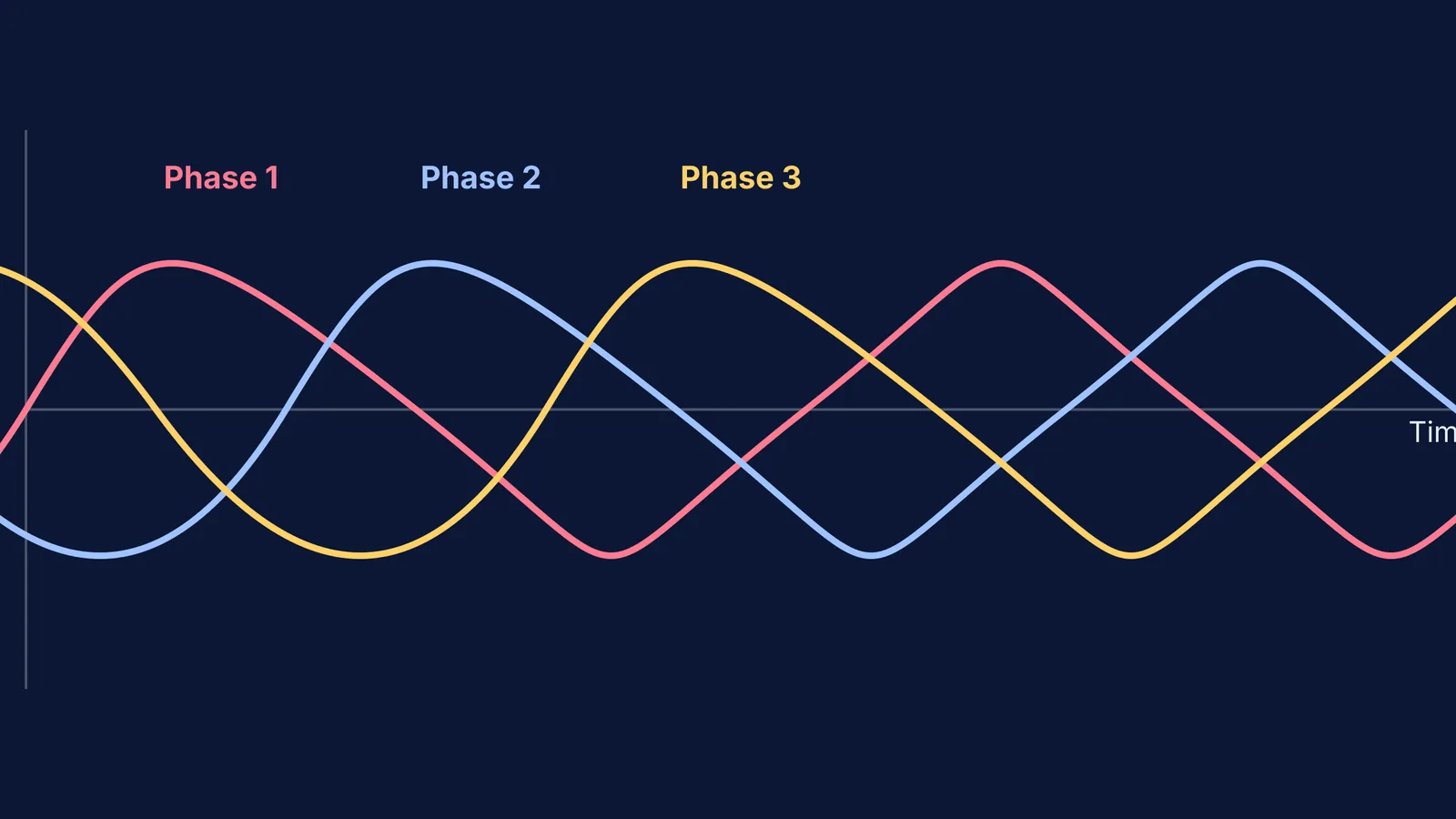
Working as an electrical engineer for AEG in Germany, Dolivo-Dobrovolsky realised that three separate alternating currents, spaced exactly 120 degrees apart, could create a perfectly smooth and continuous rotating magnetic field (Wikipedia). In 1888, he developed the world's first three-phase electric generator and three-phase motor. By 1891, he had built the squirrel-cage induction motor. This design had no brushes or commutators to spark and wear out, making it cheap to manufacture, reliable, and powerful enough to drive heavy factory machinery.
How does a three-phase system save copper?
Dolivo-Dobrovolsky also introduced the star (Y) and delta (Δ) circuit connections, which transformed how electrical networks were wired. His key insight was that in a balanced three-phase system, the sum of the three alternating currents at any instant is exactly zero. Because the returning currents completely cancel each other out, the return neutral wire can be eliminated or significantly reduced in size.
This meant that power could be transmitted using only three wires instead of the four or six required by competing polyphase systems, sharply reducing the cost of copper over long distances (Wikipedia). Less copper meant lighter cables, cheaper transmission towers, and the ability to send power over vast distances economically.
Visualising how three out-of-sync sine waves add up to a smoothly rotating magnetic field is notoriously hard to do from a textbook page. For the ideas that are easier to see than to read, you can run interactive models in the Fermi Simulation Lab. And when you sit down to calculate phase angles and root-mean-square voltages, the Fermi Problem Library has worked problems with a step-by-step solver that explains the reasoning rather than printing an answer.
How did the Lauffen-Frankfurt transmission prove the concept?
To prove that three-phase AC was the superior choice for large-scale power distribution, Dolivo-Dobrovolsky and his partner Charles E. L. Brown set up a massive demonstration for the 1891 International Electrotechnical Exhibition in Frankfurt (Wikipedia).
They connected a 300-horsepower generator to a water turbine in Lauffen am Neckar. Dolivo-Dobrovolsky's newly invented three-phase transformer stepped the voltage up from 50 V to 15,000 V. The electrical power then travelled over 175 km of overhead copper lines to the exhibition grounds in Frankfurt. There, it was stepped down to power 1,000 incandescent lamps and a 100-horsepower asynchronous motor that drove an artificial waterfall for the exhibition visitors (Wikipedia).
A test committee confirmed that the transmission system operated with a 75% efficiency (Wikipedia). This clear success proved that long-distance electrical transmission was not just possible, but highly profitable. It effectively ended the debate: three-phase AC became the worldwide standard for power generation and transmission, and it remains the backbone of the global electrical grid today.
Why do three phases sum to zero?
To understand why Dolivo-Dobrovolsky's system works without a thick return wire, look at the mathematics of the three currents. If the peak current is I₀, the three phases offset by 120° (or 2π/3 radians) are:
I₁ = I₀ sin(θ)
I₂ = I₀ sin(θ − 120°)
I₃ = I₀ sin(θ − 240°)
Using the trigonometric identity sin(A − B) = sin A cos B − cos A sin B:
I₂ = I₀ [sin θ cos 120° − cos θ sin 120°] = I₀ [−0.5 sin θ − (√3/2) cos θ]
I₃ = I₀ [sin θ cos 240° − cos θ sin 240°] = I₀ [−0.5 sin θ + (√3/2) cos θ]
Adding all three currents together: I₁ + I₂ + I₃ = I₀ sin θ + I₀ [−0.5 sin θ − (√3/2) cos θ] + I₀ [−0.5 sin θ + (√3/2) cos θ] I₁ + I₂ + I₃ = I₀ [sin θ − 0.5 sin θ − 0.5 sin θ] + I₀ [−(√3/2) cos θ + (√3/2) cos θ] I₁ + I₂ + I₃ = 0
Because the mathematical sum is constantly zero, the physical system is perfectly balanced. You can explore similar principles in our guide to Nikola Tesla and alternating current, or learn how these magnetic fields generate mechanical motion in our review of the magnetic force on charges and wires.


