

On this page
The torque on a current loop looks long in the textbook, but it rests on three ideas: find the force on each side, see which forces cancel completely, and turn the leftover pair into a couple. Seen that way, it takes about six lines, and you will use it again in galvanometer and motor problems.
What is the set-up for a rectangular coil in a magnetic field?
Take a coil of N turns with sides a and b, carrying current I in a uniform field B. It turns about an axis through its centre, parallel to the b sides, with B perpendicular to that axis. Measure θ between the coil's normal (your right thumb when your fingers curl with the current) and B, as OpenStax University Physics Volume 2, section 11.5 does.
What force acts on each of the four sides?
Use F = I L × B on each side, one turn at a time. OpenStax gets the same four forces.
The two a sides cross the axis, at an angle to B that changes as the coil turns. Each feels IaB cos θ along the axis, one up and one down.
The two b sides run along the axis and stay perpendicular to B. Each feels IbB, perpendicular to both B and the axis, in opposite directions.
For N turns, multiply each force by N.
Which forces cancel on a current loop in a uniform field?
All four, when you add them. Each pair is equal and opposite, so the net force is zero, which OpenStax notes holds for a loop of any shape in a uniform field. We explain why in why a current loop feels no net force in a uniform field.
Zero force is not zero torque. Ask of each pair: do the two forces act along the same line?
The IaB cos θ pair: yes. Both act along the axis, so they only stretch the coil. No torque.
The IbB pair: no. They push on opposite edges. That is a couple, and it turns the coil.
How do you get τ = NIAB sin θ from the remaining pair?
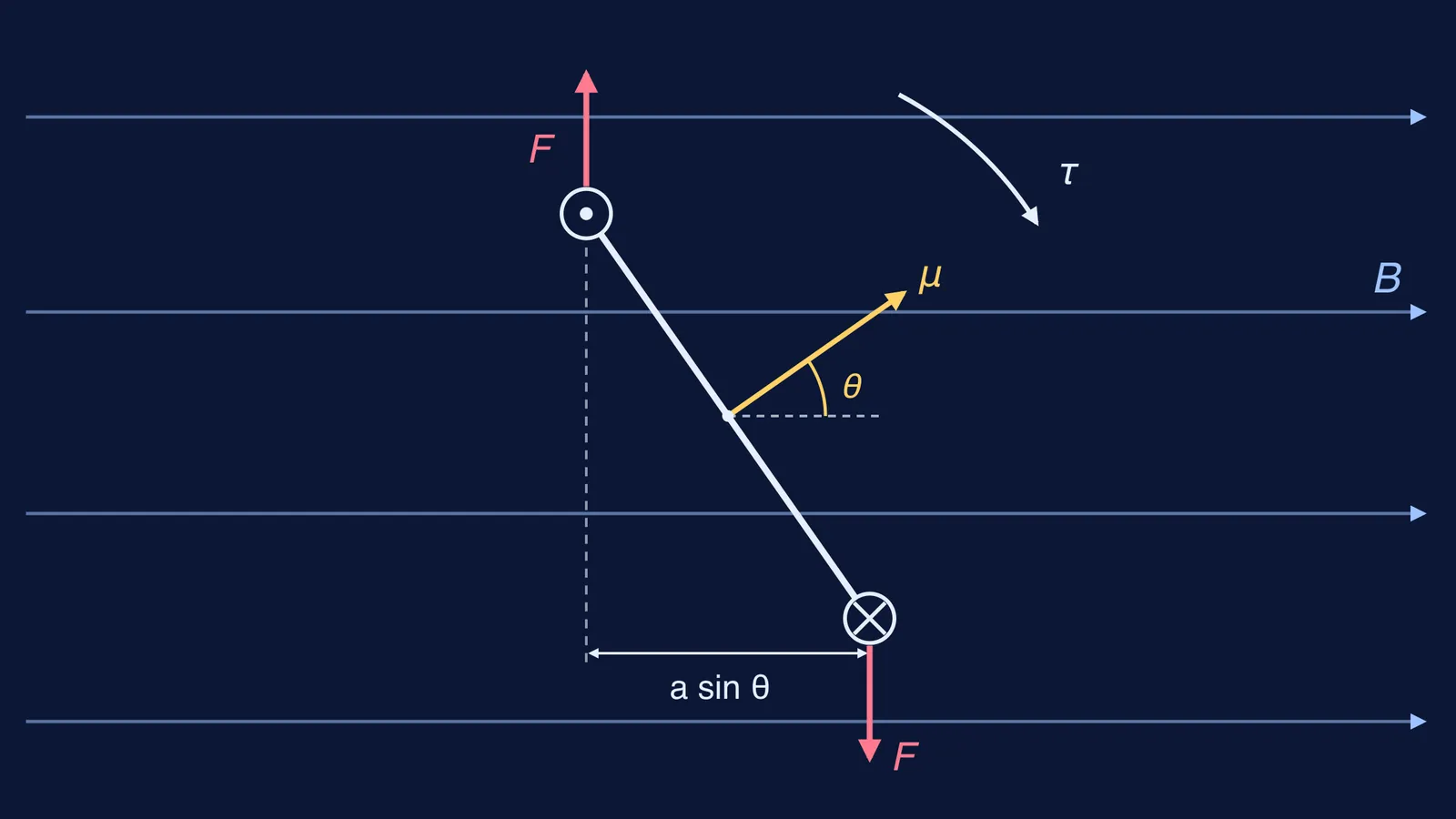
A couple's torque is one force times the perpendicular distance between the lines of action. Look down the axis, as in the diagram above. The coil appears as a line of length a with its normal at θ to B. Both forces are perpendicular to B, so the gap between them is the part of a along B: a sin θ.
Force on one b side, all N turns: F = NIbB.
Distance between the lines of action: a sin θ.
Torque: τ = NIbB × a sin θ = NI(ab)B sin θ.
With area A = ab: τ = NIAB sin θ.
With μ = NIA as the magnetic dipole moment, this is τ = μB sin θ, the size of τ = μ × B in OpenStax. The torque turns μ towards B. It is largest at θ = 90 degrees (coil plane along B) and zero at θ = 0. If the unit of μ puzzles you, see why magnetic moment can be written in A m² or J/T.
Worked example: how much torque acts on a 100-turn coil?
We use the OpenStax formula, then check with forces. A 100-turn coil, 5 cm by 4 cm, carries 2 A in a uniform 0.5 T field. The 5 cm sides lie along the axis, and the normal is at 30 degrees to the field.
Area: A = 0.05 × 0.04 = 2 × 10⁻³ m².
Moment: μ = NIA = 100 × 2 × 2 × 10⁻³ = 0.4 A m².
Torque: τ = μB sin θ = 0.4 × 0.5 × 0.5 = 0.1 N m.
Check: each 5 cm side feels F = NIbB = 100 × 2 × 0.05 × 0.5 = 5 N, and the arm is 0.04 × sin 30° = 0.02 m, so τ = 0.1 N m again. At 90 degrees the same coil feels 0.2 N m.
What mistakes cost marks in this derivation?
Using the angle with the plane instead of the normal.
Saying the a-side forces give no torque because they are equal and opposite. The b pair is equal and opposite too; the a pair gives no torque because its two forces act along the same line.
Taking the arm as a instead of a sin θ.
Not stating that B is uniform. The cancellation depends on it.
A moving-coil galvanometer keeps sin θ at 1 by shaping its field, which we cover in why a moving-coil galvanometer needs a radial field.
If you keep slipping on the angle or the arm, try torque problems in the Fermi Problem Library, whose step-by-step solver explains the reasoning rather than printing an answer. For magnetic moment itself, the Fermi Concept Library gives each physics concept its own lesson.
Next time, draw the top view first, mark a sin θ, then write the four steps.


