

On this page
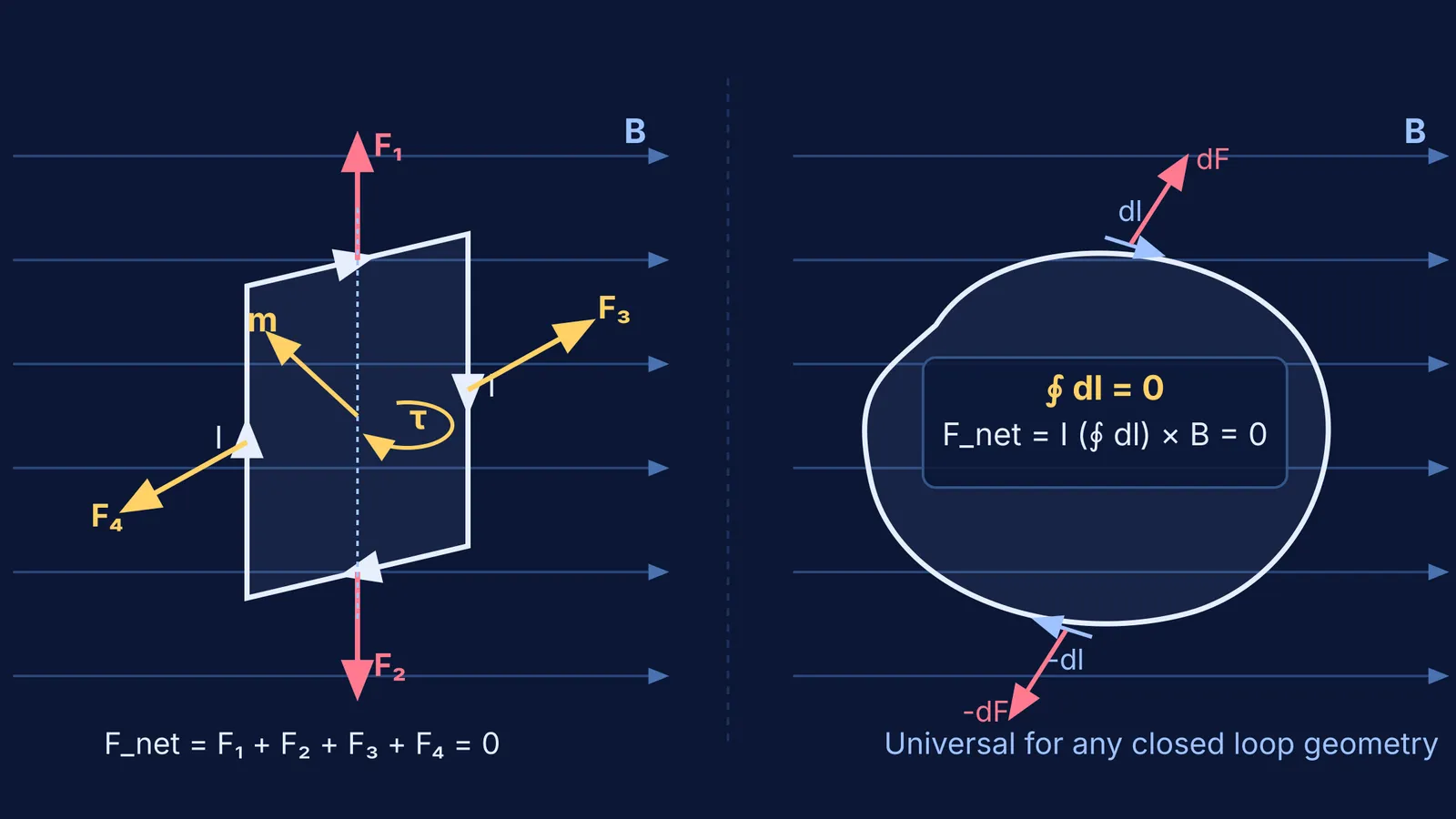
When a current-carrying wire enters an external magnetic field, moving charges experience the magnetic Lorentz force. For a straight wire of length vector L carrying steady current I in a uniform field B, the force is F = I (L × B), as formulated in the Lorentz force. If the wire forms a closed loop, however, the net translational force on the entire circuit is zero, no matter how strong the field or current.
Yet electric motors spin and galvanometers deflect. The distinction between net force and net torque is fundamental to Class 12 electromagnetism and competitive exams like JEE Main. Understanding why opposite forces cancel while a twisting couple survives gives you an intuitive model for any coil geometry.
Why is the net magnetic force on a closed loop zero?
To see why the net force vanishes, consider a rectangular loop ABCD carrying steady current I in a uniform magnetic field B. Because the field is uniform, B has identical magnitude and direction everywhere.
Opposite sides of the loop carry equal current in opposite directions. As Richard Feynman explains in Chapter 15-1 of *The Feynman Lectures on Physics*, because currents run in opposite directions on opposite sides of the loop, the forces are also opposite, leaving no net force in a uniform field.
For sides perpendicular to the field, the force on one side points out of the page while the force on the opposing side points into the page with magnitude I b B. Adding the four side vectors gives F_AB + F_BC + F_CD + F_DA = 0. Just as with a bent or curved current-carrying wire, the total force depends solely on the endpoint displacement vector. Because a closed loop returns to its start, its displacement vector is zero, ensuring zero net force.
Does the zero-force rule hold for loops of any shape?
The zero-force result is universal. It applies to circular, triangular, and irregular coils alike.
For an infinitesimal segment dl along a wire carrying steady current I, the magnetic force element is dF = I (dl × B). Integrating around the closed contour, as formulated in OpenStax University Physics, gives the net force:
F_net = ∮ I (dl × B)
Because the magnetic field B is uniform, both B and current I factor out of the line integral:
F_net = I (∮ dl) × B
The contour integral ∮ dl represents the vector displacement around the complete circuit. Because the path closes back on itself, the net displacement is identically zero: ∮ dl = 0. Therefore:
F_net = I (0) × B = 0
Even if a coil is bent into a non-planar 3D geometry, F_net remains strictly zero in any uniform field.
If the net force is zero, how does a torque remain?
Zero net force ensures translational equilibrium: the loop's center of mass will not accelerate. However, rotational equilibrium requires zero net torque.
Although opposing forces cancel, they often act along separated lines of action. Two equal, opposite, and non-collinear forces form a couple, producing pure rotation.
Evaluating torque as r × F with vectors shows that the torque depends on the loop's magnetic dipole moment m = I A n̂, where A is the area and n̂ is the normal vector from the right-hand rule:
τ = m × B
The magnitude is τ = m B sin θ, where θ is the angle between m and B, as defined for a magnetic dipole. When the loop's plane is parallel to the field (θ = 90°), torque is maximized at τ_max = I A B. When m aligns with B (θ = 0°), torque vanishes at stable equilibrium. This torque drives electric motors and galvanometers, which treat current loops as magnetic dipoles.
What happens in a non-uniform magnetic field?
When the field is non-uniform, B varies across space and cannot be factored out of ∮ I (dl × B). Opposite segments experience different field strengths, so their forces no longer cancel.
As Feynman notes in Chapter 15-1 of *The Feynman Lectures on Physics*, a dipole in a non-uniform field experiences a net translational force:
F = ∇(m · B)
Near a bar magnet's pole, where field lines diverge, a loop experiences both a torque rotating it toward alignment and a net force pulling or pushing it along the field gradient.
How do you calculate force and torque on a current loop?
To solve exam problems reliably, use this four-step checklist based on the torque principles in OpenStax University Physics:
Verify field uniformity: If B is uniform, F_net is automatically 0 N.
Find the area vector: Use the right-hand thumb rule to determine normal n̂.
Compute dipole moment: m = N I A.
Calculate torque: τ = m B sin θ.
Worked example: A circular coil with N = 50 turns and radius R = 0.10 m carries current I = 2.0 A in a uniform field B = 0.40 T. The coil's normal makes an angle of 30° with B.
Net force: Because B is uniform, F_net = 0 N.
Area: A = π R² = π × (0.10 m)² ≈ 0.0314 m².
Dipole moment: m = N I A = 50 × 2.0 A × 0.0314 m² = 3.14 A·m².
Torque: τ = m B sin 30° = 3.14 A·m² × 0.40 T × 0.50 = 0.628 N·m.
When practicing multi-step electromagnetism problems, the Fermi Problem Library provides worked problems with a step-by-step solver that explains the reasoning rather than printing an answer. For broader review, the Fermi Concept Library covers every concept in physics, chemistry, biology, mathematics and computing, each with its own lesson and its place in the map.


