

On this page
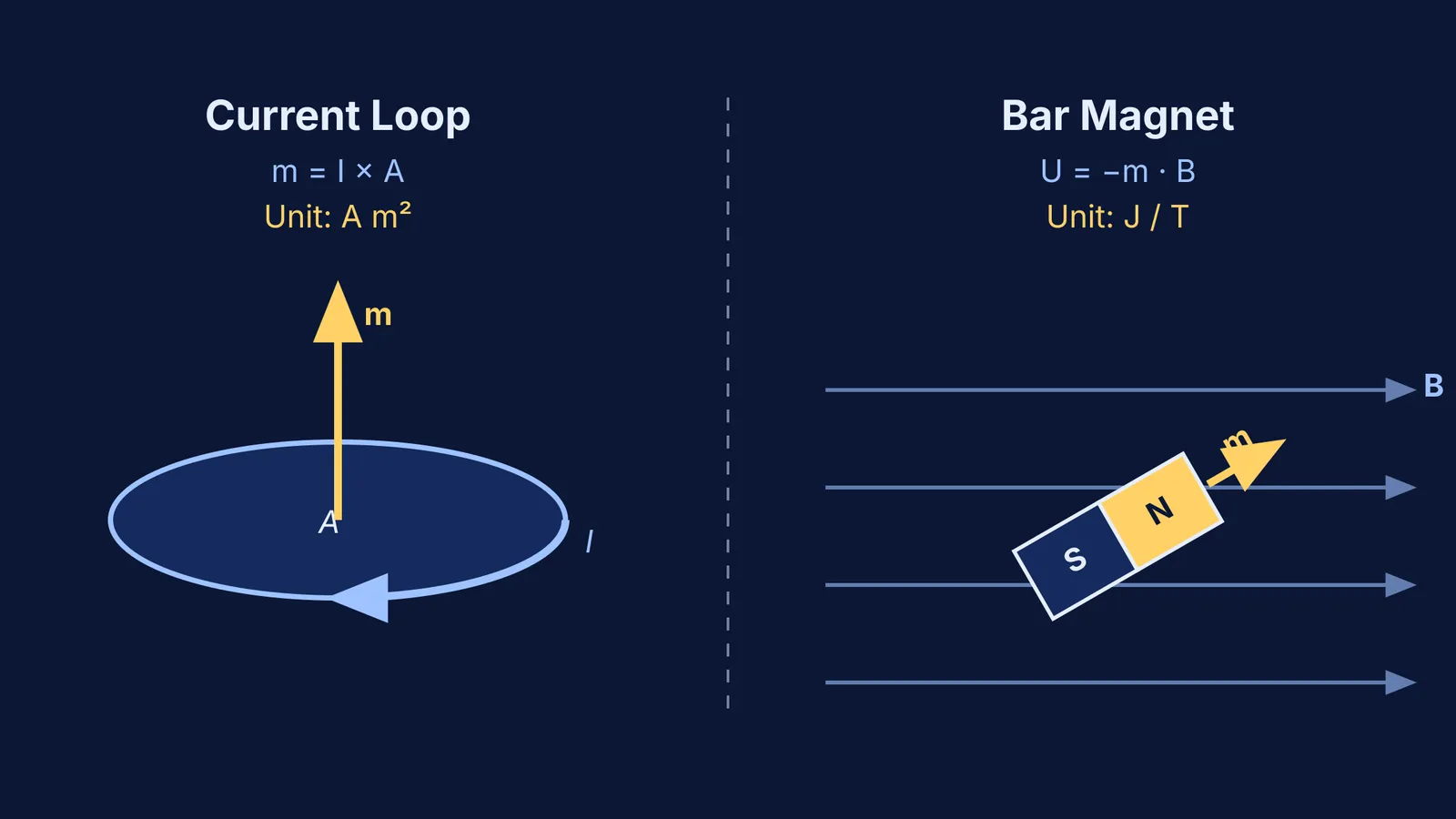
In physics, you often learn about magnetic moment twice: once when studying current-carrying loops, and again when looking at bar magnets. Because of this, the unit of magnetic moment (m) is written in two completely different ways.
The SI unit of magnetic moment is both the ampere square metre (A m²) and the joule per tesla (J/T). According to the International Bureau of Weights and Measures (BIPM) SI Brochure, these two units are perfectly equivalent. Which one you use just depends on the physical situation you are analysing.
Here is a look at where each unit comes from and how to prove they are the same.
Why is the unit ampere square metre (A m²)?
When you study electromagnetism, you first define a magnetic dipole as a loop of wire carrying a current.
The magnetic moment (m) of a current loop is the product of the current (I) and the area of the loop (A). The formula is m = I × A.
Since current is measured in amperes (A) and area in square metres (m²), the unit of magnetic moment is simply A m².
This definition makes sense when you are designing an electromagnet or calculating the field of a solenoid. It tells you exactly what causes the magnetic strength: a certain amount of charge flowing around a specific area. If you want a stronger magnetic moment, you either increase the current or make the loop bigger. (You can also see how magnetic fields behave differently at the edges in Why the Magnetic Field at the End of a Solenoid is Half).
Why is the unit joule per tesla (J/T)?
Later in the syllabus, you study permanent magnets. A bar magnet does not have an obvious current loop or area that you can measure. Instead, you define its magnetic moment by how it behaves when you place it inside an external magnetic field.
When a magnet is placed in a uniform magnetic field (B), it experiences a torque that tries to align it with the field. It also stores magnetic potential energy (U) based on its orientation. The formula for this energy is U = −m · B.
For the purpose of finding units, we can ignore the direction and angle, which gives m = U / B.
Energy is measured in joules (J) and the magnetic field in teslas (T). Therefore, the unit of magnetic moment from this perspective is J/T.
This form is much more useful in atomic physics and thermodynamics. For example, when you read about the magnetic moment of an electron (the Bohr magneton), it is almost always given in J/T, because we measure the energy shifts of the electron in a magnetic field rather than trying to measure a tiny current loop.
How do you prove the two units are equivalent?
In competitive exams like JEE Main or NEET-UG, dimensional analysis is a fast way to check if an equation makes sense. We can use it to prove that A m² and J/T are exactly the same thing.
Let's break down the joule per tesla (J/T) to see how it simplifies:
A joule (J) is the unit of work, which is force times distance. So, 1 J = 1 N m (newton metre).
A tesla (T) is the unit of magnetic field. From the magnetic force formula F = I L B, we know that B = F / (I L). So, 1 T = 1 N / (A m).
Now, substitute these into J/T:
J / T = (N m) / (N / A m)
When you divide by a fraction, you multiply by its reciprocal:
J / T = N m × (A m / N)
The newtons (N) cancel out, leaving:
J / T = m × A m = A m²
Both units boil down to the same base dimensions: [M⁰ L² T⁰ A¹].
When you are revising electromagnetism, matching the units to the formula is a reliable way to check your memory. If you are ever unsure about the derivation, you can search the Fermi Concept Library for magnetic dipole moment to see how the current loop model connects to the bar magnet model.
Which unit should you use in your exams?
For school board exams like CBSE and ICSE, follow the clues in the question using this decision checklist:
If a problem gives you the number of turns, current, and radius of a coil, use A m² in your final answer. It shows the examiner you understand where the number came from. (Read more about how to set up loops in How to visualise the magnetic field of a wire, loop and solenoid).
If a problem asks you to calculate the work done to rotate a magnet, or gives you the magnetic field strength and energy, write the unit as J/T.
If it is a multiple-choice question, check all options. If A m² is not an option, look for J/T, or even N m / T. They are mathematically identical.
If you are stuck on a numerical problem involving torque or energy of a dipole, you can type it into the Fermi Problem Library. Fermi's AI tutor teaches through the problem, notices where you are stuck, and decides whether to explain the units or ask you to check them before you calculate the answer.


