On this page
Run a mixer for a minute on dry jeera or a thick coconut chutney and the steel jar comes off warm, sometimes hot. Nothing is broken. You are feeling the Class 9 work-energy idea at work: the motor does work on the blades, the blades do work against friction in the food, and work done against friction ends up as heat.
Why does the mixer jar get hot while grinding?
Inside the jar, every rub between food particles, blade and steel wall is friction, and friction turns the ordered motion of the blade into the random jiggling of particles that we measure as temperature. The Bosch MGM8642BIN instruction manual says it plainly: "In dry grinding, the jar may become hot due to friction." It adds that this "has nothing to do with the motor".
The motor heats up too, separately. The same manual rates its 750-watt motor at 5 minutes on and 2 minutes off. It also says that if the motor gets too hot and you feel hot air from the side vent or bottom, you should switch off and restart after 10 minutes. So a warm jar means friction in the food; hot air from the vents means the motor needs a rest.
For the classic experiment showing that stirring turns work into heat, read how Joule measured the mechanical equivalent of heat.
Where does the electrical energy go?
NCERT's new Class 9 textbook defines power as the rate at which work is done, P = W/t, where 1 watt is 1 joule of work per second (NCERT Exploration Grade 9, Chapter 7). The same chapter notes that work done against friction does not lead to a storage of energy. The energy isn't destroyed. It spreads out as heat.
Follow one joule through your mixer:
Socket to motor: electrical energy comes in.
Motor to blade: most of it becomes work done by the spinning blade, and some heats the windings and bearings.
Blade to food: the blade does work breaking and churning the food.
Food to heat: friction turns that work into internal energy of the food and the jar, and a little leaves as sound.
Almost all of it ends up as heat in the food, jar, motor and kitchen air. To refresh the basics, read our Class 9 guide to work and energy. If the chain is hard to picture, the Fermi Simulation Lab has interactive simulations for ideas that are easier to see than to read.
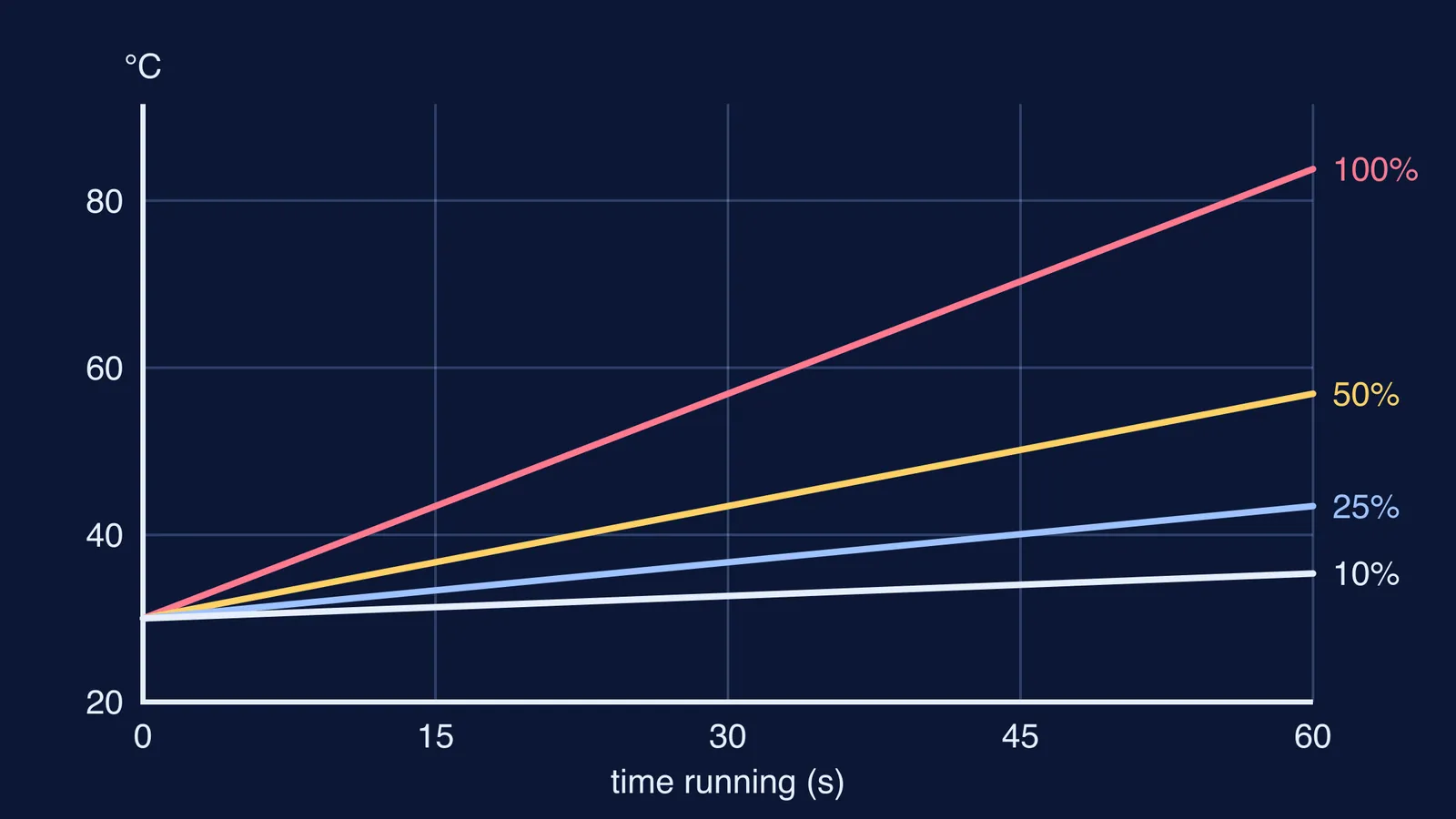
How hot can a chutney get in one minute?
Here is a worked example using the Bosch numbers. Its chutney jar is rated for 0.2 litre of wet grinding, and the motor is rated at 750 W (Bosch manual).
Energy in one minute: 750 J/s × 60 s = 45,000 J.
Treat a watery chutney as water. Water needs 4,184 joules to warm 1 kg by 1°C (USGS Water Science School).
Upper limit: rise in temperature = 45,000 ÷ (0.2 × 4,184) ≈ 54°C.
That is a ceiling, not a forecast: the motor, steel, air and sound take their share, and 750 W is a rating, not a constant draw. For every tenth of that energy that reaches the chutney, the chutney warms by about 5°C per minute. To see what a wattage rating means in amperes, read how to find the current an appliance draws.
Does the heat spoil masalas and chutneys?
It can dull the aroma. K.K. Singh and T.K. Goswami ground cumin seed at a range of temperatures (Journal of Food Process Engineering, 1999). In their grinder, raising the grinding temperature from 40 to 85°C cut the volatile oil from 2.86 to 2.26 mL per 100 g, about a fifth less. Components such as cuminaldehyde also dropped as the temperature rose.
The lesson for your kitchen: a masala that stays cooler while it is ground is likely to keep more of its volatile oil.
How do you grind without overheating?
These steps follow the Bosch manual; check your own model's manual too.
Start cool. Let roasted spices cool on a plate first; the manual says not to grind hot ingredients.
Cut big pieces to about 2 cm, as the manual suggests.
Stay within the rated fill. The manual lists overloading as a cause of overheating.
Pulse. Run a few seconds at a time and let the blade stop in between. The pauses give some heat time to leave through the steel.
Add a spoon of cold water to a thick chutney. The manual recommends adding water for thick pastes, and water's high specific heat soaks up warmth.
Respect the motor's rest. No more than 5 minutes on, then 2 minutes off. Keep the vents clear and never set the mixer on cloth or paper.
To revise work, energy and power properly before your exams, the Fermi Concept Library gives each concept its own lesson and shows its place in the map.