

On this page
When astronauts spend months in microgravity, their bones thin and their muscles weaken. The classic science-fiction solution—seen in films like *2001: A Space Odyssey* or *Interstellar*—is a spinning ring space station. By rotating continuously, the station pushes its inhabitants against the outer wall, simulating the pull of gravity and preventing long-term health issues.
But how fast does the station need to spin? If you are studying for JEE physics or just curious about orbital mechanics, this is a perfect application of uniform circular motion. The answer depends heavily on how large the station is and how much gravity you want to create.
Why does rotation feel like gravity?
According to Newton's first law of motion, an object in motion stays in motion in a straight line unless acted upon by an external force. When you stand on the inner edge of a spinning space station, your body naturally wants to fly off in a straight line at a tangent to the circular path.
The floor of the station, however, constantly pushes you inward towards the centre to keep you moving in a circle. This inward push is known as the centripetal force. Because you are in the rotating frame of reference, you feel this force as a firm pressure pushing you against the floor. This contact force creates the sensation of weight, simulating gravity.
To make this artificial gravity feel exactly like Earth, the centripetal acceleration (a) must equal Earth's standard gravitational acceleration (g = 9.81 m/s²).
How do you calculate the required spin rate?
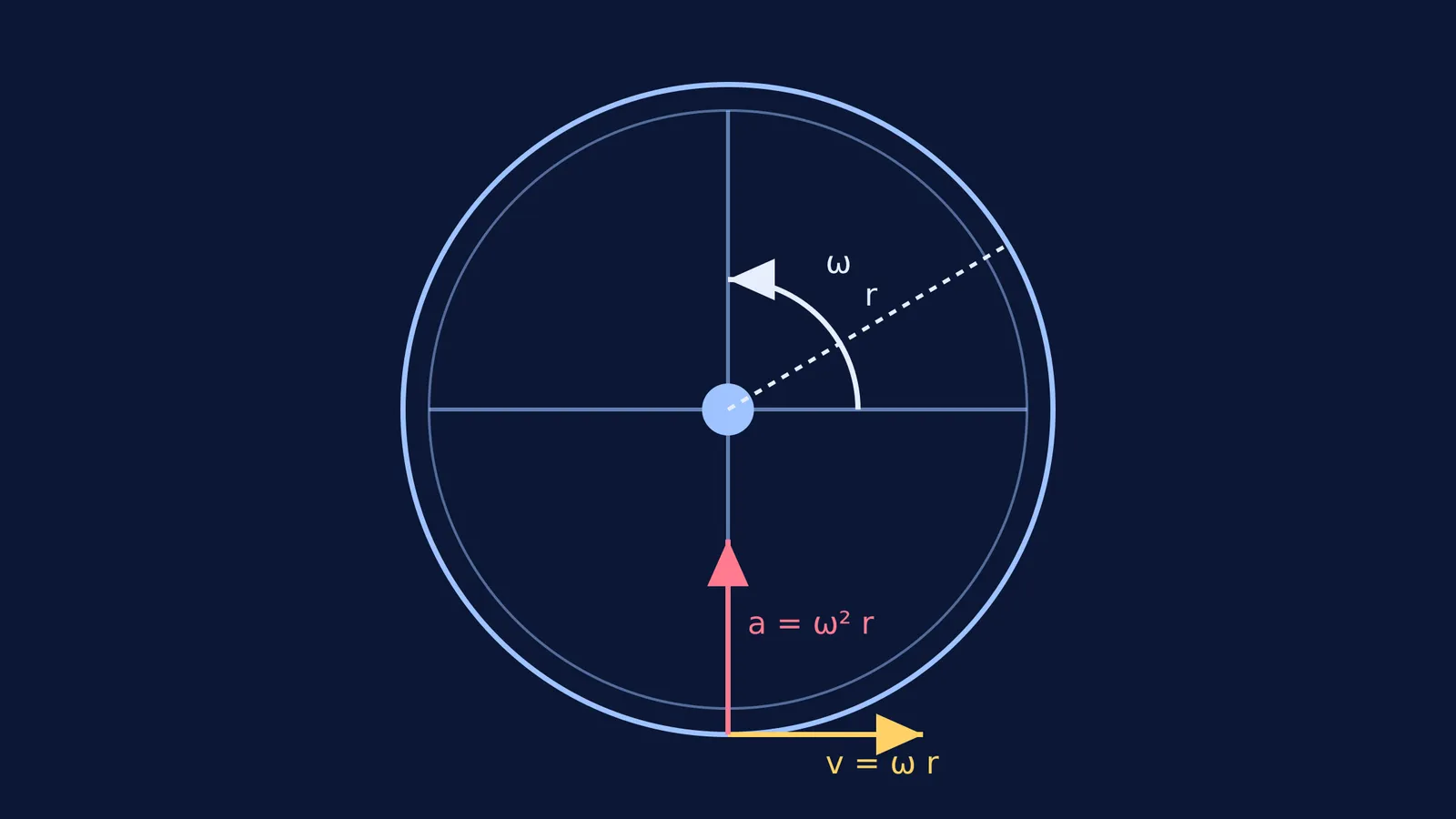
The fundamental formula for centripetal acceleration is:
a = ω² r
Where:
a is the centripetal acceleration
ω (omega) is the angular velocity in radians per second
r is the radius of the station in metres
If we set a = g, we get:
g = ω² r
Rearranging to solve for angular velocity:
ω = √(g / r)
This simple equation tells us the required speed. For a space station with a radius of 100 metres, we can plug in the numbers:
ω = √(9.81 / 100) = √0.0981 ≈ 0.313 rad/s
To convert this angular velocity to revolutions per minute (RPM), we multiply by 60 to find the radians per minute, and then divide by 2π to find the number of full revolutions. This gives us roughly 3 RPM.
What if we want to simulate Martian gravity instead? The acceleration due to gravity on Mars is roughly 3.7 m/s². Using the same 100-metre radius:
ω = √(3.7 / 100) ≈ 0.192 rad/s
This converts to about 1.8 RPM. Simulating a weaker gravitational pull requires a slower spin rate.
Why does a bigger radius need fewer turns per minute?
You might think it would be cheaper to build a smaller space station and just spin it faster. For example, if we drop the radius to 10 metres to simulate Earth's 9.81 m/s², the required speed rises to about 9.5 RPM. Mathematically, it works perfectly. Biologically, it is a disaster.
When you turn your head in a rapidly spinning room, the inner ear experiences a cross-coupled rotation known as the Coriolis illusion. Early studies suggested 3 or 4 RPM as the highest rate at which humans could easily adapt to this vestibular stimulus without severe nausea. Though a 1998 study in the *Brain Research Reviews* found humans can adapt their limb movement control to rotation rates as high as 10 RPM with practice, designing a permanent habitat for comfort requires keeping the spin rate strictly low.
Because the required angular velocity ω drops as the radius r increases, engineers must build large rings to keep the RPM down. To hit Earth's gravity at a comfortable limit of 2 RPM or less, you need a massive radius of about 224 metres. If you try to build a tiny 10-metre station, the Coriolis forces on your body as you walk would push you sideways, making a simple ladder feel slanted and making normal movement incredibly disorienting.
How do you design a station with artificial gravity?
If you are designing a space station (or solving a physics problem about one), use this quick framework to check your numbers:
Choose your gravity: Do you need Earth gravity (9.81 m/s²), Martian gravity (3.7 m/s²), or Lunar gravity (1.6 m/s²)?
Set your comfort limit: Keep the rotation rate below 4 RPM for a highly trained crew, or below 2 RPM for untrained visitors to avoid motion sickness.
Calculate the radius: Use r = g / ω². Remember to convert your target RPM to radians per second first.
Check the gravity gradient: Because artificial gravity depends on r, a person's head will feel slightly less gravity than their feet. In a 10-metre station, a 2-metre tall astronaut would experience a 20% difference in gravity between their head and feet. A larger radius minimises this strange sensation.
If you are stuck on orbital mechanics, the Fermi Concept Library contains every concept in physics, chemistry, biology, mathematics and computing. And if you need a step-by-step solver that explains the reasoning rather than just printing an answer, try the Fermi Problem Library.
For more on how motion works, you can read about Motion in a plane from r(t): velocity and acceleration vectors, or review Kepler's second law from angular momentum: areal velocity worked.


