

On this page
A flywheel stores energy by spinning. While traditional batteries store energy in chemical bonds, a flywheel acts as a mechanical battery, holding energy as rotational motion. They are used when power is needed instantly to balance supply and demand. For example, the Beacon Power plant in Stephentown, New York, uses 200 individual flywheels to provide a 20 MW frequency regulation capacity to the electrical grid, responding to power drops in less than 4 seconds 1.
What is the formula for the energy stored in a rotating flywheel?
The energy stored in a flywheel is exactly its rotational kinetic energy. According to the CBSE Class 11 Physics syllabus, the rotational kinetic energy of any spinning rigid body is calculated using its moment of inertia and angular velocity.
The fundamental formula is: E = ½ I ω²
Here, I is the moment of inertia (measured in kg·m²) and ω is the angular velocity (measured in radians per second). The moment of inertia tells us how hard it is to change the object's rotation, acting as the rotational equivalent of mass. The angular velocity tells us how fast the object is rotating around its axis.
If you are studying for entrance exams, mastering this formula is essential. You can avoid rotational motion: five common JEE mistakes and their fixes by remembering that energy depends heavily on the mass distribution, not just the total mass of the object.
How does a solid disc flywheel store energy?
The shape of the flywheel dictates its moment of inertia. Most industrial flywheels are shaped like cylinders or solid discs, because placing mass further from the axis increases the resistance to rotational acceleration.
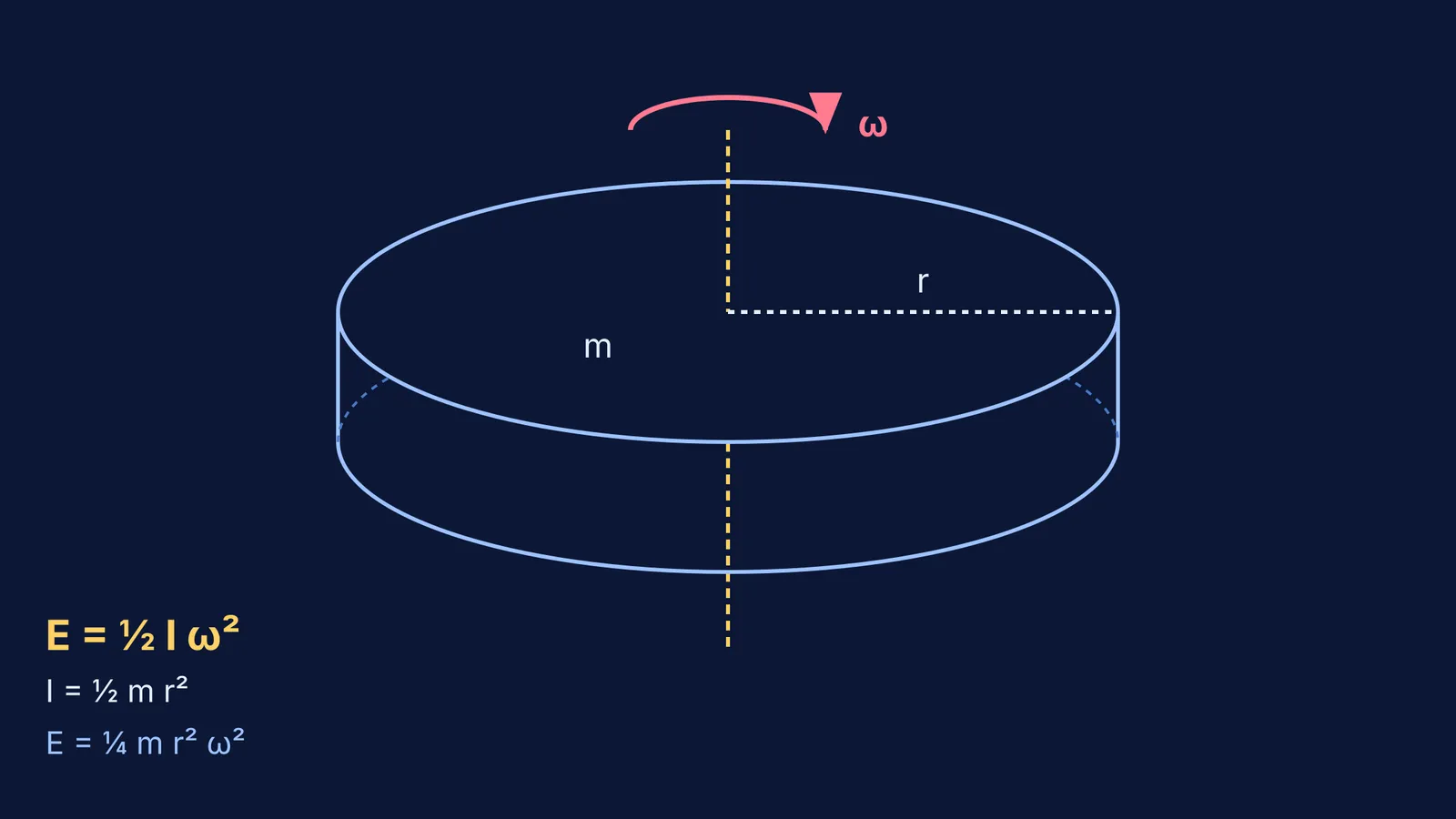
For a uniform solid disc of mass m and radius r, the moment of inertia is I = ½ m r².
When we substitute this into our fundamental kinetic energy formula, we get the exact energy equation for a disc-shaped flywheel: E = ½ (½ m r²) ω² E = ¼ m r² ω²
This equation shows that you have two main ways to store more energy in a disc: make the disc heavier and wider (increasing the radius), or spin it faster (increasing the angular velocity). Because mass is heavy and takes up space, increasing the speed is often the preferred engineering choice.
If you want to practice more rotational mechanics problems, you can find step-by-step examples in the Fermi Problem Library. Fermi's AI tutor works out what you already know, builds a plan for the session, and teaches through it—writing on a board, drawing the figure, and checking your understanding as it goes.
Why does doubling the speed quadruple the energy?
Look closely at the formula E = ¼ m r² ω². The stored energy is directly proportional to the square of the angular velocity (ω²). This means that if you double the rotational speed, the energy stored increases by a factor of four. If you triple the speed, the energy increases nine times.
This non-linear relationship is why modern utility-scale flywheels spin at extremely high speeds rather than relying on massive weight. Heavy steel flywheels can only spin so fast before centrifugal forces tear them apart. Instead, lightweight, high-strength materials like carbon fibre are used. These carbon-fibre rotors are housed in a vacuum chamber to minimise air friction and spin at extremely high speeds.
In systems like the Stephentown facility, maximizing this speed is the most efficient way to achieve its massive 5 MWh total storage capacity 1. You can test how forces and energy interact in these dynamic systems by learning torque and rotation with a simulation.
Worked Example: Calculating flywheel energy
Let's calculate the energy stored in a solid steel disc flywheel with a mass of 500 kg and a radius of 0.6 m, spinning at 3000 RPM.
Find the angular velocity (ω):
The speed is 3000 revolutions per minute. ω = 3000 × (2π / 60) ω = 100π ≈ 314.16 rad/s
Find the moment of inertia (I):
Using the formula for a solid disc: I = ½ m r² I = ½ × 500 kg × (0.6 m)² I = 250 × 0.36 = 90 kg·m²
Calculate the kinetic energy (E):
Now, substitute I and ω into the fundamental energy formula: E = ½ I ω² E = ½ × 90 × (314.16)² E = 45 × 98,696.5 E ≈ 4,441,342 Joules (or roughly 4.44 MJ)
Understanding how rotating bodies balance mass, radius, and speed is a core physics skill, much like finding the bead on a rotating ring: equilibrium angle and minimum spin. By manipulating the radius and pushing the limits of RPM, engineers can safely store immense amounts of energy in a surprisingly small physical space.


