

On this page
A bead slides without friction on a wire ring of radius R that spins at a steady ω about its vertical diameter. Where does it come to rest, and how fast must the ring spin before the bead leaves the bottom? A model solution from Oberlin College's classical mechanics course traces the problem to Jerry Marion's textbook Classical Dynamics of Particles and Systems.
How do you find the equilibrium angle of a bead on a rotating ring?
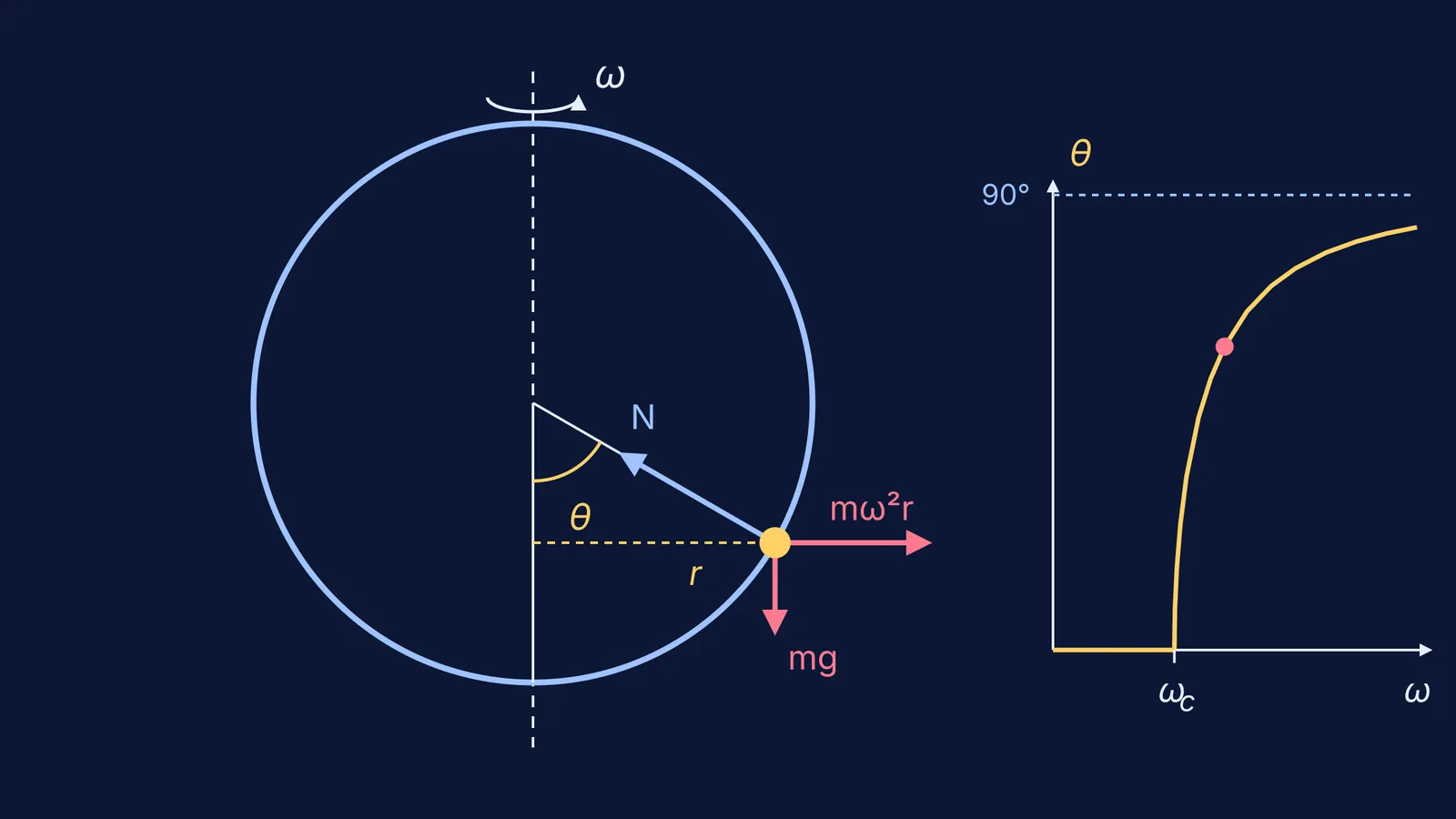
Sit in the frame that turns with the ring. There the bead is at rest, so the forces on it add to zero.
Measure θ at the centre, from the lowest point of the ring.
Draw the weight mg, the normal force N from the wire, and the centrifugal force mω²r pointing horizontally away from the axis.
Use the right radius: the bead circles the axis at r = R sin θ, not R.
Resolve along the wire, where a smooth wire's N has no component: mg sin θ = mω²R sin θ cos θ.
Solve: either sin θ = 0, or cos θ = g/(ω²R).
Centrifugal force is not a real interaction. OpenStax University Physics describes it as inertia felt in an accelerating, noninertial frame, so use it only in the rotating frame, never in the ground frame. Our post on pseudo forces in accelerating frames covers the general rule.
The raised equilibrium of a bead on a ring rotating about its vertical diameter is at cos θ = g/(ω²R), as derived in the Oberlin model solution. Resolving along the radius gives N = mω²R there.
To check, use the ground frame: N cos θ = mg holds up the weight and N sin θ = mω²R sin θ supplies the centripetal force, which gives the same answer. The geometry matches the conical pendulum, with the wire's push taking the place of the string's pull.
What is the minimum angular speed for the bead to rise?
Since cos θ ≤ 1, the critical speed is ω_c = √(g/R), and the raised position exists only when ω ≥ ω_c, according to the Oberlin solution. That same solution checks which positions are stable:
The top (θ = π) is unstable at every speed.
Below ω_c, the bottom (θ = 0) is stable.
Above ω_c, the bottom becomes unstable, and the bead moves to the raised position, which is stable whenever it exists.
Close to ω_c, small oscillations about either stable position become very slow, and their period grows without limit at ω_c itself.
This sudden change is called a bifurcation; Shovan Dutta and Subhankar Ray use the bead to introduce nonlinear dynamics.
Worked example: a ring of radius 20 cm
Take R = 0.20 m and g = 9.8 m/s², which rounds the NIST standard value of 9.806 65 m/s².
Critical speed: ω_c = √(9.8/0.20) = √49 = 7 rad/s, about 67 revolutions per minute.
At ω = 5 rad/s, below 7 rad/s, the bead stays at the bottom.
At ω = 10 rad/s: cos θ = 9.8/(10² × 0.20) = 0.49, so θ ≈ 60.7°.
Height above the bottom: R(1 − cos θ) = 0.20 × 0.51 ≈ 0.10 m.
Normal force: N = mω²R = 20m newtons, about 2.04 times the weight.
If spinning, tilting pictures are hard to hold in your head, the Fermi Simulation Lab has interactive simulations for ideas that are easier to see than to read.
Does a particle in a rotating bowl behave the same way?
Yes. Inside a smooth hemispherical bowl of radius R, the normal force points to the centre of the sphere, just as the wire's push points to the centre of the ring. The force balance is the same, so cos θ = g/(ω²R) and ω_c = √(g/R) again.
A shortcut: the particle sits R cos θ = g/ω² below the bowl's centre, a depth that does not depend on R, so its height above the bottom is h = R − g/ω². In a rough bowl, add friction along the surface, pointing against the way the particle tends to slide; for a given position, the two limits give a range of ω instead of one value.
Which mistakes cost marks on this problem?
Using R instead of R sin θ for the radius of the circle.
Measuring θ from the top or from the horizontal, then using cos θ = g/(ω²R) unchanged.
Cancelling sin θ and losing the θ = 0 answer, which is the only answer when ω < ω_c.
Adding centrifugal force in the ground frame, which counts the same effect twice.
For more practice on the same forces, try our circular motion and banking problems. If your method goes wrong partway through, the Fermi Problem Library has worked problems with a step-by-step solver that explains the reasoning rather than printing an answer.


