On this page
NCERT Class 11 exercise 6.45 asks you to find the concentration of S²⁻ in hydrogen sulphide water, using a second dissociation constant of 1.2 × 10⁻¹³. Since the 1970s, though, measurements have put the real second constant thousands of times lower. In 2018, a group of solution chemists argued that S²⁻ does not exist in water in any amount anyone can detect. Here is what they found, why NCERT's numericals still work, and what to write in your exam.
What does NCERT say about S²⁻ in H₂S solution?
In the Class 11 equilibrium unit (kech106, Reprint 2026-27), exercise 6.45 gives Ka₁ = 9.1 × 10⁻⁸ and Ka₂ = 1.2 × 10⁻¹³ for H₂S. That Ka₂ means pKa₂ = 12.92. Exercise 6.73 states that "the concentration of sulphide ion in 0.1M HCl solution saturated with hydrogen sulphide is 1.0 × 10⁻¹⁹ M". Table 6.9 lists sulphide solubility products written as [M²⁺][S²⁻], for example CuS 6.3 × 10⁻³⁶, FeS 6.3 × 10⁻¹⁸ and HgS 4.0 × 10⁻⁵³.
The arithmetic in these exercises is consistent. With NCERT's constants, [S²⁻] in 0.1 M HCl saturated with H₂S (0.1 M) is Ka₁Ka₂[H₂S]/[H⁺]² = 9.1 × 10⁻⁸ × 1.2 × 10⁻¹³ × 0.1 / 0.01 = 1.1 × 10⁻¹⁹ M, which matches the figure in 6.73. The standard working is in our post on the pH of a diprotic acid like H₂S.
NCERT is in large company: the 2018 paper below finds S²⁻(aq) in inorganic treatises, the CRC Handbook and introductory textbooks worldwide. The question is not a copying error. It is whether the species is real in water.
What is the real second pKa of H₂S?
A clear summary is the 2018 paper by May, Batka, Hefter, Königsberger and Rowland, Goodbye to S²⁻ in aqueous solution, Chem. Commun. 54, 1980. It reviews the measurements:
Giggenbach (1971, UV spectroscopy): a lower limit of pKa₂ = 17.1 ± 0.2.
Meyer and co-workers (1983, Raman spectroscopy): pKa₂ = 17 ± 1.
Licht and co-workers: 17.6 ± 0.3 from glass-electrode pH, 17.0 ± 0.3 from density measurements, though May and co-workers place little reliance on these methods at such high pH.
The OECD Nuclear Energy Agency's iron review: a recommended value of 19.
Older values near 14 are described in the paper as an earlier erroneous agreement.
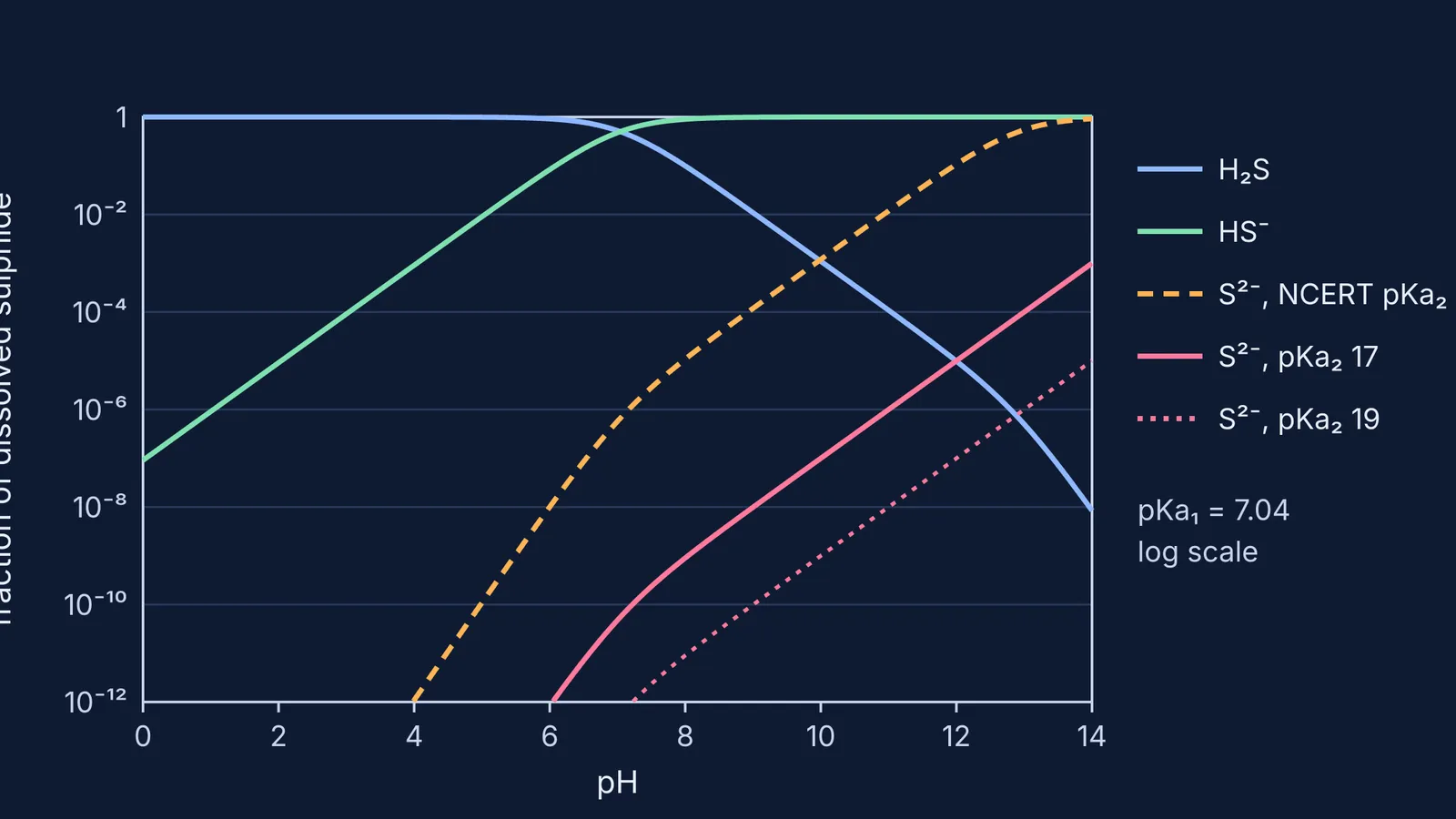
A pKa₂ of 17 makes Ka₂ about 10⁴ times smaller than NCERT's 1.2 × 10⁻¹³. A pKa₂ of 19 makes it about 10⁶ times smaller. The paper also notes that a 1986 article by Myers had already ruled out significant S²⁻ in water, but the species stayed in textbooks.
Why do chemists now doubt that S²⁻ exists in water at all?
The measured estimates of 17 or more came from very concentrated sodium hydroxide, because that is the only place where HS⁻ might lose its proton. May and co-workers argue that solutions above about 10 M NaOH are so short of free water that no constant measured there can be carried back to ordinary solutions.
They then followed the Raman band of the H–S bond in HS⁻, near 2600 cm⁻¹:
In NaOH, the HS⁻ signal dropped noticeably only above about 7 mol/kg NaOH, and was still above 50% at about 20 mol/kg.
In CsOH, the signal did not drop at all, right up to about 11 mol/kg, close to the solubility limit.
If hydroxide were pulling the proton off HS⁻, it would do so in both solutions. The drop in NaOH fits better with sodium ions pairing with sulphide, HS⁻ + OH⁻ + Na⁺ ⇌ NaS⁻ + H₂O, though the authors note there is no spectral signal for NaS⁻ either.
They are careful about what this proves: "While it is impossible to prove that a chemical species never exists, we demonstrate that there is no credible experimental evidence to support the existence of S2–(aq) even when conditions are most favourable." Their proposal is a null hypothesis: treat S²⁻ as absent from water unless someone shows otherwise.
One limit on this: it is about water only. Solid Na₂S, ZnS and CuS really do contain S²⁻ ions in their crystal lattices. The claim is that S²⁻ does not survive once dissolved.
Worked example: how much S²⁻ would 1 M NaOH contain?
In 1 M NaOH, [H⁺] is about 10⁻¹⁴ M (ignoring activity corrections). From HS⁻ ⇌ H⁺ + S²⁻, the ratio is [S²⁻]/[HS⁻] = Ka₂/[H⁺].
NCERT's value. 1.2 × 10⁻¹³ / 10⁻¹⁴ = 12. So 12 out of every 13 sulphide particles, about 92%, would be S²⁻.
pKa₂ = 17. 10⁻¹⁷ / 10⁻¹⁴ = 10⁻³. Only 1 in about 1000 would be S²⁻.
pKa₂ = 19. 10⁻¹⁹ / 10⁻¹⁴ = 10⁻⁵. One in 100,000.
Compare with experiment. If step 1 were right, the HS⁻ Raman band would almost vanish in 1 M NaOH. It does not drop significantly until NaOH is above about 7 mol/kg. Step 1 fails the test; steps 2 and 3 are consistent with it.
So when you dissolve sodium sulphide, the solution holds HS⁻ and OH⁻: Na₂S + H₂O → 2Na⁺ + HS⁻ + OH⁻. When you read about the sodium nitroprusside test for sulphide, think "sulphide, present as HS⁻".
Do the group 2 and group 4 separations still work without S²⁻?
Yes, and this is the reassuring part. What really decides precipitation is an equilibrium with species that do exist:
MS(s) + 2H⁺ ⇌ M²⁺ + H₂S, with K = Ksp / (Ka₁Ka₂)
Comparing [M²⁺][S²⁻] with Ksp is algebraically the same test as comparing [M²⁺][H₂S]/[H⁺]² with Ksp/(Ka₁Ka₂). The S²⁻ cancels out. It is a bookkeeping step in the middle.
With NCERT's numbers, K is 5.8 × 10⁻¹⁶ for CuS and about 580 for FeS. In 0.1 M HCl saturated with H₂S (0.1 M), a 0.01 M metal ion gives [M²⁺][H₂S]/[H⁺]² = 0.01 × 0.1 / 0.01 = 0.1. For CuS, 0.1 is far above 5.8 × 10⁻¹⁶, so CuS precipitates. For FeS, 0.1 is below 580, so FeS stays dissolved. That is exactly the group 2 versus group 4 split explained in why H₂S is passed in acidic medium for group 2.
So sulphide Ksp values are not useless. They are conventional products that assume a species absent from water, and work only with a matching Ka₂. May and co-workers note that the problem is "easy enough to avoid by writing the reaction equations differently". Geochemists now use constants written with HS⁻; we have not checked those values, so we do not quote them here.
What should you write in the exam?
NCERT's numbers do their job: they test whether you can handle two linked equilibria. If you want help with linked equilibria like these, Fermi Test Prep covers JEE Main and Advanced preparation with an AI tutor you can ask when a step does not make sense. For the underlying acid-base ideas, the Concept Library covers every concept in chemistry.
Quick checklist
NCERT: Ka₂(H₂S) = 1.2 × 10⁻¹³, pKa₂ = 12.92. Use it in exam numericals.
Spectroscopy since 1971: pKa₂ of 17 or more; OECD-NEA recommends 19.
May et al. (2018): no Raman evidence of S²⁻ even in very concentrated NaOH or CsOH.
In water, "sulphide" is HS⁻; Na₂S solution is Na⁺, HS⁻ and OH⁻.
Precipitation tests still work because S²⁻ cancels: MS + 2H⁺ ⇌ M²⁺ + H₂S.